Event submissions
Published
This submission belongs to the session S2. Nanosciences, Chemistry and Materials Science of the event The 6th International Electronic Conference on Applied Sciences
Published date
03 Dec, 2025
Academic Editor
'%3e%3cpath%20d='M12.6657%2010.9104C12.4185%2010.325%2012.0599%209.79327%2011.6097%209.34482C11.1609%208.89508%2010.6293%208.5365%2010.0442%208.28888C10.0389%208.28626%2010.0337%208.28495%2010.0285%208.28233C10.8446%207.69279%2011.3752%206.73249%2011.3752%205.64904C11.3752%203.8542%209.92103%202.39999%208.1262%202.39999C6.33136%202.39999%204.87715%203.8542%204.87715%205.64904C4.87715%206.73249%205.40774%207.69279%206.22393%208.28364C6.21869%208.28626%206.21345%208.28757%206.20821%208.29019C5.62129%208.5378%205.09463%208.89284%204.64265%209.34613C4.1929%209.79493%203.83432%2010.3266%203.58671%2010.9117C3.34345%2011.4845%203.21226%2012.0987%203.20023%2012.7209C3.19988%2012.7349%203.20233%2012.7488%203.20744%2012.7619C3.21255%2012.7749%203.22022%2012.7867%203.22998%2012.7968C3.23975%2012.8068%203.25142%2012.8147%203.26431%2012.8202C3.2772%2012.8256%203.29105%2012.8284%203.30504%2012.8284H4.09109C4.14874%2012.8284%204.19459%2012.7825%204.1959%2012.7262C4.2221%2011.7148%204.62823%2010.7676%205.34617%2010.0497C6.08899%209.30683%207.0755%208.89808%208.1262%208.89808C9.17689%208.89808%2010.1634%209.30683%2010.9062%2010.0497C11.6242%2010.7676%2012.0303%2011.7148%2012.0565%2012.7262C12.0578%2012.7838%2012.1037%2012.8284%2012.1613%2012.8284H12.9474C12.9613%2012.8284%2012.9752%2012.8256%2012.9881%2012.8202C13.001%2012.8147%2013.0126%2012.8068%2013.0224%2012.7968C13.0322%2012.7867%2013.0398%2012.7749%2013.0449%2012.7619C13.0501%2012.7488%2013.0525%2012.7349%2013.0522%2012.7209C13.0391%2012.0947%2012.9094%2011.4855%2012.6657%2010.9104ZM8.1262%207.9024C7.52486%207.9024%206.9589%207.6679%206.53312%207.24211C6.10733%206.81633%205.87283%206.25037%205.87283%205.64904C5.87283%205.0477%206.10733%204.48174%206.53312%204.05596C6.9589%203.63018%207.52486%203.39567%208.1262%203.39567C8.72753%203.39567%209.29349%203.63018%209.71927%204.05596C10.1451%204.48174%2010.3796%205.0477%2010.3796%205.64904C10.3796%206.25037%2010.1451%206.81633%209.71927%207.24211C9.29349%207.6679%208.72753%207.9024%208.1262%207.9024Z'%20fill='%235D1EE1'/%3e%3c/g%3e%3c/svg%3e) Mimimorena Seggio
Mimimorena SeggioCitation
Zahra Esmaeili Dehaghi, Alejandro Cortés Fernández, Andrea Pantín Cordero, Isaac Isarn Garcia, Silvia González Prolongo, Alberto Jiménez Suárez, Evaluation of New Bio-Based Hybrid Composite Materials Reinforced with Basalt Fiber and Recycled Carbon Fiber, in Proceedings of The 6th International Electronic Conference on Applied Sciences, 9 December–11 December 2025, MDPI: Basel, Switzerland
Share
Email
Facebook
Twitter
LinkedIn
Evaluation of New Bio-Based Hybrid Composite Materials Reinforced with Basalt Fiber and Recycled Carbon Fiber
'%3e%3cpath%20d='M12.6647%2010.9104C12.4176%2010.325%2012.0589%209.7933%2011.6088%209.34485C11.16%208.89511%2010.6283%208.53653%2010.0432%208.28891C10.038%208.28629%2010.0327%208.28498%2010.0275%208.28236C10.8437%207.69282%2011.3743%206.73252%2011.3743%205.64907C11.3743%203.85423%209.92005%202.40002%208.12522%202.40002C6.33038%202.40002%204.87618%203.85423%204.87618%205.64907C4.87618%206.73252%205.40677%207.69282%206.22296%208.28367C6.21772%208.28629%206.21248%208.2876%206.20724%208.29022C5.62031%208.53783%205.09365%208.89287%204.64167%209.34616C4.19192%209.79496%203.83334%2010.3266%203.58573%2010.9117C3.34247%2011.4846%203.21128%2012.0987%203.19925%2012.721C3.1989%2012.735%203.20135%2012.7489%203.20646%2012.7619C3.21157%2012.7749%203.21924%2012.7868%203.22901%2012.7968C3.23877%2012.8068%203.25045%2012.8148%203.26334%2012.8202C3.27623%2012.8256%203.29007%2012.8284%203.30406%2012.8284H4.09012C4.14776%2012.8284%204.19362%2012.7825%204.19493%2012.7262C4.22113%2011.7148%204.62726%2010.7676%205.34519%2010.0497C6.08802%209.30686%207.07452%208.89811%208.12522%208.89811C9.17592%208.89811%2010.1624%209.30686%2010.9052%2010.0497C11.6232%2010.7676%2012.0293%2011.7148%2012.0555%2012.7262C12.0568%2012.7839%2012.1027%2012.8284%2012.1603%2012.8284H12.9464C12.9604%2012.8284%2012.9742%2012.8256%2012.9871%2012.8202C13%2012.8148%2013.0117%2012.8068%2013.0214%2012.7968C13.0312%2012.7868%2013.0389%2012.7749%2013.044%2012.7619C13.0491%2012.7489%2013.0515%2012.735%2013.0512%2012.721C13.0381%2012.0947%2012.9084%2011.4856%2012.6647%2010.9104ZM8.12522%207.90243C7.52388%207.90243%206.95792%207.66793%206.53214%207.24215C6.10636%206.81636%205.87185%206.2504%205.87185%205.64907C5.87185%205.04773%206.10636%204.48177%206.53214%204.05599C6.95792%203.63021%207.52388%203.3957%208.12522%203.3957C8.72655%203.3957%209.29252%203.63021%209.7183%204.05599C10.1441%204.48177%2010.3786%205.04773%2010.3786%205.64907C10.3786%206.2504%2010.1441%206.81636%209.7183%207.24215C9.29252%207.66793%208.72655%207.90243%208.12522%207.90243Z'%20fill='%235D1EE1'/%3e%3c/g%3e%3c/svg%3e)
Zahra Esmaeili Dehaghi 1

Alejandro Cortés Fernández 1
Andrea Pantín Cordero 1
Isaac Isarn Garcia 1

Silvia González Prolongo 1,2

Alberto Jiménez Suárez 1,2
1. Materials Science and Engineering Area, Escuela Superior de Ciencias Experimentales y Tecnología, Rey Juan Carlos University, Calle Tulipán s/n, 28933 Móstoles (Madrid), Spain.
2. Instituto de Tecnologías para la Sostenibilidad, Rey Juan Carlos University, C/Tulipán s/n, 28933 Móstoles (Madrid), Spain
Abstract
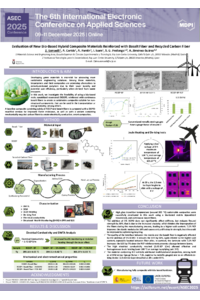
Developing green materials is essential for the transition toward more sustainable engineering solutions. Among these, biopolymers and their composites represent promising alternatives to petroleum-based polymers due to their biodegradability, lower toxicity, and potential cost-efficiency—especially when derived from waste. In this work, we explore the feasibility of using a bio-based resin, epoxidized resveratrol (RESEP), reinforced with continuous basalt fibers as a sustainable composite for non-structural components in railway vehicles.
Three composite laminates were fabricated via the hand lay-up method, a reference laminate (RESEP + basalt), a laminate with 5%wt DOPO (a flame-retardant agent), and a laminate with 7.5%wt mechanically recycled carbon fiber (RCF), to obtain smart materials by developing electrically conductive composites. The composites were characterized by density measurements, mechanical and thermomechanical testing, and fire resistance evaluations. Additionally, the RCF-reinforced laminate was assessed for structural health monitoring (SHM) capabilities and de-icing performance via Joule heating.
Our results show that the RCF-reinforced laminate combines good mechanical behavior with added functionalities such as SHM and active de-icing, despite slight mechanical trade-offs. In contrast, DOPO inclusion negatively impacted mechanical and fire performance. Here, a significant decrease in interlaminar shear strength was observed, likely due to the increased resin viscosity, hindering fiber impregnation. These defects compromise both mechanical integrity and fire resistance. Consequently, the RCF laminate is proposed for external applications requiring multifunctionality, while the reference laminate is more suitable for fire-sensitive interior uses.
This study supports the advancement of sustainable, high-performance composites for the transportation sector in alignment with circular economy and emission reduction goals.
Keywords
Bio-based composite materiales
Basalt fibers
Recycled carbon fiber
Poster
Conference-Zahra.pdf
AI-Powered Smart Urban Navigation and Safety Alert System for Visually Impaired Pedestrians
Surface hydrophilicity of dental copolymer modified with dimethacrylates possessing quaternary ammonium groups