Event submissions
Published
This submission belongs to the session S2. Nanosciences, Chemistry and Materials Science of the event The 6th International Electronic Conference on Applied Sciences
Published date
03 Dec, 2025
Academic Editor
'%3e%3cpath%20d='M12.6657%2010.9104C12.4185%2010.325%2012.0599%209.79327%2011.6097%209.34482C11.1609%208.89508%2010.6293%208.5365%2010.0442%208.28888C10.0389%208.28626%2010.0337%208.28495%2010.0285%208.28233C10.8446%207.69279%2011.3752%206.73249%2011.3752%205.64904C11.3752%203.8542%209.92103%202.39999%208.1262%202.39999C6.33136%202.39999%204.87715%203.8542%204.87715%205.64904C4.87715%206.73249%205.40774%207.69279%206.22393%208.28364C6.21869%208.28626%206.21345%208.28757%206.20821%208.29019C5.62129%208.5378%205.09463%208.89284%204.64265%209.34613C4.1929%209.79493%203.83432%2010.3266%203.58671%2010.9117C3.34345%2011.4845%203.21226%2012.0987%203.20023%2012.7209C3.19988%2012.7349%203.20233%2012.7488%203.20744%2012.7619C3.21255%2012.7749%203.22022%2012.7867%203.22998%2012.7968C3.23975%2012.8068%203.25142%2012.8147%203.26431%2012.8202C3.2772%2012.8256%203.29105%2012.8284%203.30504%2012.8284H4.09109C4.14874%2012.8284%204.19459%2012.7825%204.1959%2012.7262C4.2221%2011.7148%204.62823%2010.7676%205.34617%2010.0497C6.08899%209.30683%207.0755%208.89808%208.1262%208.89808C9.17689%208.89808%2010.1634%209.30683%2010.9062%2010.0497C11.6242%2010.7676%2012.0303%2011.7148%2012.0565%2012.7262C12.0578%2012.7838%2012.1037%2012.8284%2012.1613%2012.8284H12.9474C12.9613%2012.8284%2012.9752%2012.8256%2012.9881%2012.8202C13.001%2012.8147%2013.0126%2012.8068%2013.0224%2012.7968C13.0322%2012.7867%2013.0398%2012.7749%2013.0449%2012.7619C13.0501%2012.7488%2013.0525%2012.7349%2013.0522%2012.7209C13.0391%2012.0947%2012.9094%2011.4855%2012.6657%2010.9104ZM8.1262%207.9024C7.52486%207.9024%206.9589%207.6679%206.53312%207.24211C6.10733%206.81633%205.87283%206.25037%205.87283%205.64904C5.87283%205.0477%206.10733%204.48174%206.53312%204.05596C6.9589%203.63018%207.52486%203.39567%208.1262%203.39567C8.72753%203.39567%209.29349%203.63018%209.71927%204.05596C10.1451%204.48174%2010.3796%205.0477%2010.3796%205.64904C10.3796%206.25037%2010.1451%206.81633%209.71927%207.24211C9.29349%207.6679%208.72753%207.9024%208.1262%207.9024Z'%20fill='%235D1EE1'/%3e%3c/g%3e%3c/svg%3e) Alberto Jiménez Suárez
Alberto Jiménez SuárezCitation
Patryk Drejka, Izabela Barszczewska-Rybarek, Surface hydrophilicity of dental copolymer modified with dimethacrylates possessing quaternary ammonium groups, in Proceedings of The 6th International Electronic Conference on Applied Sciences, 9 December–11 December 2025, MDPI: Basel, Switzerland
Share
Email
Facebook
Twitter
LinkedIn
Surface hydrophilicity of dental copolymer modified with dimethacrylates possessing quaternary ammonium groups

Patryk Drejka 1

Izabela Barszczewska-Rybarek 1
1. Department of Physical Chemistry and Technology of Polymers, Faculty of Chemistry, Silesian University of Technology, Gliwice, 44-100, Poland
Abstract
Introduction: The human mouth is a challenging environment due to the presence of bacteria, its relatively high temperature, and high moisture levels. This poses a challenge to designing materials possessing satisfactory functional properties. One of those aspects is to achieve low water sorption and water leachability, because water, which is present in humans’ saliva, can cause excessive swelling of the material and leaching out of uncured monomer.
The aim of the study is the modification of dental copolymer with urethane-dimethacrylate monomers possessing quaternary ammonium groups and the determination of their water sorption, water solubility and water contact angle.
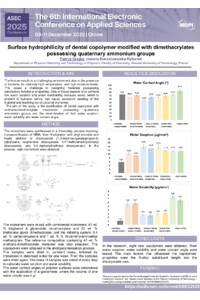
Methods: The monomers were synthesised in a three-step process involving transesterification of MMA, then N-alkylation with alkyl bromide and finally addition to diisocyanate (1,3-bis(2-isocyanatopropan-2-yl)benzene, isophorone diisocyanate, 4,4’-methylenedicyclohexyl diisocyanate, 4,4’-diphenylmethane diisocyanate). The monomers were mixed with commercial monomers bisphenol A glycerolate dimethacrylate and triethylene glycol dimethacrylate, and the initiating system camphorquinone and N, N-dimethylaminoethyl methacrylate. The copolymers were obtained in the photopolymerization process. The reference copolymer was also prepared. The water sorption, water solubility and water contact angle were determined for copolymers.
Results: The eight modified copolymers were obtained. The modified copolymers showed higher water sorption and water leachability. Regarding the water contact angle, five copolymers showed lower values, two copolymers showed similar values, and one copolymer showed a higher value of water contact angle compared to the reference copolymer.
Conclusions: The factors that influenced copolymers' properties were the length of the N-alkyl substituent and the diisocyanate core.
Keywords
photocurable dental resins
urethane-dimethacrylate
quaternary ammonium groups
antibacterial activity
Poster
ASEC 2025.pdf
Evaluation of New Bio-Based Hybrid Composite Materials Reinforced with Basalt Fiber and Recycled Carbon Fiber
Advancing Colorectal Cancer Prevention: Region-Guided Polyp Detection in Colonoscopy