Event submissions
Published
This submission belongs to the session S7. Food Science and Technology of the event The 6th International Electronic Conference on Applied Sciences
Published date
03 Dec, 2025
Academic Editor
'%3e%3cpath%20d='M12.6657%2010.9104C12.4185%2010.325%2012.0599%209.79327%2011.6097%209.34482C11.1609%208.89508%2010.6293%208.5365%2010.0442%208.28888C10.0389%208.28626%2010.0337%208.28495%2010.0285%208.28233C10.8446%207.69279%2011.3752%206.73249%2011.3752%205.64904C11.3752%203.8542%209.92103%202.39999%208.1262%202.39999C6.33136%202.39999%204.87715%203.8542%204.87715%205.64904C4.87715%206.73249%205.40774%207.69279%206.22393%208.28364C6.21869%208.28626%206.21345%208.28757%206.20821%208.29019C5.62129%208.5378%205.09463%208.89284%204.64265%209.34613C4.1929%209.79493%203.83432%2010.3266%203.58671%2010.9117C3.34345%2011.4845%203.21226%2012.0987%203.20023%2012.7209C3.19988%2012.7349%203.20233%2012.7488%203.20744%2012.7619C3.21255%2012.7749%203.22022%2012.7867%203.22998%2012.7968C3.23975%2012.8068%203.25142%2012.8147%203.26431%2012.8202C3.2772%2012.8256%203.29105%2012.8284%203.30504%2012.8284H4.09109C4.14874%2012.8284%204.19459%2012.7825%204.1959%2012.7262C4.2221%2011.7148%204.62823%2010.7676%205.34617%2010.0497C6.08899%209.30683%207.0755%208.89808%208.1262%208.89808C9.17689%208.89808%2010.1634%209.30683%2010.9062%2010.0497C11.6242%2010.7676%2012.0303%2011.7148%2012.0565%2012.7262C12.0578%2012.7838%2012.1037%2012.8284%2012.1613%2012.8284H12.9474C12.9613%2012.8284%2012.9752%2012.8256%2012.9881%2012.8202C13.001%2012.8147%2013.0126%2012.8068%2013.0224%2012.7968C13.0322%2012.7867%2013.0398%2012.7749%2013.0449%2012.7619C13.0501%2012.7488%2013.0525%2012.7349%2013.0522%2012.7209C13.0391%2012.0947%2012.9094%2011.4855%2012.6657%2010.9104ZM8.1262%207.9024C7.52486%207.9024%206.9589%207.6679%206.53312%207.24211C6.10733%206.81633%205.87283%206.25037%205.87283%205.64904C5.87283%205.0477%206.10733%204.48174%206.53312%204.05596C6.9589%203.63018%207.52486%203.39567%208.1262%203.39567C8.72753%203.39567%209.29349%203.63018%209.71927%204.05596C10.1451%204.48174%2010.3796%205.0477%2010.3796%205.64904C10.3796%206.25037%2010.1451%206.81633%209.71927%207.24211C9.29349%207.6679%208.72753%207.9024%208.1262%207.9024Z'%20fill='%235D1EE1'/%3e%3c/g%3e%3c/svg%3e) Antonios Koutelidakis
Antonios KoutelidakisCitation
Benjamin Ifeoluwa Okeleye, Gbolagade Segun Jonathan, Olayemi Mariam Makinde, In Vitro Antibacterial Activity of Vernonia amygdalina Methanol Extract Against Bacterial Isolates from Abattoir Meat, in Proceedings of The 6th International Electronic Conference on Applied Sciences, 9 December–11 December 2025, MDPI: Basel, Switzerland
Share
Email
Facebook
Twitter
LinkedIn
In Vitro Antibacterial Activity of Vernonia amygdalina Methanol Extract Against Bacterial Isolates from Abattoir Meat
'%3e%3cpath%20d='M12.6647%2010.9104C12.4176%2010.325%2012.0589%209.7933%2011.6088%209.34485C11.16%208.89511%2010.6283%208.53653%2010.0432%208.28891C10.038%208.28629%2010.0327%208.28498%2010.0275%208.28236C10.8437%207.69282%2011.3743%206.73252%2011.3743%205.64907C11.3743%203.85423%209.92005%202.40002%208.12522%202.40002C6.33038%202.40002%204.87618%203.85423%204.87618%205.64907C4.87618%206.73252%205.40677%207.69282%206.22296%208.28367C6.21772%208.28629%206.21248%208.2876%206.20724%208.29022C5.62031%208.53783%205.09365%208.89287%204.64167%209.34616C4.19192%209.79496%203.83334%2010.3266%203.58573%2010.9117C3.34247%2011.4846%203.21128%2012.0987%203.19925%2012.721C3.1989%2012.735%203.20135%2012.7489%203.20646%2012.7619C3.21157%2012.7749%203.21924%2012.7868%203.22901%2012.7968C3.23877%2012.8068%203.25045%2012.8148%203.26334%2012.8202C3.27623%2012.8256%203.29007%2012.8284%203.30406%2012.8284H4.09012C4.14776%2012.8284%204.19362%2012.7825%204.19493%2012.7262C4.22113%2011.7148%204.62726%2010.7676%205.34519%2010.0497C6.08802%209.30686%207.07452%208.89811%208.12522%208.89811C9.17592%208.89811%2010.1624%209.30686%2010.9052%2010.0497C11.6232%2010.7676%2012.0293%2011.7148%2012.0555%2012.7262C12.0568%2012.7839%2012.1027%2012.8284%2012.1603%2012.8284H12.9464C12.9604%2012.8284%2012.9742%2012.8256%2012.9871%2012.8202C13%2012.8148%2013.0117%2012.8068%2013.0214%2012.7968C13.0312%2012.7868%2013.0389%2012.7749%2013.044%2012.7619C13.0491%2012.7489%2013.0515%2012.735%2013.0512%2012.721C13.0381%2012.0947%2012.9084%2011.4856%2012.6647%2010.9104ZM8.12522%207.90243C7.52388%207.90243%206.95792%207.66793%206.53214%207.24215C6.10636%206.81636%205.87185%206.2504%205.87185%205.64907C5.87185%205.04773%206.10636%204.48177%206.53214%204.05599C6.95792%203.63021%207.52388%203.3957%208.12522%203.3957C8.72655%203.3957%209.29252%203.63021%209.7183%204.05599C10.1441%204.48177%2010.3786%205.04773%2010.3786%205.64907C10.3786%206.2504%2010.1441%206.81636%209.7183%207.24215C9.29252%207.66793%208.72655%207.90243%208.12522%207.90243Z'%20fill='%235D1EE1'/%3e%3c/g%3e%3c/svg%3e)
Benjamin Ifeoluwa Okeleye 1
Gbolagade Segun Jonathan 2
Olayemi Mariam Makinde 1
1. Department of Microbiology, Hallmark University, Ijebu Itele, Nigeria
2. Department of Botany and Microbiology, University of Ibadan, Ibadan, Nigeria
Abstract
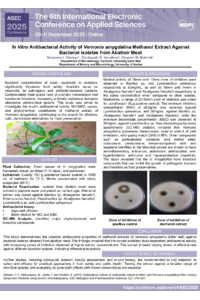
Fish and meat products are known to transmit foodborne pathogens. Vernonia amygdalina, commonly called bitter leaf in English, “ewuro” in Yoruba, and “onugbu” in Igbo have been traditionally used as vegetable, food preservative and insect repellant. This study aimed to assess the susceptibility pattern of methanol extract of bitter leaf against bacteria isolated from abattoir meat and delineate its bioactive compounds. Methanol extract was tested against Bacillus sp, Alcaligenes faecalis1, Enterococcus faecium, Paenibacillus sp, Alcaligenes faecalis2, Lysinibacillus sp, and Lysinibacillus sphearicus, using agar well diffusion and broth dilution methods. Marked activity of 18mm and 13mm zone of inhibition were observed in Bacillus sp, and Lysinibacillus sphearicus respectively at 50mg/mL, as well as 18mm and 14mm in Alcaligenes faecalis1 and Alcaligenes faecalis2 respectively at the same concentration when compared to other isolates. Meanwhile, a range of 25-36mm zone of inhibition was noted for ciprofloxacin (5µg positive control). The minimum inhibitory concentration (MIC) of 25mg/mL was recorded against Lysinibacillus sphearicus, and 50mg/mL against Bacillus sp, Alcaligenes faecalis1and Alcaligenes faecalis2, while the minimum bactericidal concentration (MBC) was observed at 50mg/mL against Lysinibacillus sp. Gas chromatography-mass spectrometry (GC-MS) analysis revealed that Vernonia amygdalina possesses pest controlled Heneicosane with quality match (QM) of 86%. Other compounds such as pentadecane, nonanoic acid methyl ester, octacosane, pentacosane, benzenepropanoic acid, and squalene identified in the biter-leaf extract are known to have anti-inflammatory, anticancer, antioxidant, and antimicrobial properties. The study revealed that the extract can inhibit the growth of pathogenic bacteria.
Keywords
Antimicrobial
Bitter Leaf
Methanol Extract
Abattoir Meat
Preservatives.
Poster
OKELEYE MDPI CONFERENCE POSTER.pdf
From Waves to Wisdom: Leveraging Transformers and CNNs for ECG Signal Classification
A Machine Learning Methods over Wildfire damage assessment using Radar and Multispectral Data from Sentinel Satellites