Event submissions
Published
This submission belongs to the session S7. Food Science and Technology of the event The 6th International Electronic Conference on Applied Sciences
Published date
03 Dec, 2025
Academic Editor
'%3e%3cpath%20d='M12.6657%2010.9104C12.4185%2010.325%2012.0599%209.79327%2011.6097%209.34482C11.1609%208.89508%2010.6293%208.5365%2010.0442%208.28888C10.0389%208.28626%2010.0337%208.28495%2010.0285%208.28233C10.8446%207.69279%2011.3752%206.73249%2011.3752%205.64904C11.3752%203.8542%209.92103%202.39999%208.1262%202.39999C6.33136%202.39999%204.87715%203.8542%204.87715%205.64904C4.87715%206.73249%205.40774%207.69279%206.22393%208.28364C6.21869%208.28626%206.21345%208.28757%206.20821%208.29019C5.62129%208.5378%205.09463%208.89284%204.64265%209.34613C4.1929%209.79493%203.83432%2010.3266%203.58671%2010.9117C3.34345%2011.4845%203.21226%2012.0987%203.20023%2012.7209C3.19988%2012.7349%203.20233%2012.7488%203.20744%2012.7619C3.21255%2012.7749%203.22022%2012.7867%203.22998%2012.7968C3.23975%2012.8068%203.25142%2012.8147%203.26431%2012.8202C3.2772%2012.8256%203.29105%2012.8284%203.30504%2012.8284H4.09109C4.14874%2012.8284%204.19459%2012.7825%204.1959%2012.7262C4.2221%2011.7148%204.62823%2010.7676%205.34617%2010.0497C6.08899%209.30683%207.0755%208.89808%208.1262%208.89808C9.17689%208.89808%2010.1634%209.30683%2010.9062%2010.0497C11.6242%2010.7676%2012.0303%2011.7148%2012.0565%2012.7262C12.0578%2012.7838%2012.1037%2012.8284%2012.1613%2012.8284H12.9474C12.9613%2012.8284%2012.9752%2012.8256%2012.9881%2012.8202C13.001%2012.8147%2013.0126%2012.8068%2013.0224%2012.7968C13.0322%2012.7867%2013.0398%2012.7749%2013.0449%2012.7619C13.0501%2012.7488%2013.0525%2012.7349%2013.0522%2012.7209C13.0391%2012.0947%2012.9094%2011.4855%2012.6657%2010.9104ZM8.1262%207.9024C7.52486%207.9024%206.9589%207.6679%206.53312%207.24211C6.10733%206.81633%205.87283%206.25037%205.87283%205.64904C5.87283%205.0477%206.10733%204.48174%206.53312%204.05596C6.9589%203.63018%207.52486%203.39567%208.1262%203.39567C8.72753%203.39567%209.29349%203.63018%209.71927%204.05596C10.1451%204.48174%2010.3796%205.0477%2010.3796%205.64904C10.3796%206.25037%2010.1451%206.81633%209.71927%207.24211C9.29349%207.6679%208.72753%207.9024%208.1262%207.9024Z'%20fill='%235D1EE1'/%3e%3c/g%3e%3c/svg%3e) Antonios Koutelidakis
Antonios KoutelidakisCitation
Rachid Sahraoui, Souad Djellali, Yasmine Abdelouahed, Lakhdar Gasmi, Chemical Analysis and In Vitro Antioxidant Activity of Taraxacum officinale with Functional Food Implications, in Proceedings of The 6th International Electronic Conference on Applied Sciences, 9 December–11 December 2025, MDPI: Basel, Switzerland
Share
Email
Facebook
Twitter
LinkedIn
Chemical Analysis and In Vitro Antioxidant Activity of Taraxacum officinale with Functional Food Implications
'%3e%3cpath%20d='M12.6647%2010.9104C12.4176%2010.325%2012.0589%209.7933%2011.6088%209.34485C11.16%208.89511%2010.6283%208.53653%2010.0432%208.28891C10.038%208.28629%2010.0327%208.28498%2010.0275%208.28236C10.8437%207.69282%2011.3743%206.73252%2011.3743%205.64907C11.3743%203.85423%209.92005%202.40002%208.12522%202.40002C6.33038%202.40002%204.87618%203.85423%204.87618%205.64907C4.87618%206.73252%205.40677%207.69282%206.22296%208.28367C6.21772%208.28629%206.21248%208.2876%206.20724%208.29022C5.62031%208.53783%205.09365%208.89287%204.64167%209.34616C4.19192%209.79496%203.83334%2010.3266%203.58573%2010.9117C3.34247%2011.4846%203.21128%2012.0987%203.19925%2012.721C3.1989%2012.735%203.20135%2012.7489%203.20646%2012.7619C3.21157%2012.7749%203.21924%2012.7868%203.22901%2012.7968C3.23877%2012.8068%203.25045%2012.8148%203.26334%2012.8202C3.27623%2012.8256%203.29007%2012.8284%203.30406%2012.8284H4.09012C4.14776%2012.8284%204.19362%2012.7825%204.19493%2012.7262C4.22113%2011.7148%204.62726%2010.7676%205.34519%2010.0497C6.08802%209.30686%207.07452%208.89811%208.12522%208.89811C9.17592%208.89811%2010.1624%209.30686%2010.9052%2010.0497C11.6232%2010.7676%2012.0293%2011.7148%2012.0555%2012.7262C12.0568%2012.7839%2012.1027%2012.8284%2012.1603%2012.8284H12.9464C12.9604%2012.8284%2012.9742%2012.8256%2012.9871%2012.8202C13%2012.8148%2013.0117%2012.8068%2013.0214%2012.7968C13.0312%2012.7868%2013.0389%2012.7749%2013.044%2012.7619C13.0491%2012.7489%2013.0515%2012.735%2013.0512%2012.721C13.0381%2012.0947%2012.9084%2011.4856%2012.6647%2010.9104ZM8.12522%207.90243C7.52388%207.90243%206.95792%207.66793%206.53214%207.24215C6.10636%206.81636%205.87185%206.2504%205.87185%205.64907C5.87185%205.04773%206.10636%204.48177%206.53214%204.05599C6.95792%203.63021%207.52388%203.3957%208.12522%203.3957C8.72655%203.3957%209.29252%203.63021%209.7183%204.05599C10.1441%204.48177%2010.3786%205.04773%2010.3786%205.64907C10.3786%206.2504%2010.1441%206.81636%209.7183%207.24215C9.29252%207.66793%208.72655%207.90243%208.12522%207.90243Z'%20fill='%235D1EE1'/%3e%3c/g%3e%3c/svg%3e)
Rachid Sahraoui 1
Souad Djellali 2,3
Yasmine Abdelouahed 2
Lakhdar Gasmi 4
1. Laboratory of Valorization of Natural Biological Resources, University Setif 1- Ferhat Abbas, Algeria
2. Department of Chemistry, University Setif 1 Ferhat Abbas, Algeria
3. Laboratory of Physical-Chemistry of High Polymers, University Setif 1 Ferhat Abbas, Algeria
4. Laboratory of Phytotherapy Applied to Chronic Disease, University Ferhat Abbas Setif 1, Algeria
Abstract
Background
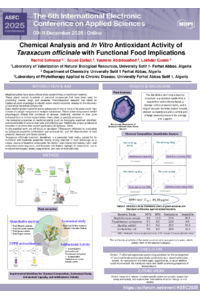
Taraxacum officinale (common dandelion) is a perennial herb widely valued for its nutritional and medicinal properties having strong potential in food technology as a natural source of bioactive compounds. Its vitamin- and mineral-rich leaves, inulin- and antioxidant-containing roots, and flavonoid-rich flowers highlight its potential for use in functional beverages, dietary supplements, and natural food additives.
Methods
The research included morphological and anatomical analysis, chemical composition determination (polyphenols, flavonoids, tannins, sugars), and the assessment of antioxidant activity using DPPH method. The antibacterial activity of the prepared extracts was assessed using the disk diffusion method on Mueller-Hinton agar. The tested bacterial strains included Gram-negative (Escherichia coli, Pseudomonas aeruginosa) and Gram-positive (Staphylococcus aureus , Bacillus subtilis ) species. This screening aimed to determine the inhibitory potential of the extracts against clinically relevant microorganisms.
Results
Anatomical studies revealed well-defined vascular structures and storage parenchyma, consistent with its taxonomic classification. Phytochemical screening showed high concentrations of polyphenols (33.76 μg GAE/mg), tannins and sugars but lower flavonoids. The extract exhibited strong antioxidant capacity (IC₅₀: 143.97 μg/mL) in DPPH assays, confirming its efficacy against oxidative stress. However, antibacterial tests against standard strains revealed negligible inhibition zones. The results highlight T. officinale's significant antioxidant properties while suggesting limited direct antimicrobial activity, supporting its traditional use in antioxidant-related therapies.
Conclusion
Overall, T. officinale represents a promising candidate for the development of functional foods and nutraceuticals, particularly as a natural antioxidant source. Its incorporation into beverages, supplements, or as an additive could improve both the nutritional value and health-promoting properties of food products.
Keywords
Taraxacum officinale
Antioxidant activity
Phytochemicals
polyphenols
Nutraceuticals
Poster
Sahraoui_151644_ASEC_Poster.pdf
GAN-Based Image Segmentation for Extraction of Horticulture Plantation type using VHRS data in parts of arid regions of Rajasthan
Hybrid Federated Learning with Client-Side Personalization for Privacy-Preserving and Scalable Medical Imaging Analytics