Event submissions
Published
This submission belongs to the session S7. Food Science and Technology of the event The 6th International Electronic Conference on Applied Sciences
Published date
03 Dec, 2025
Academic Editor
'%3e%3cpath%20d='M12.6657%2010.9104C12.4185%2010.325%2012.0599%209.79327%2011.6097%209.34482C11.1609%208.89508%2010.6293%208.5365%2010.0442%208.28888C10.0389%208.28626%2010.0337%208.28495%2010.0285%208.28233C10.8446%207.69279%2011.3752%206.73249%2011.3752%205.64904C11.3752%203.8542%209.92103%202.39999%208.1262%202.39999C6.33136%202.39999%204.87715%203.8542%204.87715%205.64904C4.87715%206.73249%205.40774%207.69279%206.22393%208.28364C6.21869%208.28626%206.21345%208.28757%206.20821%208.29019C5.62129%208.5378%205.09463%208.89284%204.64265%209.34613C4.1929%209.79493%203.83432%2010.3266%203.58671%2010.9117C3.34345%2011.4845%203.21226%2012.0987%203.20023%2012.7209C3.19988%2012.7349%203.20233%2012.7488%203.20744%2012.7619C3.21255%2012.7749%203.22022%2012.7867%203.22998%2012.7968C3.23975%2012.8068%203.25142%2012.8147%203.26431%2012.8202C3.2772%2012.8256%203.29105%2012.8284%203.30504%2012.8284H4.09109C4.14874%2012.8284%204.19459%2012.7825%204.1959%2012.7262C4.2221%2011.7148%204.62823%2010.7676%205.34617%2010.0497C6.08899%209.30683%207.0755%208.89808%208.1262%208.89808C9.17689%208.89808%2010.1634%209.30683%2010.9062%2010.0497C11.6242%2010.7676%2012.0303%2011.7148%2012.0565%2012.7262C12.0578%2012.7838%2012.1037%2012.8284%2012.1613%2012.8284H12.9474C12.9613%2012.8284%2012.9752%2012.8256%2012.9881%2012.8202C13.001%2012.8147%2013.0126%2012.8068%2013.0224%2012.7968C13.0322%2012.7867%2013.0398%2012.7749%2013.0449%2012.7619C13.0501%2012.7488%2013.0525%2012.7349%2013.0522%2012.7209C13.0391%2012.0947%2012.9094%2011.4855%2012.6657%2010.9104ZM8.1262%207.9024C7.52486%207.9024%206.9589%207.6679%206.53312%207.24211C6.10733%206.81633%205.87283%206.25037%205.87283%205.64904C5.87283%205.0477%206.10733%204.48174%206.53312%204.05596C6.9589%203.63018%207.52486%203.39567%208.1262%203.39567C8.72753%203.39567%209.29349%203.63018%209.71927%204.05596C10.1451%204.48174%2010.3796%205.0477%2010.3796%205.64904C10.3796%206.25037%2010.1451%206.81633%209.71927%207.24211C9.29349%207.6679%208.72753%207.9024%208.1262%207.9024Z'%20fill='%235D1EE1'/%3e%3c/g%3e%3c/svg%3e) Antonios Koutelidakis
Antonios KoutelidakisCitation
Carlos Jiménez-Pérez, Karel Silva-García, Alma Cruz-Guerrero, Sergio Alatorre-Santamaría, Aflatoxin M1 retention by exopolysaccharides from kefir grains: Impact of extraction method on binding efficiency, in Proceedings of The 6th International Electronic Conference on Applied Sciences, 9 December–11 December 2025, MDPI: Basel, Switzerland
Share
Email
Facebook
Twitter
LinkedIn
Aflatoxin M1 retention by exopolysaccharides from kefir grains: Impact of extraction method on binding efficiency
'%3e%3cpath%20d='M12.6647%2010.9104C12.4176%2010.325%2012.0589%209.7933%2011.6088%209.34485C11.16%208.89511%2010.6283%208.53653%2010.0432%208.28891C10.038%208.28629%2010.0327%208.28498%2010.0275%208.28236C10.8437%207.69282%2011.3743%206.73252%2011.3743%205.64907C11.3743%203.85423%209.92005%202.40002%208.12522%202.40002C6.33038%202.40002%204.87618%203.85423%204.87618%205.64907C4.87618%206.73252%205.40677%207.69282%206.22296%208.28367C6.21772%208.28629%206.21248%208.2876%206.20724%208.29022C5.62031%208.53783%205.09365%208.89287%204.64167%209.34616C4.19192%209.79496%203.83334%2010.3266%203.58573%2010.9117C3.34247%2011.4846%203.21128%2012.0987%203.19925%2012.721C3.1989%2012.735%203.20135%2012.7489%203.20646%2012.7619C3.21157%2012.7749%203.21924%2012.7868%203.22901%2012.7968C3.23877%2012.8068%203.25045%2012.8148%203.26334%2012.8202C3.27623%2012.8256%203.29007%2012.8284%203.30406%2012.8284H4.09012C4.14776%2012.8284%204.19362%2012.7825%204.19493%2012.7262C4.22113%2011.7148%204.62726%2010.7676%205.34519%2010.0497C6.08802%209.30686%207.07452%208.89811%208.12522%208.89811C9.17592%208.89811%2010.1624%209.30686%2010.9052%2010.0497C11.6232%2010.7676%2012.0293%2011.7148%2012.0555%2012.7262C12.0568%2012.7839%2012.1027%2012.8284%2012.1603%2012.8284H12.9464C12.9604%2012.8284%2012.9742%2012.8256%2012.9871%2012.8202C13%2012.8148%2013.0117%2012.8068%2013.0214%2012.7968C13.0312%2012.7868%2013.0389%2012.7749%2013.044%2012.7619C13.0491%2012.7489%2013.0515%2012.735%2013.0512%2012.721C13.0381%2012.0947%2012.9084%2011.4856%2012.6647%2010.9104ZM8.12522%207.90243C7.52388%207.90243%206.95792%207.66793%206.53214%207.24215C6.10636%206.81636%205.87185%206.2504%205.87185%205.64907C5.87185%205.04773%206.10636%204.48177%206.53214%204.05599C6.95792%203.63021%207.52388%203.3957%208.12522%203.3957C8.72655%203.3957%209.29252%203.63021%209.7183%204.05599C10.1441%204.48177%2010.3786%205.04773%2010.3786%205.64907C10.3786%206.2504%2010.1441%206.81636%209.7183%207.24215C9.29252%207.66793%208.72655%207.90243%208.12522%207.90243Z'%20fill='%235D1EE1'/%3e%3c/g%3e%3c/svg%3e)
Carlos Jiménez-Pérez 1
Karel Silva-García 2
Alma Cruz-Guerrero 1
Sergio Alatorre-Santamaría 1
1. Departamento de Biotecnología, Universidad Autónoma Metropolitana, Ciudad de México 09340, Mexico
2. Universidad Nacional Autónoma de México, Ciudad de México 04510, Mexico
Abstract
Introduction:
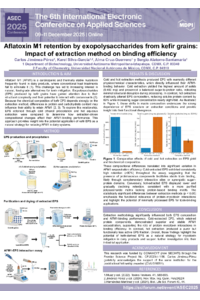
Aflatoxin M1 (AFM1) is a carcinogenic mycotoxin commonly found in dairy products from livestock consuming contaminated feed. Its thermal stability renders pasteurization ineffective, necessitating alternative detoxification strategies. This study evaluated the AFM1-binding capacity of exopolysaccharides (EPS) from kefir grains using two extraction methods.
Methods:
EPS were produced by fermenting semi-skimmed milk with 10% kefir grains. After grain removal and casein elimination, EPS were extracted via (1) cold ethanol precipitation and (2) hot aqueous extraction followed by ethanol precipitation. EPS were dialyzed (14 kDa), lyophilized, and analyzed for sugar and protein content. AFM1 retention (1 μg/L) by 1% EPS was assessed in phosphate buffer (pH 6.8, 30°C) over 3 hours with hourly sampling, ultrafiltration (30 kDa), and HPLC-fluorescence quantification.
Results:
Cold extraction yielded higher solids (9,400 mg) with balanced sugar-to-protein ratios, while hot extraction reduced protein content by 69% and increased sugar concentration eight-fold. Cold-extracted EPS maintained >80% AFM1 retention throughout the assay period. Hot-extracted EPS exhibited lower, time-dependent retention. Method-dependent differences were statistically significant (p < 0.05).
Conclusions:
Extraction methodology significantly affects EPS composition and AFM1-binding efficiency. Cold-extracted EPS, retaining protein components, demonstrated superior AFM1 sequestration, suggesting protein–mycotoxin interactions are crucial for binding. These findings highlight the potential of kefir EPS as a natural mycotoxin mitigation strategy in dairy processing, warranting further investigation for industrial applications.
Keywords
Aflatoxin M1
exopolysaccharides
kefir grains
mycotoxin binding
food safety
dairy detoxification
Poster
Poster-Carlos Jimenez Perez.pdf
Integrated Linear Transformer-Based Diode Bridge Rectifier for Improved Power Quality in Electric Vehicle Charging Stations
Real-Time Gain Scheduling via Adaptive Fuzzy PID Control: Application to Nonlinear Inverted Pendulum Stabilization