Event submissions
Published
This submission belongs to the session S7. Food Science and Technology of the event The 6th International Electronic Conference on Applied Sciences
Published date
03 Dec, 2025
Academic Editor
'%3e%3cpath%20d='M12.6657%2010.9104C12.4185%2010.325%2012.0599%209.79327%2011.6097%209.34482C11.1609%208.89508%2010.6293%208.5365%2010.0442%208.28888C10.0389%208.28626%2010.0337%208.28495%2010.0285%208.28233C10.8446%207.69279%2011.3752%206.73249%2011.3752%205.64904C11.3752%203.8542%209.92103%202.39999%208.1262%202.39999C6.33136%202.39999%204.87715%203.8542%204.87715%205.64904C4.87715%206.73249%205.40774%207.69279%206.22393%208.28364C6.21869%208.28626%206.21345%208.28757%206.20821%208.29019C5.62129%208.5378%205.09463%208.89284%204.64265%209.34613C4.1929%209.79493%203.83432%2010.3266%203.58671%2010.9117C3.34345%2011.4845%203.21226%2012.0987%203.20023%2012.7209C3.19988%2012.7349%203.20233%2012.7488%203.20744%2012.7619C3.21255%2012.7749%203.22022%2012.7867%203.22998%2012.7968C3.23975%2012.8068%203.25142%2012.8147%203.26431%2012.8202C3.2772%2012.8256%203.29105%2012.8284%203.30504%2012.8284H4.09109C4.14874%2012.8284%204.19459%2012.7825%204.1959%2012.7262C4.2221%2011.7148%204.62823%2010.7676%205.34617%2010.0497C6.08899%209.30683%207.0755%208.89808%208.1262%208.89808C9.17689%208.89808%2010.1634%209.30683%2010.9062%2010.0497C11.6242%2010.7676%2012.0303%2011.7148%2012.0565%2012.7262C12.0578%2012.7838%2012.1037%2012.8284%2012.1613%2012.8284H12.9474C12.9613%2012.8284%2012.9752%2012.8256%2012.9881%2012.8202C13.001%2012.8147%2013.0126%2012.8068%2013.0224%2012.7968C13.0322%2012.7867%2013.0398%2012.7749%2013.0449%2012.7619C13.0501%2012.7488%2013.0525%2012.7349%2013.0522%2012.7209C13.0391%2012.0947%2012.9094%2011.4855%2012.6657%2010.9104ZM8.1262%207.9024C7.52486%207.9024%206.9589%207.6679%206.53312%207.24211C6.10733%206.81633%205.87283%206.25037%205.87283%205.64904C5.87283%205.0477%206.10733%204.48174%206.53312%204.05596C6.9589%203.63018%207.52486%203.39567%208.1262%203.39567C8.72753%203.39567%209.29349%203.63018%209.71927%204.05596C10.1451%204.48174%2010.3796%205.0477%2010.3796%205.64904C10.3796%206.25037%2010.1451%206.81633%209.71927%207.24211C9.29349%207.6679%208.72753%207.9024%208.1262%207.9024Z'%20fill='%235D1EE1'/%3e%3c/g%3e%3c/svg%3e) Antonios Koutelidakis
Antonios KoutelidakisCitation
Sunil Sharma, Sandip Das, Anu Mehra, Prashant Sharma, Athar Ahmed, Prasun Chakrabarti, Chin Shiuh Shieh, Design and Simulation of a Smart Arrow Photonic Crystal Fiber Sensor for Multimodal Optical Detection of Food Adulteration, in Proceedings of The 6th International Electronic Conference on Applied Sciences, 9 December–11 December 2025, MDPI: Basel, Switzerland
Share
Email
Facebook
Twitter
LinkedIn
Design and Simulation of a Smart Arrow Photonic Crystal Fiber Sensor for Multimodal Optical Detection of Food Adulteration
'%3e%3cpath%20d='M12.6647%2010.9104C12.4176%2010.325%2012.0589%209.7933%2011.6088%209.34485C11.16%208.89511%2010.6283%208.53653%2010.0432%208.28891C10.038%208.28629%2010.0327%208.28498%2010.0275%208.28236C10.8437%207.69282%2011.3743%206.73252%2011.3743%205.64907C11.3743%203.85423%209.92005%202.40002%208.12522%202.40002C6.33038%202.40002%204.87618%203.85423%204.87618%205.64907C4.87618%206.73252%205.40677%207.69282%206.22296%208.28367C6.21772%208.28629%206.21248%208.2876%206.20724%208.29022C5.62031%208.53783%205.09365%208.89287%204.64167%209.34616C4.19192%209.79496%203.83334%2010.3266%203.58573%2010.9117C3.34247%2011.4846%203.21128%2012.0987%203.19925%2012.721C3.1989%2012.735%203.20135%2012.7489%203.20646%2012.7619C3.21157%2012.7749%203.21924%2012.7868%203.22901%2012.7968C3.23877%2012.8068%203.25045%2012.8148%203.26334%2012.8202C3.27623%2012.8256%203.29007%2012.8284%203.30406%2012.8284H4.09012C4.14776%2012.8284%204.19362%2012.7825%204.19493%2012.7262C4.22113%2011.7148%204.62726%2010.7676%205.34519%2010.0497C6.08802%209.30686%207.07452%208.89811%208.12522%208.89811C9.17592%208.89811%2010.1624%209.30686%2010.9052%2010.0497C11.6232%2010.7676%2012.0293%2011.7148%2012.0555%2012.7262C12.0568%2012.7839%2012.1027%2012.8284%2012.1603%2012.8284H12.9464C12.9604%2012.8284%2012.9742%2012.8256%2012.9871%2012.8202C13%2012.8148%2013.0117%2012.8068%2013.0214%2012.7968C13.0312%2012.7868%2013.0389%2012.7749%2013.044%2012.7619C13.0491%2012.7489%2013.0515%2012.735%2013.0512%2012.721C13.0381%2012.0947%2012.9084%2011.4856%2012.6647%2010.9104ZM8.12522%207.90243C7.52388%207.90243%206.95792%207.66793%206.53214%207.24215C6.10636%206.81636%205.87185%206.2504%205.87185%205.64907C5.87185%205.04773%206.10636%204.48177%206.53214%204.05599C6.95792%203.63021%207.52388%203.3957%208.12522%203.3957C8.72655%203.3957%209.29252%203.63021%209.7183%204.05599C10.1441%204.48177%2010.3786%205.04773%2010.3786%205.64907C10.3786%206.2504%2010.1441%206.81636%209.7183%207.24215C9.29252%207.66793%208.72655%207.90243%208.12522%207.90243Z'%20fill='%235D1EE1'/%3e%3c/g%3e%3c/svg%3e)
Sunil Sharma 1,2
Sandip Das 3
Anu Mehra 4
Prashant Sharma 5
Athar Ahmed 6
Prasun Chakrabarti 7

Chin Shiuh Shieh 8
1. Department of Computer Science and Engineering, Techno NJR Institute of Technology, Udaipur, Rajasthan 313001, India
2. National Kaohsiung University of Science and Technology, Kaohsiung, Taiwan
3. Computer Science and Engineering, Brainware University, Kolkata, West Bengal, India
4. Amity University, Noida, Uttar Pradesh, India
5. Computer Science and Engineering, Vivekananda Global University, Jaipur, Rajasthan, India
6. Department of CSE, Vivekanand Global University, Jaipur, India
7. Sir Padampat Singhania University, Udaipur, Rajasthan, India
8. Department of Electronic Engineering, National Kaohsiung University of Science and Technology, Kaohsiung 807618, Taiwan
Abstract
The challenge of food adulteration has always been a major concern and thus there is a need to formulate quick, sensitive, and un-destructive methods to detect food adulteration. Authors provide the design and performance analysis of a Smart Optical Sensing platform driven by Arrow-type Silica Photonic Crystal Fiber (PCF) that is designed to specifically detect adulterants in food products. The COMSOL Multiphysics numerical simulation environment is used to increase the interaction between light and matter. The intended PCF structure has a pitch size of 1.5 µm, diameter of the air holes to be 0.75 µm and core displacement parameters to be asymmetrical (dx = 0.5 µm, dy = 0.25 µm) that leads to a robust field of evanescent confinements and proves to have high optical sensing qualities. The simulation outcomes also show a large absorbance difference (0.8512 a.u.) between non-adulterated and adulterated ones and the greatest decrease in transmittance amounting to 30% exists in the case of the adulterated specimens. Fluorescence spectral displacement of 40 nm to 75 nm and Raman based at 200 to 800 cm-1 allowed distinguishing between chemicals at the level of a molecule, and identification of adulterants which include artificial food dyes, heavy metals, and chemical preservatives. A combination of NIR spectroscopy with COMSOL-based modelling will define a sound system of non-destructive, fast, and scalable food safety tests.
Keywords
Food Adulteration
Optical Sensor
Photonic Crystal Fiber
COMSOL
Near-Infrared Region
Poster
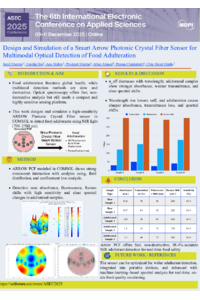
Design and Simulation of a Smart Arrow Photonic Crystal Fiber Sensor for Multimodal Optical Detection of Food Adulteration Author 1, Author 2 Affiliation 1 Affiliation 2.pdf
Comparative Evaluation of Flavonoids and Water-Soluble Vitamins in Solar- and Open-Air-Dried Plantago major L. Leaves for Functional Food Applications
Determination of pathogens causing mastitis in milk by gas phase analysis using chemical sensors