Event submissions
Published
This submission belongs to the session S4. Electrical, Electronics and Communications Engineering of the event The 6th International Electronic Conference on Applied Sciences
Published date
03 Dec, 2025
Academic Editor
'%3e%3cpath%20d='M12.6657%2010.9104C12.4185%2010.325%2012.0599%209.79327%2011.6097%209.34482C11.1609%208.89508%2010.6293%208.5365%2010.0442%208.28888C10.0389%208.28626%2010.0337%208.28495%2010.0285%208.28233C10.8446%207.69279%2011.3752%206.73249%2011.3752%205.64904C11.3752%203.8542%209.92103%202.39999%208.1262%202.39999C6.33136%202.39999%204.87715%203.8542%204.87715%205.64904C4.87715%206.73249%205.40774%207.69279%206.22393%208.28364C6.21869%208.28626%206.21345%208.28757%206.20821%208.29019C5.62129%208.5378%205.09463%208.89284%204.64265%209.34613C4.1929%209.79493%203.83432%2010.3266%203.58671%2010.9117C3.34345%2011.4845%203.21226%2012.0987%203.20023%2012.7209C3.19988%2012.7349%203.20233%2012.7488%203.20744%2012.7619C3.21255%2012.7749%203.22022%2012.7867%203.22998%2012.7968C3.23975%2012.8068%203.25142%2012.8147%203.26431%2012.8202C3.2772%2012.8256%203.29105%2012.8284%203.30504%2012.8284H4.09109C4.14874%2012.8284%204.19459%2012.7825%204.1959%2012.7262C4.2221%2011.7148%204.62823%2010.7676%205.34617%2010.0497C6.08899%209.30683%207.0755%208.89808%208.1262%208.89808C9.17689%208.89808%2010.1634%209.30683%2010.9062%2010.0497C11.6242%2010.7676%2012.0303%2011.7148%2012.0565%2012.7262C12.0578%2012.7838%2012.1037%2012.8284%2012.1613%2012.8284H12.9474C12.9613%2012.8284%2012.9752%2012.8256%2012.9881%2012.8202C13.001%2012.8147%2013.0126%2012.8068%2013.0224%2012.7968C13.0322%2012.7867%2013.0398%2012.7749%2013.0449%2012.7619C13.0501%2012.7488%2013.0525%2012.7349%2013.0522%2012.7209C13.0391%2012.0947%2012.9094%2011.4855%2012.6657%2010.9104ZM8.1262%207.9024C7.52486%207.9024%206.9589%207.6679%206.53312%207.24211C6.10733%206.81633%205.87283%206.25037%205.87283%205.64904C5.87283%205.0477%206.10733%204.48174%206.53312%204.05596C6.9589%203.63018%207.52486%203.39567%208.1262%203.39567C8.72753%203.39567%209.29349%203.63018%209.71927%204.05596C10.1451%204.48174%2010.3796%205.0477%2010.3796%205.64904C10.3796%206.25037%2010.1451%206.81633%209.71927%207.24211C9.29349%207.6679%208.72753%207.9024%208.1262%207.9024Z'%20fill='%235D1EE1'/%3e%3c/g%3e%3c/svg%3e) Alessandro Lo Schiavo
Alessandro Lo SchiavoCitation
Jose Luis Garcia Tucci, Jordi Burriel-Valencia, Ángel Sapena-Bañó, Javier Martínez-Román, Kevin Barrera, Non-invasive diagnosis of broken rotor bars in induction motors using deep learning and GASF representations, in Proceedings of The 6th International Electronic Conference on Applied Sciences, 9 December–11 December 2025, MDPI: Basel, Switzerland
Share
Email
Facebook
Twitter
LinkedIn
Non-invasive diagnosis of broken rotor bars in induction motors using deep learning and GASF representations

Jose Luis Garcia Tucci 1
'%3e%3cpath%20d='M12.6647%2010.9104C12.4176%2010.325%2012.0589%209.7933%2011.6088%209.34485C11.16%208.89511%2010.6283%208.53653%2010.0432%208.28891C10.038%208.28629%2010.0327%208.28498%2010.0275%208.28236C10.8437%207.69282%2011.3743%206.73252%2011.3743%205.64907C11.3743%203.85423%209.92005%202.40002%208.12522%202.40002C6.33038%202.40002%204.87618%203.85423%204.87618%205.64907C4.87618%206.73252%205.40677%207.69282%206.22296%208.28367C6.21772%208.28629%206.21248%208.2876%206.20724%208.29022C5.62031%208.53783%205.09365%208.89287%204.64167%209.34616C4.19192%209.79496%203.83334%2010.3266%203.58573%2010.9117C3.34247%2011.4846%203.21128%2012.0987%203.19925%2012.721C3.1989%2012.735%203.20135%2012.7489%203.20646%2012.7619C3.21157%2012.7749%203.21924%2012.7868%203.22901%2012.7968C3.23877%2012.8068%203.25045%2012.8148%203.26334%2012.8202C3.27623%2012.8256%203.29007%2012.8284%203.30406%2012.8284H4.09012C4.14776%2012.8284%204.19362%2012.7825%204.19493%2012.7262C4.22113%2011.7148%204.62726%2010.7676%205.34519%2010.0497C6.08802%209.30686%207.07452%208.89811%208.12522%208.89811C9.17592%208.89811%2010.1624%209.30686%2010.9052%2010.0497C11.6232%2010.7676%2012.0293%2011.7148%2012.0555%2012.7262C12.0568%2012.7839%2012.1027%2012.8284%2012.1603%2012.8284H12.9464C12.9604%2012.8284%2012.9742%2012.8256%2012.9871%2012.8202C13%2012.8148%2013.0117%2012.8068%2013.0214%2012.7968C13.0312%2012.7868%2013.0389%2012.7749%2013.044%2012.7619C13.0491%2012.7489%2013.0515%2012.735%2013.0512%2012.721C13.0381%2012.0947%2012.9084%2011.4856%2012.6647%2010.9104ZM8.12522%207.90243C7.52388%207.90243%206.95792%207.66793%206.53214%207.24215C6.10636%206.81636%205.87185%206.2504%205.87185%205.64907C5.87185%205.04773%206.10636%204.48177%206.53214%204.05599C6.95792%203.63021%207.52388%203.3957%208.12522%203.3957C8.72655%203.3957%209.29252%203.63021%209.7183%204.05599C10.1441%204.48177%2010.3786%205.04773%2010.3786%205.64907C10.3786%206.2504%2010.1441%206.81636%209.7183%207.24215C9.29252%207.66793%208.72655%207.90243%208.12522%207.90243Z'%20fill='%235D1EE1'/%3e%3c/g%3e%3c/svg%3e)
Jordi Burriel-Valencia 2
Ángel Sapena-Bañó 2

Javier Martínez-Román 2

Kevin Barrera 1,2,3
1. Universitat Oberta de Catalunya (UOC), Av. del Tibidabo 39-43, 08035, Barcelona, Spain
2. Institute for Energy Engineering, Universitat Politècnica de València, Cmno. de Vera s/n, 46022, Valencia, Spain
3. Control, Data and Artificial Intelligence (CoDAlab), Escola d’Enginyeria de Barcelona Est (EEBE), Universitat Politècnica de Catalunya (UPC), Eduard Maristany 16, 08019, Barcelona, Spain
Abstract
Introduction and objectives:
Three-phase induction motors are widely used in industry for their reliability and low maintenance. However, faults such as broken rotor bars (BRBs) can disrupt performance and increase costs. Early detection is therefore necessary. This work presents a non-invasive method that combines phase current signals with deep learning to detect and classify BRB faults in squirrel-cage induction motors.
Methods:
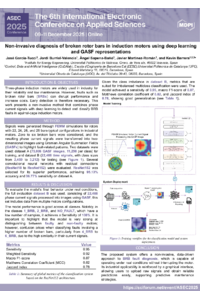
Signals were generated through FEMM simulations for rotors with 22, 24, 26, and 28 bars—typical configurations in industrial motors. Zero to six broken bars were considered, and the resulting phase current signals were transformed into two-dimensional images using Gramian Angular Summation Fields (GASFs) to highlight fault-related patterns. Two datasets were used: dataset A (79,086 GASF images, 11,298 per class) for training, and dataset B (22,488 time signals, with class sizes from 2,459 to 3,212) for testing. Several convolutional neural networks with residual connections (ResNet18 to ResNet152) were evaluated. ResNet152 was selected for its superior performance, achieving 95.13% accuracy and 96.77% sensitivity on dataset A.
Results:
Given the class imbalance in dataset B, metrics that are suited for imbalanced multiclass classification were used. The model achieved a sensitivity of 0.95, macro F1-score of 0.87, Matthews correlation coefficient of 0.82, and Jaccard index of 0.78, showing good generalization.
Conclusion:
The proposed system offers a non-invasive, data-driven approach to BRB fault diagnosis, which is capable of operating under real conditions without interrupting the motor. Its industrial applicability is reinforced by a graphical interface, allowing users to upload raw signals and obtain reliable predictions easily, supporting predictive maintenance strategies.
Keywords
broken rotor bar
induction motor
fault diagnosis
predictive maintenance
deep learning
FEMM
GASF
ResNet
non-invasive method
Poster
Poster_ASEC2025_BRB_FINAL.pdf
A Practical Approach for Acquiring the Hall–Huray Surface Ratio Using HFSS Simulations and VNA Measurements
A Hybrid Path Planning Strategy for Mobile Robot Navigation Using A* and the Dynamic Window Approach