Event submissions
Published
This submission belongs to the session S2. Nanosciences, Chemistry and Materials Science of the event The 6th International Electronic Conference on Applied Sciences
Published date
03 Dec, 2025
Academic Editor
'%3e%3cpath%20d='M12.6657%2010.9104C12.4185%2010.325%2012.0599%209.79327%2011.6097%209.34482C11.1609%208.89508%2010.6293%208.5365%2010.0442%208.28888C10.0389%208.28626%2010.0337%208.28495%2010.0285%208.28233C10.8446%207.69279%2011.3752%206.73249%2011.3752%205.64904C11.3752%203.8542%209.92103%202.39999%208.1262%202.39999C6.33136%202.39999%204.87715%203.8542%204.87715%205.64904C4.87715%206.73249%205.40774%207.69279%206.22393%208.28364C6.21869%208.28626%206.21345%208.28757%206.20821%208.29019C5.62129%208.5378%205.09463%208.89284%204.64265%209.34613C4.1929%209.79493%203.83432%2010.3266%203.58671%2010.9117C3.34345%2011.4845%203.21226%2012.0987%203.20023%2012.7209C3.19988%2012.7349%203.20233%2012.7488%203.20744%2012.7619C3.21255%2012.7749%203.22022%2012.7867%203.22998%2012.7968C3.23975%2012.8068%203.25142%2012.8147%203.26431%2012.8202C3.2772%2012.8256%203.29105%2012.8284%203.30504%2012.8284H4.09109C4.14874%2012.8284%204.19459%2012.7825%204.1959%2012.7262C4.2221%2011.7148%204.62823%2010.7676%205.34617%2010.0497C6.08899%209.30683%207.0755%208.89808%208.1262%208.89808C9.17689%208.89808%2010.1634%209.30683%2010.9062%2010.0497C11.6242%2010.7676%2012.0303%2011.7148%2012.0565%2012.7262C12.0578%2012.7838%2012.1037%2012.8284%2012.1613%2012.8284H12.9474C12.9613%2012.8284%2012.9752%2012.8256%2012.9881%2012.8202C13.001%2012.8147%2013.0126%2012.8068%2013.0224%2012.7968C13.0322%2012.7867%2013.0398%2012.7749%2013.0449%2012.7619C13.0501%2012.7488%2013.0525%2012.7349%2013.0522%2012.7209C13.0391%2012.0947%2012.9094%2011.4855%2012.6657%2010.9104ZM8.1262%207.9024C7.52486%207.9024%206.9589%207.6679%206.53312%207.24211C6.10733%206.81633%205.87283%206.25037%205.87283%205.64904C5.87283%205.0477%206.10733%204.48174%206.53312%204.05596C6.9589%203.63018%207.52486%203.39567%208.1262%203.39567C8.72753%203.39567%209.29349%203.63018%209.71927%204.05596C10.1451%204.48174%2010.3796%205.0477%2010.3796%205.64904C10.3796%206.25037%2010.1451%206.81633%209.71927%207.24211C9.29349%207.6679%208.72753%207.9024%208.1262%207.9024Z'%20fill='%235D1EE1'/%3e%3c/g%3e%3c/svg%3e) Alberto Jiménez Suárez
Alberto Jiménez SuárezCitation
Fathi Brioua, Chouaib Daoudi, Improved Optical and Electrical Characteristics of PTB7:PCBM Organic Solar Cells via ZnO Spacer Integration, in Proceedings of The 6th International Electronic Conference on Applied Sciences, 9 December–11 December 2025, MDPI: Basel, Switzerland
Share
Email
Facebook
Twitter
LinkedIn
Improved Optical and Electrical Characteristics of PTB7:PCBM Organic Solar Cells via ZnO Spacer Integration
'%3e%3cpath%20d='M12.6647%2010.9104C12.4176%2010.325%2012.0589%209.7933%2011.6088%209.34485C11.16%208.89511%2010.6283%208.53653%2010.0432%208.28891C10.038%208.28629%2010.0327%208.28498%2010.0275%208.28236C10.8437%207.69282%2011.3743%206.73252%2011.3743%205.64907C11.3743%203.85423%209.92005%202.40002%208.12522%202.40002C6.33038%202.40002%204.87618%203.85423%204.87618%205.64907C4.87618%206.73252%205.40677%207.69282%206.22296%208.28367C6.21772%208.28629%206.21248%208.2876%206.20724%208.29022C5.62031%208.53783%205.09365%208.89287%204.64167%209.34616C4.19192%209.79496%203.83334%2010.3266%203.58573%2010.9117C3.34247%2011.4846%203.21128%2012.0987%203.19925%2012.721C3.1989%2012.735%203.20135%2012.7489%203.20646%2012.7619C3.21157%2012.7749%203.21924%2012.7868%203.22901%2012.7968C3.23877%2012.8068%203.25045%2012.8148%203.26334%2012.8202C3.27623%2012.8256%203.29007%2012.8284%203.30406%2012.8284H4.09012C4.14776%2012.8284%204.19362%2012.7825%204.19493%2012.7262C4.22113%2011.7148%204.62726%2010.7676%205.34519%2010.0497C6.08802%209.30686%207.07452%208.89811%208.12522%208.89811C9.17592%208.89811%2010.1624%209.30686%2010.9052%2010.0497C11.6232%2010.7676%2012.0293%2011.7148%2012.0555%2012.7262C12.0568%2012.7839%2012.1027%2012.8284%2012.1603%2012.8284H12.9464C12.9604%2012.8284%2012.9742%2012.8256%2012.9871%2012.8202C13%2012.8148%2013.0117%2012.8068%2013.0214%2012.7968C13.0312%2012.7868%2013.0389%2012.7749%2013.044%2012.7619C13.0491%2012.7489%2013.0515%2012.735%2013.0512%2012.721C13.0381%2012.0947%2012.9084%2011.4856%2012.6647%2010.9104ZM8.12522%207.90243C7.52388%207.90243%206.95792%207.66793%206.53214%207.24215C6.10636%206.81636%205.87185%206.2504%205.87185%205.64907C5.87185%205.04773%206.10636%204.48177%206.53214%204.05599C6.95792%203.63021%207.52388%203.3957%208.12522%203.3957C8.72655%203.3957%209.29252%203.63021%209.7183%204.05599C10.1441%204.48177%2010.3786%205.04773%2010.3786%205.64907C10.3786%206.2504%2010.1441%206.81636%209.7183%207.24215C9.29252%207.66793%208.72655%207.90243%208.12522%207.90243Z'%20fill='%235D1EE1'/%3e%3c/g%3e%3c/svg%3e)
Fathi Brioua 1
Chouaib Daoudi 2
1. Electrical Engineering Department, Ahmed Draia University, Route Nationale N°6, Adrar, Algeria
2. Département Génie Électrique, Université 20 Août 1955, Skikda, Algeria
Abstract
Introduction
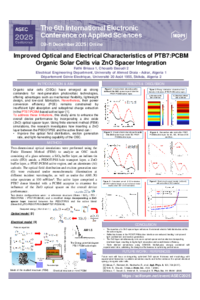
Organic solar cells (OSCs) are attractive for low-cost, lightweight, and mechanically flexible photovoltaic technologies. However, their efficiency is limited by suboptimal light absorption and charge extraction. Incorporating an optical spacer, such as zinc oxide (ZnO), has been proposed to improve device performance by enhancing both optical and electrical responses.
Methods
Finite element method (FEM)-based simulations were carried out to examine the effect of a ZnO optical spacer in OSCs. The active layer consisted of a PTB7 donor blended with a PCBM acceptor. Two device structures were analyzed: a reference design (Glass/SiO₂/ITO/PEDOT:PSS/PTB7:PCBM/Al) and a modified configuration with a ZnO spacer inserted between the PEDOT:PSS layer and the active blend (Glass/SiO₂/ITO/PEDOT:PSS/ZnO/PTB7:PCBM/Al). Optical field distribution, exciton generation rate (G), and short-circuit current density (JSC) were evaluated under monochromatic illumination (450–850 nm) and standard AM1.5 solar conditions at 100 mW/cm².
Results
The inclusion of ZnO significantly enhanced the internal electric field distribution and increased exciton generation across the active layer. This improvement is attributed to the dual role of ZnO: (i) its optical spacer effect, which reduces reflection losses at the PEDOT:PSS/active interface and redistributes light more effectively within the absorber, and (ii) its favorable electronic properties, which facilitate electron transport and mitigate interfacial recombination. Under AM1.5 illumination, the ZnO-modified structure exhibited nearly 30% higher light absorption and a notable increase in JSC compared to the reference cell.
Conclusion
This numerical study demonstrates that integrating a ZnO spacer layer into OSCs simultaneously improves light harvesting and charge extraction. The findings, in agreement with experimental reports, confirm the multifunctional role of ZnO as both an optical spacer and an electron-transporting interfacial layer, providing a practical strategy for enhancing the efficiency of organic photovoltaics.
Keywords
Organic solar cells (OSCs)
ZnO spacer
PTB7\:PCBM active layer
Electron transport layer (ETL)
Optical absorption
Poster
MDBI conf 1 ZnO 26 11 2025 brioua and daoudi.pdf
Finite Element Modeling of Bilayer P3HT/C60 Organic Solar Cells: Influence of Active-Layer Thickness on Optical Performance
Preparation of Composite Nanofibers with M-Type Nickel Ferrite and Graphene Oxide and Investigation of Their Application in Dye Pollutant Adsorption