Event submissions
Published
This submission belongs to the session S2. Nanosciences, Chemistry and Materials Science of the event The 6th International Electronic Conference on Applied Sciences
Published date
03 Dec, 2025
Academic Editor
'%3e%3cpath%20d='M12.6657%2010.9104C12.4185%2010.325%2012.0599%209.79327%2011.6097%209.34482C11.1609%208.89508%2010.6293%208.5365%2010.0442%208.28888C10.0389%208.28626%2010.0337%208.28495%2010.0285%208.28233C10.8446%207.69279%2011.3752%206.73249%2011.3752%205.64904C11.3752%203.8542%209.92103%202.39999%208.1262%202.39999C6.33136%202.39999%204.87715%203.8542%204.87715%205.64904C4.87715%206.73249%205.40774%207.69279%206.22393%208.28364C6.21869%208.28626%206.21345%208.28757%206.20821%208.29019C5.62129%208.5378%205.09463%208.89284%204.64265%209.34613C4.1929%209.79493%203.83432%2010.3266%203.58671%2010.9117C3.34345%2011.4845%203.21226%2012.0987%203.20023%2012.7209C3.19988%2012.7349%203.20233%2012.7488%203.20744%2012.7619C3.21255%2012.7749%203.22022%2012.7867%203.22998%2012.7968C3.23975%2012.8068%203.25142%2012.8147%203.26431%2012.8202C3.2772%2012.8256%203.29105%2012.8284%203.30504%2012.8284H4.09109C4.14874%2012.8284%204.19459%2012.7825%204.1959%2012.7262C4.2221%2011.7148%204.62823%2010.7676%205.34617%2010.0497C6.08899%209.30683%207.0755%208.89808%208.1262%208.89808C9.17689%208.89808%2010.1634%209.30683%2010.9062%2010.0497C11.6242%2010.7676%2012.0303%2011.7148%2012.0565%2012.7262C12.0578%2012.7838%2012.1037%2012.8284%2012.1613%2012.8284H12.9474C12.9613%2012.8284%2012.9752%2012.8256%2012.9881%2012.8202C13.001%2012.8147%2013.0126%2012.8068%2013.0224%2012.7968C13.0322%2012.7867%2013.0398%2012.7749%2013.0449%2012.7619C13.0501%2012.7488%2013.0525%2012.7349%2013.0522%2012.7209C13.0391%2012.0947%2012.9094%2011.4855%2012.6657%2010.9104ZM8.1262%207.9024C7.52486%207.9024%206.9589%207.6679%206.53312%207.24211C6.10733%206.81633%205.87283%206.25037%205.87283%205.64904C5.87283%205.0477%206.10733%204.48174%206.53312%204.05596C6.9589%203.63018%207.52486%203.39567%208.1262%203.39567C8.72753%203.39567%209.29349%203.63018%209.71927%204.05596C10.1451%204.48174%2010.3796%205.0477%2010.3796%205.64904C10.3796%206.25037%2010.1451%206.81633%209.71927%207.24211C9.29349%207.6679%208.72753%207.9024%208.1262%207.9024Z'%20fill='%235D1EE1'/%3e%3c/g%3e%3c/svg%3e) Alberto Jiménez Suárez
Alberto Jiménez SuárezCitation
Mariana Chelu, Hermine Stroescu, Jose María Calderon Moreno, Peter Petrik, Zoltan Labadi, Mariuca gartner, Optimizing Piezoelectric Performance of ZnO Nanowire Arrays through Integration with Metallic Substrates, in Proceedings of The 6th International Electronic Conference on Applied Sciences, 9 December–11 December 2025, MDPI: Basel, Switzerland
Share
Email
Facebook
Twitter
LinkedIn
Optimizing Piezoelectric Performance of ZnO Nanowire Arrays through Integration with Metallic Substrates

Mariana Chelu 1

Hermine Stroescu 1
'%3e%3cpath%20d='M12.6647%2010.9104C12.4176%2010.325%2012.0589%209.7933%2011.6088%209.34485C11.16%208.89511%2010.6283%208.53653%2010.0432%208.28891C10.038%208.28629%2010.0327%208.28498%2010.0275%208.28236C10.8437%207.69282%2011.3743%206.73252%2011.3743%205.64907C11.3743%203.85423%209.92005%202.40002%208.12522%202.40002C6.33038%202.40002%204.87618%203.85423%204.87618%205.64907C4.87618%206.73252%205.40677%207.69282%206.22296%208.28367C6.21772%208.28629%206.21248%208.2876%206.20724%208.29022C5.62031%208.53783%205.09365%208.89287%204.64167%209.34616C4.19192%209.79496%203.83334%2010.3266%203.58573%2010.9117C3.34247%2011.4846%203.21128%2012.0987%203.19925%2012.721C3.1989%2012.735%203.20135%2012.7489%203.20646%2012.7619C3.21157%2012.7749%203.21924%2012.7868%203.22901%2012.7968C3.23877%2012.8068%203.25045%2012.8148%203.26334%2012.8202C3.27623%2012.8256%203.29007%2012.8284%203.30406%2012.8284H4.09012C4.14776%2012.8284%204.19362%2012.7825%204.19493%2012.7262C4.22113%2011.7148%204.62726%2010.7676%205.34519%2010.0497C6.08802%209.30686%207.07452%208.89811%208.12522%208.89811C9.17592%208.89811%2010.1624%209.30686%2010.9052%2010.0497C11.6232%2010.7676%2012.0293%2011.7148%2012.0555%2012.7262C12.0568%2012.7839%2012.1027%2012.8284%2012.1603%2012.8284H12.9464C12.9604%2012.8284%2012.9742%2012.8256%2012.9871%2012.8202C13%2012.8148%2013.0117%2012.8068%2013.0214%2012.7968C13.0312%2012.7868%2013.0389%2012.7749%2013.044%2012.7619C13.0491%2012.7489%2013.0515%2012.735%2013.0512%2012.721C13.0381%2012.0947%2012.9084%2011.4856%2012.6647%2010.9104ZM8.12522%207.90243C7.52388%207.90243%206.95792%207.66793%206.53214%207.24215C6.10636%206.81636%205.87185%206.2504%205.87185%205.64907C5.87185%205.04773%206.10636%204.48177%206.53214%204.05599C6.95792%203.63021%207.52388%203.3957%208.12522%203.3957C8.72655%203.3957%209.29252%203.63021%209.7183%204.05599C10.1441%204.48177%2010.3786%205.04773%2010.3786%205.64907C10.3786%206.2504%2010.1441%206.81636%209.7183%207.24215C9.29252%207.66793%208.72655%207.90243%208.12522%207.90243Z'%20fill='%235D1EE1'/%3e%3c/g%3e%3c/svg%3e)
Jose María Calderon Moreno 1
Peter Petrik 2
Zoltan Labadi 2

Mariuca gartner 1
1. “Ilie Murgulescu” Institute of Physical Chemistry, Spl. Independentei 202, 060021, Bucharest, Romania
2. Centre for Energy Research, Hungarian Academy of Sciences, Konkoly-Thege Str. 29-33, H-1121 Budapest, Hungary
Abstract
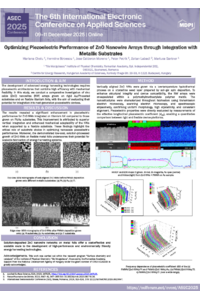
The development of advanced energy harvesting technologies requires piezoelectric architectures that combine high efficiency with mechanical flexibility. In this study, we conduct a comparative investigation of zinc oxide (ZnO) nanowires (NW) arrays grown on rigid Au/Pt-coated substrates and on flexible titanium foils, with the aim of evaluating their potential for integration into next-generation piezoelectric devices.
Vertically aligned ZnO NWs were grown via a low-temperature hydrothermal process on a crystalline seed layer prepared by sol–gel spin deposition. To enhance structural integrity and device compatibility, the NW arrays were encapsulated within a polymethylmethacrylate polymer matrix. The nanostructures were characterized throughout fabrication using transmission electron microscopy, scanning electron microscopy, and spectroscopic ellipsometry, confirming uniform morphology, high crystallinity, and consistent alignment. Piezoelectric properties were directly evaluated by measurements of the effective longitudinal piezoelectric coefficient (d33), enabling a quantitative comparison between rigid and flexible device platforms. The results revealed a significant enhancement in piezoelectric performance for ZnO NWs integrated on titanium foil compared to those grown on Pt/Au substrates. This improvement is attributed to superior vertical integration and enhanced mechanical adaptability of the NWs when supported by a flexible substrate. These findings highlight the critical role of substrate choice in optimizing nanoscale piezoelectric performance. Moreover, the demonstrated low-cost, solution-processed growth of ZnO NWs on flexible metal foils underscores their potential for scalable fabrication of energy harvesting systems.
These results indicate that solution-processed ZnO nanowires networks on metal foils provide a cost-effective, scalable pathway to developing efficient, environmentally sustainable energy harvesting devices.
Keywords
Zinc oxide nanowires
piezoelectric properties
metallic substrates
spectroscopic ellipsometry
energy harvesting
Poster
Poster_ASEC 2025.pdf
Machine Learning and Molecular Dynamics for the thermal conductivity of doped semiconductors
Antifungal Properties of 3-(Morpholin-4-yl)propane-2,3-dione 4-Phenylthiosemicarbazone and Its Mixed Ligand–Copper(II) Complexes Toward Cryptococcus neoformans