Event submissions
Published
This submission belongs to the session S2. Nanosciences, Chemistry and Materials Science of the event The 6th International Electronic Conference on Applied Sciences
Published date
03 Dec, 2025
Academic Editor
'%3e%3cpath%20d='M12.6657%2010.9104C12.4185%2010.325%2012.0599%209.79327%2011.6097%209.34482C11.1609%208.89508%2010.6293%208.5365%2010.0442%208.28888C10.0389%208.28626%2010.0337%208.28495%2010.0285%208.28233C10.8446%207.69279%2011.3752%206.73249%2011.3752%205.64904C11.3752%203.8542%209.92103%202.39999%208.1262%202.39999C6.33136%202.39999%204.87715%203.8542%204.87715%205.64904C4.87715%206.73249%205.40774%207.69279%206.22393%208.28364C6.21869%208.28626%206.21345%208.28757%206.20821%208.29019C5.62129%208.5378%205.09463%208.89284%204.64265%209.34613C4.1929%209.79493%203.83432%2010.3266%203.58671%2010.9117C3.34345%2011.4845%203.21226%2012.0987%203.20023%2012.7209C3.19988%2012.7349%203.20233%2012.7488%203.20744%2012.7619C3.21255%2012.7749%203.22022%2012.7867%203.22998%2012.7968C3.23975%2012.8068%203.25142%2012.8147%203.26431%2012.8202C3.2772%2012.8256%203.29105%2012.8284%203.30504%2012.8284H4.09109C4.14874%2012.8284%204.19459%2012.7825%204.1959%2012.7262C4.2221%2011.7148%204.62823%2010.7676%205.34617%2010.0497C6.08899%209.30683%207.0755%208.89808%208.1262%208.89808C9.17689%208.89808%2010.1634%209.30683%2010.9062%2010.0497C11.6242%2010.7676%2012.0303%2011.7148%2012.0565%2012.7262C12.0578%2012.7838%2012.1037%2012.8284%2012.1613%2012.8284H12.9474C12.9613%2012.8284%2012.9752%2012.8256%2012.9881%2012.8202C13.001%2012.8147%2013.0126%2012.8068%2013.0224%2012.7968C13.0322%2012.7867%2013.0398%2012.7749%2013.0449%2012.7619C13.0501%2012.7488%2013.0525%2012.7349%2013.0522%2012.7209C13.0391%2012.0947%2012.9094%2011.4855%2012.6657%2010.9104ZM8.1262%207.9024C7.52486%207.9024%206.9589%207.6679%206.53312%207.24211C6.10733%206.81633%205.87283%206.25037%205.87283%205.64904C5.87283%205.0477%206.10733%204.48174%206.53312%204.05596C6.9589%203.63018%207.52486%203.39567%208.1262%203.39567C8.72753%203.39567%209.29349%203.63018%209.71927%204.05596C10.1451%204.48174%2010.3796%205.0477%2010.3796%205.64904C10.3796%206.25037%2010.1451%206.81633%209.71927%207.24211C9.29349%207.6679%208.72753%207.9024%208.1262%207.9024Z'%20fill='%235D1EE1'/%3e%3c/g%3e%3c/svg%3e) Alberto Jiménez Suárez
Alberto Jiménez SuárezCitation
Ianina Graur, Vasilii Graur, Irina Usataia, Victor Tsapkov, Carolina Lozan-Tirsu, Greta Balan, Aurelian Gulea, Antifungal Properties of 3-(Morpholin-4-yl)propane-2,3-dione 4-Phenylthiosemicarbazone and Its Mixed Ligand–Copper(II) Complexes Toward Cryptococcus neoformans, in Proceedings of The 6th International Electronic Conference on Applied Sciences, 9 December–11 December 2025, MDPI: Basel, Switzerland
Share
Email
Facebook
Twitter
LinkedIn
Antifungal Properties of 3-(Morpholin-4-yl)propane-2,3-dione 4-Phenylthiosemicarbazone and Its Mixed Ligand–Copper(II) Complexes Toward Cryptococcus neoformans
'%3e%3cpath%20d='M12.6647%2010.9104C12.4176%2010.325%2012.0589%209.7933%2011.6088%209.34485C11.16%208.89511%2010.6283%208.53653%2010.0432%208.28891C10.038%208.28629%2010.0327%208.28498%2010.0275%208.28236C10.8437%207.69282%2011.3743%206.73252%2011.3743%205.64907C11.3743%203.85423%209.92005%202.40002%208.12522%202.40002C6.33038%202.40002%204.87618%203.85423%204.87618%205.64907C4.87618%206.73252%205.40677%207.69282%206.22296%208.28367C6.21772%208.28629%206.21248%208.2876%206.20724%208.29022C5.62031%208.53783%205.09365%208.89287%204.64167%209.34616C4.19192%209.79496%203.83334%2010.3266%203.58573%2010.9117C3.34247%2011.4846%203.21128%2012.0987%203.19925%2012.721C3.1989%2012.735%203.20135%2012.7489%203.20646%2012.7619C3.21157%2012.7749%203.21924%2012.7868%203.22901%2012.7968C3.23877%2012.8068%203.25045%2012.8148%203.26334%2012.8202C3.27623%2012.8256%203.29007%2012.8284%203.30406%2012.8284H4.09012C4.14776%2012.8284%204.19362%2012.7825%204.19493%2012.7262C4.22113%2011.7148%204.62726%2010.7676%205.34519%2010.0497C6.08802%209.30686%207.07452%208.89811%208.12522%208.89811C9.17592%208.89811%2010.1624%209.30686%2010.9052%2010.0497C11.6232%2010.7676%2012.0293%2011.7148%2012.0555%2012.7262C12.0568%2012.7839%2012.1027%2012.8284%2012.1603%2012.8284H12.9464C12.9604%2012.8284%2012.9742%2012.8256%2012.9871%2012.8202C13%2012.8148%2013.0117%2012.8068%2013.0214%2012.7968C13.0312%2012.7868%2013.0389%2012.7749%2013.044%2012.7619C13.0491%2012.7489%2013.0515%2012.735%2013.0512%2012.721C13.0381%2012.0947%2012.9084%2011.4856%2012.6647%2010.9104ZM8.12522%207.90243C7.52388%207.90243%206.95792%207.66793%206.53214%207.24215C6.10636%206.81636%205.87185%206.2504%205.87185%205.64907C5.87185%205.04773%206.10636%204.48177%206.53214%204.05599C6.95792%203.63021%207.52388%203.3957%208.12522%203.3957C8.72655%203.3957%209.29252%203.63021%209.7183%204.05599C10.1441%204.48177%2010.3786%205.04773%2010.3786%205.64907C10.3786%206.2504%2010.1441%206.81636%209.7183%207.24215C9.29252%207.66793%208.72655%207.90243%208.12522%207.90243Z'%20fill='%235D1EE1'/%3e%3c/g%3e%3c/svg%3e)
Ianina Graur 1
Vasilii Graur 1
Irina Usataia 1
Victor Tsapkov 1
Carolina Lozan-Tirsu 2
Greta Balan 2
Aurelian Gulea 1
1. Institute of Chemistry, Moldova State University, Chișinău, Republic of Moldova
2. “Nicolae Testemitanu” State University of Medicine and Pharmacy, Chisinau, Republic of Moldova
Abstract
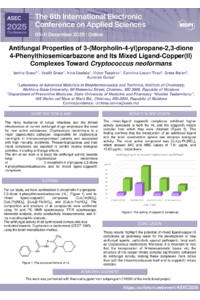
The rising incidence of fungal infections and the limited effectiveness of current antifungal drugs emphasize the need for new active substances. Cryptococcus neoformans is a major opportunistic pathogen, responsible for cryptococcal meningitis in immunocompromised patients and associated with high mortality worldwide. Thiosemicarbazones and their metal complexes are reported to exhibit diverse biological activities, including antifungal effects.
For our study, we have synthesized 3-(morpholin-4-yl)propane-2,3-dione 4-phenylthiosemicarbazone (HL) and its mixed ligand–copper(II) complexes [CuL(Im)NO3], [CuL(Py)NO3], [CuL(β-Pic)NO3], and [CuL(γ-Pic)NO3]. The composition and structure of all compounds were confirmed using 1H and 13C NMR, FTIR, elemental analysis, molar conductivity measurements, and X-ray crystallographic analysis.
The antifungal activity of all synthesized compounds was evaluated towards Cryptococcus neoformans (CECT 1043) using the broth microdilution method. The mixed ligand–copper(II) complexes exhibited higher activity compared to both the HL and the copper(II) nitrate complex from which they were obtained. This finding confirms that the introduction of an additional ligand into the inner coordination sphere can enhance biological activity. The most active compound was [CuL(γ-Pic)NO3], which showed MIC and MBC values of 7.81 µg/mL and 15.63 µg/mL, respectively.
These results highlight the potential of mixed ligand–copper(II) complexes as promising leads for the development of new antifungal agents, particularly against pathogenic fungi such as Cryptococcus neoformans.
The work was performed with financial support from subprogram 010602 of the institutional project.
Keywords
Antifungal activity
Thiosemicarbazone
Pyruvamides
Copper(II) complexes
Poster
Graur_Poster.pdf
Optimizing Piezoelectric Performance of ZnO Nanowire Arrays through Integration with Metallic Substrates
Urea-modified activated carbons and their application in methylene blue removal