Event submissions
Published
This submission belongs to the session S2. Nanosciences, Chemistry and Materials Science of the event The 6th International Electronic Conference on Applied Sciences
Published date
03 Dec, 2025
Academic Editor
'%3e%3cpath%20d='M12.6657%2010.9104C12.4185%2010.325%2012.0599%209.79327%2011.6097%209.34482C11.1609%208.89508%2010.6293%208.5365%2010.0442%208.28888C10.0389%208.28626%2010.0337%208.28495%2010.0285%208.28233C10.8446%207.69279%2011.3752%206.73249%2011.3752%205.64904C11.3752%203.8542%209.92103%202.39999%208.1262%202.39999C6.33136%202.39999%204.87715%203.8542%204.87715%205.64904C4.87715%206.73249%205.40774%207.69279%206.22393%208.28364C6.21869%208.28626%206.21345%208.28757%206.20821%208.29019C5.62129%208.5378%205.09463%208.89284%204.64265%209.34613C4.1929%209.79493%203.83432%2010.3266%203.58671%2010.9117C3.34345%2011.4845%203.21226%2012.0987%203.20023%2012.7209C3.19988%2012.7349%203.20233%2012.7488%203.20744%2012.7619C3.21255%2012.7749%203.22022%2012.7867%203.22998%2012.7968C3.23975%2012.8068%203.25142%2012.8147%203.26431%2012.8202C3.2772%2012.8256%203.29105%2012.8284%203.30504%2012.8284H4.09109C4.14874%2012.8284%204.19459%2012.7825%204.1959%2012.7262C4.2221%2011.7148%204.62823%2010.7676%205.34617%2010.0497C6.08899%209.30683%207.0755%208.89808%208.1262%208.89808C9.17689%208.89808%2010.1634%209.30683%2010.9062%2010.0497C11.6242%2010.7676%2012.0303%2011.7148%2012.0565%2012.7262C12.0578%2012.7838%2012.1037%2012.8284%2012.1613%2012.8284H12.9474C12.9613%2012.8284%2012.9752%2012.8256%2012.9881%2012.8202C13.001%2012.8147%2013.0126%2012.8068%2013.0224%2012.7968C13.0322%2012.7867%2013.0398%2012.7749%2013.0449%2012.7619C13.0501%2012.7488%2013.0525%2012.7349%2013.0522%2012.7209C13.0391%2012.0947%2012.9094%2011.4855%2012.6657%2010.9104ZM8.1262%207.9024C7.52486%207.9024%206.9589%207.6679%206.53312%207.24211C6.10733%206.81633%205.87283%206.25037%205.87283%205.64904C5.87283%205.0477%206.10733%204.48174%206.53312%204.05596C6.9589%203.63018%207.52486%203.39567%208.1262%203.39567C8.72753%203.39567%209.29349%203.63018%209.71927%204.05596C10.1451%204.48174%2010.3796%205.0477%2010.3796%205.64904C10.3796%206.25037%2010.1451%206.81633%209.71927%207.24211C9.29349%207.6679%208.72753%207.9024%208.1262%207.9024Z'%20fill='%235D1EE1'/%3e%3c/g%3e%3c/svg%3e) Alberto Jiménez Suárez
Alberto Jiménez SuárezCitation
S.S. Millavithanachchi, M.D.K.M Gunasena, G.D.C.P. Galpaya, K.R. Koswattage, D.V.S. Kaluthanthri, Exploiting an Invasive Plant (Tithonia diversifolia) for Green Synthesis of CuO Nanoparticles: Petals vs. Leaves, in Proceedings of The 6th International Electronic Conference on Applied Sciences, 9 December–11 December 2025, MDPI: Basel, Switzerland
Share
Email
Facebook
Twitter
LinkedIn
Exploiting an Invasive Plant (Tithonia diversifolia) for Green Synthesis of CuO Nanoparticles: Petals vs. Leaves
'%3e%3cpath%20d='M12.6647%2010.9104C12.4176%2010.325%2012.0589%209.7933%2011.6088%209.34485C11.16%208.89511%2010.6283%208.53653%2010.0432%208.28891C10.038%208.28629%2010.0327%208.28498%2010.0275%208.28236C10.8437%207.69282%2011.3743%206.73252%2011.3743%205.64907C11.3743%203.85423%209.92005%202.40002%208.12522%202.40002C6.33038%202.40002%204.87618%203.85423%204.87618%205.64907C4.87618%206.73252%205.40677%207.69282%206.22296%208.28367C6.21772%208.28629%206.21248%208.2876%206.20724%208.29022C5.62031%208.53783%205.09365%208.89287%204.64167%209.34616C4.19192%209.79496%203.83334%2010.3266%203.58573%2010.9117C3.34247%2011.4846%203.21128%2012.0987%203.19925%2012.721C3.1989%2012.735%203.20135%2012.7489%203.20646%2012.7619C3.21157%2012.7749%203.21924%2012.7868%203.22901%2012.7968C3.23877%2012.8068%203.25045%2012.8148%203.26334%2012.8202C3.27623%2012.8256%203.29007%2012.8284%203.30406%2012.8284H4.09012C4.14776%2012.8284%204.19362%2012.7825%204.19493%2012.7262C4.22113%2011.7148%204.62726%2010.7676%205.34519%2010.0497C6.08802%209.30686%207.07452%208.89811%208.12522%208.89811C9.17592%208.89811%2010.1624%209.30686%2010.9052%2010.0497C11.6232%2010.7676%2012.0293%2011.7148%2012.0555%2012.7262C12.0568%2012.7839%2012.1027%2012.8284%2012.1603%2012.8284H12.9464C12.9604%2012.8284%2012.9742%2012.8256%2012.9871%2012.8202C13%2012.8148%2013.0117%2012.8068%2013.0214%2012.7968C13.0312%2012.7868%2013.0389%2012.7749%2013.044%2012.7619C13.0491%2012.7489%2013.0515%2012.735%2013.0512%2012.721C13.0381%2012.0947%2012.9084%2011.4856%2012.6647%2010.9104ZM8.12522%207.90243C7.52388%207.90243%206.95792%207.66793%206.53214%207.24215C6.10636%206.81636%205.87185%206.2504%205.87185%205.64907C5.87185%205.04773%206.10636%204.48177%206.53214%204.05599C6.95792%203.63021%207.52388%203.3957%208.12522%203.3957C8.72655%203.3957%209.29252%203.63021%209.7183%204.05599C10.1441%204.48177%2010.3786%205.04773%2010.3786%205.64907C10.3786%206.2504%2010.1441%206.81636%209.7183%207.24215C9.29252%207.66793%208.72655%207.90243%208.12522%207.90243Z'%20fill='%235D1EE1'/%3e%3c/g%3e%3c/svg%3e)
S.S. Millavithanachchi 1,2,3

M.D.K.M Gunasena 1,3
G.D.C.P. Galpaya 3
K.R. Koswattage 3,4
D.V.S. Kaluthanthri 5
1. Department of Biosystems Technology, Faculty of Technology, Sabaragamuwa University of Sri Lanka, Belihuloya 70140, Sri Lanka
2. Faculty of Graduate Studies, Sabaragamuwa University of Sri Lanka, Belihuloya 70140, Sri Lanka
3. Center for Nanodevice Fabrication and Characterization, Faculty of Technology, Sabaragamuwa University of Sri Lanka, Belihuloya 70140, Sri Lanka
4. Department of Engineering Technology, Faculty of Technology, Sabaragamuwa University of Sri Lanka, Belihuloya 70140, Sri Lanka
5. Department of Plant and Molecular Biology, Faculty of Science, University of Kelaniya, Kelaniya 11600, Sri Lanka
Abstract
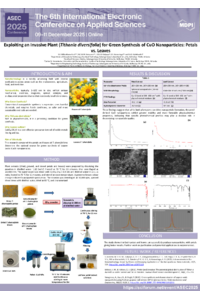
Green synthesis of nanoparticles provides an alternative to conventional methods, which often involve harsh conditions and hazardous chemicals. This study utilized Tithonia diversifolia, an invasive plant species in Sri Lanka. Rich in phytochemicals, it is a promising candidate for green synthesis while converting it into a useful application. CuSO₄·5H₂O (Copper (II) sulfate) was used as the metal precursor. This research compared the petals and leaves of T. diversifolia to determine the optimal source for green synthesis of copper oxide (CuO) nanoparticles. Plant extracts (dried, ground, and sieved petals and leaves) were prepared by dissolving the powders in distilled water [1:10 (w/v)], heating at 70 °C for 15 minutes, and then centrifuging at 10,000 rpm. The supernatant was mixed with CuSO₄·5H₂O (0.5 M) and distilled water in a 1:1:1 ratio, heated to 70 °C for 15 minutes, and stirred at room temperature. The colour change indicated nanoparticle production. The solution was centrifuged at 10,000 rpm, washed three times with distilled water, dried at 60 °C, and characterized. Results for petals and leaves were as follows: UV–Vis absorbances at 200–250 nm and 265–285 nm; SEM revealed spherical shapes (20-50 nm) and flake-like structures (~100 nm); FTIR confirmed Cu–O bonding at 500–650 cm⁻¹ with phytochemical residues; zeta potential values were -0.2 mV (petals) and -1.8 mV (leaves), with hydrodynamic diameters of 262 nm and 385 nm, respectively. The study confirms that both are effective, with petals showing improved characteristics. Further research on purification and applications is recommended.
Keywords
Characterization
CuO nanoparticles
green synthesis
Tithonia diversifolia
Poster
sahani - final.pdf
Biomimetic Catalyst for Solar CO2 Methanation: Harnessing Natural Pigments in a Halloysite–Kojic Acid Composite
Characteristics and Analytical Study of Ni-Zr-Melamine-Based Coordination Polymer/ Charcoal Composite