Event submissions
Published
This submission belongs to the session S1. Personalised nutrition for athletic performance of the event The 5th International Online Conference on Nutrients
Published date
05 Dec, 2025
Academic Editor
'%3e%3cpath%20d='M12.6657%2010.9104C12.4185%2010.325%2012.0599%209.79327%2011.6097%209.34482C11.1609%208.89508%2010.6293%208.5365%2010.0442%208.28888C10.0389%208.28626%2010.0337%208.28495%2010.0285%208.28233C10.8446%207.69279%2011.3752%206.73249%2011.3752%205.64904C11.3752%203.8542%209.92103%202.39999%208.1262%202.39999C6.33136%202.39999%204.87715%203.8542%204.87715%205.64904C4.87715%206.73249%205.40774%207.69279%206.22393%208.28364C6.21869%208.28626%206.21345%208.28757%206.20821%208.29019C5.62129%208.5378%205.09463%208.89284%204.64265%209.34613C4.1929%209.79493%203.83432%2010.3266%203.58671%2010.9117C3.34345%2011.4845%203.21226%2012.0987%203.20023%2012.7209C3.19988%2012.7349%203.20233%2012.7488%203.20744%2012.7619C3.21255%2012.7749%203.22022%2012.7867%203.22998%2012.7968C3.23975%2012.8068%203.25142%2012.8147%203.26431%2012.8202C3.2772%2012.8256%203.29105%2012.8284%203.30504%2012.8284H4.09109C4.14874%2012.8284%204.19459%2012.7825%204.1959%2012.7262C4.2221%2011.7148%204.62823%2010.7676%205.34617%2010.0497C6.08899%209.30683%207.0755%208.89808%208.1262%208.89808C9.17689%208.89808%2010.1634%209.30683%2010.9062%2010.0497C11.6242%2010.7676%2012.0303%2011.7148%2012.0565%2012.7262C12.0578%2012.7838%2012.1037%2012.8284%2012.1613%2012.8284H12.9474C12.9613%2012.8284%2012.9752%2012.8256%2012.9881%2012.8202C13.001%2012.8147%2013.0126%2012.8068%2013.0224%2012.7968C13.0322%2012.7867%2013.0398%2012.7749%2013.0449%2012.7619C13.0501%2012.7488%2013.0525%2012.7349%2013.0522%2012.7209C13.0391%2012.0947%2012.9094%2011.4855%2012.6657%2010.9104ZM8.1262%207.9024C7.52486%207.9024%206.9589%207.6679%206.53312%207.24211C6.10733%206.81633%205.87283%206.25037%205.87283%205.64904C5.87283%205.0477%206.10733%204.48174%206.53312%204.05596C6.9589%203.63018%207.52486%203.39567%208.1262%203.39567C8.72753%203.39567%209.29349%203.63018%209.71927%204.05596C10.1451%204.48174%2010.3796%205.0477%2010.3796%205.64904C10.3796%206.25037%2010.1451%206.81633%209.71927%207.24211C9.29349%207.6679%208.72753%207.9024%208.1262%207.9024Z'%20fill='%235D1EE1'/%3e%3c/g%3e%3c/svg%3e) Mauro Lombardo
Mauro LombardoCitation
Jadala Shankaraswamy, Development and evaluation of plant-based 3D-printed oral dispersible films for personalized nutrition for athletes, in Proceedings of The 5th International Online Conference on Nutrients, 10 December–12 December 2025, MDPI: Basel, Switzerland
Share
Email
Facebook
Twitter
LinkedIn
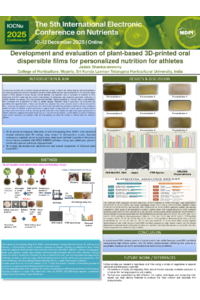
Development and evaluation of plant-based 3D-printed oral dispersible films for personalized nutrition for athletes

Jadala Shankaraswamy 1
1. Department of Fruit Science, College of Horticulture, Mojerla, Sri Konda Laxman Telangana Horticultural University, Wanaparthy, Telangana-509382, India
Abstract
In athletes, perspiration depletes reserves of minerals and electrolytes and oxidative stress increases with effort, and is accompanied by muscle fatigue, cellular damage, and impaired immunity. Athletes often use artificial supplements in order to correct mineral deficiency; however, they also pose risks related to bioavailability and potential toxicity. However, it is emphasized that sports nutrition is not a one-size-fits-all solution, as each athlete has specific nutritional needs. Hence, nutritional customization with 3D food printing can allow for the creation of tailored food for individual athletes. In the present investigation, oral disintegrating films (ODFs) were developed through extrusion-based 3D printing using extracts of Alternanthera sessilis; Sauropus androgynous, popularly known as multivitamin plant leaves; and extracts of the fruit Momordica dioica combined with HPMC K4M/E5, pullulan, moringa gum, ghatti gum, glycerol, roselle calyx powder, and fructo-oligosaccharide. The fabricated ODFs displayed consistent thicknesses (0.228 ± 0.008 mm to 0.340 ± 0.012 mm), rapid disintegration (15.23 ± 0.53 to 36.545 ± 0.65 s), and strong organoleptic scores (92.4 ± 1.60 to 91.2 ± 4.18/100). Moisture content (7.50 ± 0.13 to 6.154 ± 0.21%) and swelling index (26.68 ± 0.92 to 40.40 ± 2.80%) supported stability and mucosal compatibility. SEM images of all formulations revealed a uniform matrix with irregular depressions. FTIR confirmed functional groups such as C–O–C, phenolic O–H, and carbonyls, common among all the formulations, with H-bonded O-H bond vibration in sauropus-based films. ICP-MS identified macro elements such as K: 568.21, Na: 222.92, Mg: 72.23, and Ca: 19.74 mg/100g in Alternanthera-based ODFs; K: 137.41, Na: 218.15, Mg: 151.11, and Ca: 32.95 mg/100g in Sauropus; and K: 537.34, Na: 187.09, Mg: 65.65, and Ca: 37.97 mg/100g in Momordica-based films, and trace microelements Fe, Zn, Cu, Se, Mn, Cr, and Co were also identified. A. sessilis-based ODFs showed superior physicochemical traits, while Sauropus-based ODFs exhibited comparatively high mineral content, and 136 distinct phytonutrients (phytochemicals) with potential antioxidant potential, confirming their promise as sustainable, bioactive carriers for personalized nutrient delivery in athletes.
Keywords
3D Food printing
plant based nutrition
Oral dispersible films
Sauropus androgynous
Alternanthera sessilis
Momordica dioica
Poster
MDPI-ICONu-2025-Jadala Shankaraswamy.pdf
Genetic Profiling of Inflammation, Connective Tissue, and One-Carbon Metabolism Genes in Athletes: A Hypothesis-Based Perspective on Personalized Nutrition
Do you know body composition and dietary habits of combat sports athletes? A systematic review.