Event submissions
Published
This submission belongs to the session S1. Personalised nutrition for athletic performance of the event The 5th International Online Conference on Nutrients
Published date
05 Dec, 2025
Academic Editor
'%3e%3cpath%20d='M12.6657%2010.9104C12.4185%2010.325%2012.0599%209.79327%2011.6097%209.34482C11.1609%208.89508%2010.6293%208.5365%2010.0442%208.28888C10.0389%208.28626%2010.0337%208.28495%2010.0285%208.28233C10.8446%207.69279%2011.3752%206.73249%2011.3752%205.64904C11.3752%203.8542%209.92103%202.39999%208.1262%202.39999C6.33136%202.39999%204.87715%203.8542%204.87715%205.64904C4.87715%206.73249%205.40774%207.69279%206.22393%208.28364C6.21869%208.28626%206.21345%208.28757%206.20821%208.29019C5.62129%208.5378%205.09463%208.89284%204.64265%209.34613C4.1929%209.79493%203.83432%2010.3266%203.58671%2010.9117C3.34345%2011.4845%203.21226%2012.0987%203.20023%2012.7209C3.19988%2012.7349%203.20233%2012.7488%203.20744%2012.7619C3.21255%2012.7749%203.22022%2012.7867%203.22998%2012.7968C3.23975%2012.8068%203.25142%2012.8147%203.26431%2012.8202C3.2772%2012.8256%203.29105%2012.8284%203.30504%2012.8284H4.09109C4.14874%2012.8284%204.19459%2012.7825%204.1959%2012.7262C4.2221%2011.7148%204.62823%2010.7676%205.34617%2010.0497C6.08899%209.30683%207.0755%208.89808%208.1262%208.89808C9.17689%208.89808%2010.1634%209.30683%2010.9062%2010.0497C11.6242%2010.7676%2012.0303%2011.7148%2012.0565%2012.7262C12.0578%2012.7838%2012.1037%2012.8284%2012.1613%2012.8284H12.9474C12.9613%2012.8284%2012.9752%2012.8256%2012.9881%2012.8202C13.001%2012.8147%2013.0126%2012.8068%2013.0224%2012.7968C13.0322%2012.7867%2013.0398%2012.7749%2013.0449%2012.7619C13.0501%2012.7488%2013.0525%2012.7349%2013.0522%2012.7209C13.0391%2012.0947%2012.9094%2011.4855%2012.6657%2010.9104ZM8.1262%207.9024C7.52486%207.9024%206.9589%207.6679%206.53312%207.24211C6.10733%206.81633%205.87283%206.25037%205.87283%205.64904C5.87283%205.0477%206.10733%204.48174%206.53312%204.05596C6.9589%203.63018%207.52486%203.39567%208.1262%203.39567C8.72753%203.39567%209.29349%203.63018%209.71927%204.05596C10.1451%204.48174%2010.3796%205.0477%2010.3796%205.64904C10.3796%206.25037%2010.1451%206.81633%209.71927%207.24211C9.29349%207.6679%208.72753%207.9024%208.1262%207.9024Z'%20fill='%235D1EE1'/%3e%3c/g%3e%3c/svg%3e) Mauro Lombardo
Mauro LombardoCitation
Aureliusz Kosendiak, Nutritional Knowledge, Dietary Mistakes, and Supplement Use Among Amateur American Football Players, in Proceedings of The 5th International Online Conference on Nutrients, 10 December–12 December 2025, MDPI: Basel, Switzerland
Share
Email
Facebook
Twitter
LinkedIn
Nutritional Knowledge, Dietary Mistakes, and Supplement Use Among Amateur American Football Players

Aureliusz Kosendiak 1
1. Department of Health Studies, DSW University of Lower Silesia, Wroclaw, 53-611, Poland
Abstract
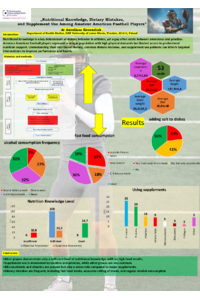
Background: Nutritional knowledge is a key determinant of dietary behavior in athletes, yet a gap often exists between awareness and practice. Amateur American football players represent a unique population with high physical demands but limited access to professional nutrition support. Understanding their nutritional literacy, common dietary mistakes, and supplement use patterns can inform targeted interventions to improve performance and health.
Aim: The aim of this study was to assess the level of nutritional knowledge, identify prevalent dietary mistakes, and analyze supplement use among amateur American football players.
Methods: A cross‑sectional survey was conducted among [n = 53] male amateur American football players aged 23 years. The questionnaire included items on meal frequency and timing, consumption of key food groups, intake of sugar‑sweetened beverages and fast food, self‑perceived nutritional knowledge, and supplement use. Descriptive statistics were applied to summarize the findings, and associations between knowledge level and dietary behaviors were explored.
Results: While a majority of players reported moderate to high self‑perceived nutritional knowledge, discrepancies were observed between knowledge and practice. Frequent dietary mistakes included irregular meal timing, excessive consumption of sugar‑sweetened beverages, and high fast food intake. Vegetable consumption was generally adequate, but protein sources were often limited to processed meats. Supplement use was reported by a substantial proportion of players, with protein powders, creatine, and multivitamins being the most common. However, supplement choices were not always aligned with evidence‑based recommendations or individual training needs.
Conclusions: Despite reasonable nutritional awareness, amateur American football players exhibit dietary patterns that may compromise performance and recovery. Education strategies should focus on translating knowledge into consistent healthy practices, reducing high‑sugar and high‑fat food intake, and promoting informed, evidence‑based supplement use.
Keywords
nutritional knowledge
dietary mistakes
supplement use
amateur athletes
American football
sports nutrition
Poster
Plakatnew konferencjafootbolsisciamerykanscy.pdf
Nutrition Knowledge, Dietary Habits, and Dietary Intake of Collegiate Athletes Living in Selected Rural and Urban Areas in the Philippines
Nutrigenomic Modeling of Performance Phenotypes in Sport: An Evidence-Based Systematic Review