Event submissions
Published
This submission belongs to the session S1. Personalised nutrition for athletic performance of the event The 5th International Online Conference on Nutrients
Published date
05 Dec, 2025
Academic Editor
'%3e%3cpath%20d='M12.6657%2010.9104C12.4185%2010.325%2012.0599%209.79327%2011.6097%209.34482C11.1609%208.89508%2010.6293%208.5365%2010.0442%208.28888C10.0389%208.28626%2010.0337%208.28495%2010.0285%208.28233C10.8446%207.69279%2011.3752%206.73249%2011.3752%205.64904C11.3752%203.8542%209.92103%202.39999%208.1262%202.39999C6.33136%202.39999%204.87715%203.8542%204.87715%205.64904C4.87715%206.73249%205.40774%207.69279%206.22393%208.28364C6.21869%208.28626%206.21345%208.28757%206.20821%208.29019C5.62129%208.5378%205.09463%208.89284%204.64265%209.34613C4.1929%209.79493%203.83432%2010.3266%203.58671%2010.9117C3.34345%2011.4845%203.21226%2012.0987%203.20023%2012.7209C3.19988%2012.7349%203.20233%2012.7488%203.20744%2012.7619C3.21255%2012.7749%203.22022%2012.7867%203.22998%2012.7968C3.23975%2012.8068%203.25142%2012.8147%203.26431%2012.8202C3.2772%2012.8256%203.29105%2012.8284%203.30504%2012.8284H4.09109C4.14874%2012.8284%204.19459%2012.7825%204.1959%2012.7262C4.2221%2011.7148%204.62823%2010.7676%205.34617%2010.0497C6.08899%209.30683%207.0755%208.89808%208.1262%208.89808C9.17689%208.89808%2010.1634%209.30683%2010.9062%2010.0497C11.6242%2010.7676%2012.0303%2011.7148%2012.0565%2012.7262C12.0578%2012.7838%2012.1037%2012.8284%2012.1613%2012.8284H12.9474C12.9613%2012.8284%2012.9752%2012.8256%2012.9881%2012.8202C13.001%2012.8147%2013.0126%2012.8068%2013.0224%2012.7968C13.0322%2012.7867%2013.0398%2012.7749%2013.0449%2012.7619C13.0501%2012.7488%2013.0525%2012.7349%2013.0522%2012.7209C13.0391%2012.0947%2012.9094%2011.4855%2012.6657%2010.9104ZM8.1262%207.9024C7.52486%207.9024%206.9589%207.6679%206.53312%207.24211C6.10733%206.81633%205.87283%206.25037%205.87283%205.64904C5.87283%205.0477%206.10733%204.48174%206.53312%204.05596C6.9589%203.63018%207.52486%203.39567%208.1262%203.39567C8.72753%203.39567%209.29349%203.63018%209.71927%204.05596C10.1451%204.48174%2010.3796%205.0477%2010.3796%205.64904C10.3796%206.25037%2010.1451%206.81633%209.71927%207.24211C9.29349%207.6679%208.72753%207.9024%208.1262%207.9024Z'%20fill='%235D1EE1'/%3e%3c/g%3e%3c/svg%3e) David Nieman
David NiemanCitation
P. Barciela, A. Perez-Vazquez, M. Carpena, X. Reguera-López-de-la-Osa, I. Prieto-Lage, A. Gutiérrez-Santiago, M. A. Prieto, Nutrigenomic Modeling of Performance Phenotypes in Sport: An Evidence-Based Systematic Review, in Proceedings of The 5th International Online Conference on Nutrients, 10 December–12 December 2025, MDPI: Basel, Switzerland
Share
Email
Facebook
Twitter
LinkedIn
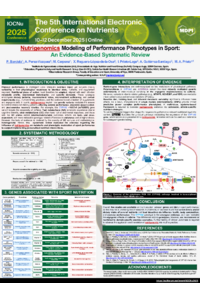
Nutrigenomic Modeling of Performance Phenotypes in Sport: An Evidence-Based Systematic Review

P. Barciela 1
'%3e%3cpath%20d='M12.6647%2010.9104C12.4176%2010.325%2012.0589%209.7933%2011.6088%209.34485C11.16%208.89511%2010.6283%208.53653%2010.0432%208.28891C10.038%208.28629%2010.0327%208.28498%2010.0275%208.28236C10.8437%207.69282%2011.3743%206.73252%2011.3743%205.64907C11.3743%203.85423%209.92005%202.40002%208.12522%202.40002C6.33038%202.40002%204.87618%203.85423%204.87618%205.64907C4.87618%206.73252%205.40677%207.69282%206.22296%208.28367C6.21772%208.28629%206.21248%208.2876%206.20724%208.29022C5.62031%208.53783%205.09365%208.89287%204.64167%209.34616C4.19192%209.79496%203.83334%2010.3266%203.58573%2010.9117C3.34247%2011.4846%203.21128%2012.0987%203.19925%2012.721C3.1989%2012.735%203.20135%2012.7489%203.20646%2012.7619C3.21157%2012.7749%203.21924%2012.7868%203.22901%2012.7968C3.23877%2012.8068%203.25045%2012.8148%203.26334%2012.8202C3.27623%2012.8256%203.29007%2012.8284%203.30406%2012.8284H4.09012C4.14776%2012.8284%204.19362%2012.7825%204.19493%2012.7262C4.22113%2011.7148%204.62726%2010.7676%205.34519%2010.0497C6.08802%209.30686%207.07452%208.89811%208.12522%208.89811C9.17592%208.89811%2010.1624%209.30686%2010.9052%2010.0497C11.6232%2010.7676%2012.0293%2011.7148%2012.0555%2012.7262C12.0568%2012.7839%2012.1027%2012.8284%2012.1603%2012.8284H12.9464C12.9604%2012.8284%2012.9742%2012.8256%2012.9871%2012.8202C13%2012.8148%2013.0117%2012.8068%2013.0214%2012.7968C13.0312%2012.7868%2013.0389%2012.7749%2013.044%2012.7619C13.0491%2012.7489%2013.0515%2012.735%2013.0512%2012.721C13.0381%2012.0947%2012.9084%2011.4856%2012.6647%2010.9104ZM8.12522%207.90243C7.52388%207.90243%206.95792%207.66793%206.53214%207.24215C6.10636%206.81636%205.87185%206.2504%205.87185%205.64907C5.87185%205.04773%206.10636%204.48177%206.53214%204.05599C6.95792%203.63021%207.52388%203.3957%208.12522%203.3957C8.72655%203.3957%209.29252%203.63021%209.7183%204.05599C10.1441%204.48177%2010.3786%205.04773%2010.3786%205.64907C10.3786%206.2504%2010.1441%206.81636%209.7183%207.24215C9.29252%207.66793%208.72655%207.90243%208.12522%207.90243Z'%20fill='%235D1EE1'/%3e%3c/g%3e%3c/svg%3e)
A. Perez-Vazquez 1

M. Carpena 1
X. Reguera-López-de-la-Osa 2

I. Prieto-Lage 3

A. Gutiérrez-Santiago 3

M. A. Prieto 1
1. Instituto de Agroecoloxía e Alimentación (IAA), Universidade de Vigo, Nutrition and Food
Group (NuFoG), Campus Auga, 32004 Ourense, Spain.
2. Education, Physical Activity and Health Research Group (Gies10-DE3), Galicia Sur Health Research
Institute (IIS Galicia Sur), SERGAS-UVIGO, 36208 Vigo, Spain.
3. Observational Research Group, Faculty of Education and Sport, University of Vigo, 36005 Pontevedra, Spain.
Abstract
The efficacy of high-intensity physical workouts can be optimized by tailoring nutritional interventions specific to an athlete's genetic traits to account for intrinsic and extrinsic factors. In the area of sports, nutrigenomics focuses on how genetic variants modulate the response to nutrients and dietary supplements, thereby affecting endurance, power, and recovery. For instance, the ACTN3 and ACE genes are linked to key performance (Pe) factors, while the COL1A1 and COL5A1 polymorphisms are correlated with a higher predisposition to tendon injuries. Following PRISMA guidelines, a systematic review was conducted in the PubMed, Scopus, and Web of Science databases (2019-2024). Then, articles establishing a relationship between genetic variants, nutrient response, and athletic Pe were screened. The objective of this review was to critically evaluate the existing body of evidence on the influence of nutrigenomics on metabolic and phenotypic modulation of athletic Pe to support the implementation of personalized nutrition (PN) interventions. The data reveal over 250 genetic variants linked to athletic phenotypes. Of these, the most robust evidence is related to the ergogenic effect of caffeine on Pe, which is modulated by variants of the CYP1A2 gene. Statistically significant interactions were also found between genotypes and responsiveness to nutrients such as fatty acids, antioxidants, and proteins, all of which impact recovery and injury prevention. Yet, methodological heterogeneity, insufficient cohorts of athletes, ethical limitations, and costs restrict the direct application of these outcomes to clinical practice in sports.
Keywords
Genes
Nutrigenomics
Tailored nutrition
Sport performance
Phenotypic modulation
Poster
IOCNu 2025_sciforum-144160_PaulaBarciela.pdf
Nutritional Knowledge, Dietary Mistakes, and Supplement Use Among Amateur American Football Players
Effects of Early Time-Restricted Eating (eTRE) on Postural Mobility, Body Composition, and Energy Intake in Judo Athletes