Event submissions
Published
This submission belongs to the session S1. Personalised nutrition for athletic performance of the event The 5th International Online Conference on Nutrients
Published date
05 Dec, 2025
Academic Editor
'%3e%3cpath%20d='M12.6657%2010.9104C12.4185%2010.325%2012.0599%209.79327%2011.6097%209.34482C11.1609%208.89508%2010.6293%208.5365%2010.0442%208.28888C10.0389%208.28626%2010.0337%208.28495%2010.0285%208.28233C10.8446%207.69279%2011.3752%206.73249%2011.3752%205.64904C11.3752%203.8542%209.92103%202.39999%208.1262%202.39999C6.33136%202.39999%204.87715%203.8542%204.87715%205.64904C4.87715%206.73249%205.40774%207.69279%206.22393%208.28364C6.21869%208.28626%206.21345%208.28757%206.20821%208.29019C5.62129%208.5378%205.09463%208.89284%204.64265%209.34613C4.1929%209.79493%203.83432%2010.3266%203.58671%2010.9117C3.34345%2011.4845%203.21226%2012.0987%203.20023%2012.7209C3.19988%2012.7349%203.20233%2012.7488%203.20744%2012.7619C3.21255%2012.7749%203.22022%2012.7867%203.22998%2012.7968C3.23975%2012.8068%203.25142%2012.8147%203.26431%2012.8202C3.2772%2012.8256%203.29105%2012.8284%203.30504%2012.8284H4.09109C4.14874%2012.8284%204.19459%2012.7825%204.1959%2012.7262C4.2221%2011.7148%204.62823%2010.7676%205.34617%2010.0497C6.08899%209.30683%207.0755%208.89808%208.1262%208.89808C9.17689%208.89808%2010.1634%209.30683%2010.9062%2010.0497C11.6242%2010.7676%2012.0303%2011.7148%2012.0565%2012.7262C12.0578%2012.7838%2012.1037%2012.8284%2012.1613%2012.8284H12.9474C12.9613%2012.8284%2012.9752%2012.8256%2012.9881%2012.8202C13.001%2012.8147%2013.0126%2012.8068%2013.0224%2012.7968C13.0322%2012.7867%2013.0398%2012.7749%2013.0449%2012.7619C13.0501%2012.7488%2013.0525%2012.7349%2013.0522%2012.7209C13.0391%2012.0947%2012.9094%2011.4855%2012.6657%2010.9104ZM8.1262%207.9024C7.52486%207.9024%206.9589%207.6679%206.53312%207.24211C6.10733%206.81633%205.87283%206.25037%205.87283%205.64904C5.87283%205.0477%206.10733%204.48174%206.53312%204.05596C6.9589%203.63018%207.52486%203.39567%208.1262%203.39567C8.72753%203.39567%209.29349%203.63018%209.71927%204.05596C10.1451%204.48174%2010.3796%205.0477%2010.3796%205.64904C10.3796%206.25037%2010.1451%206.81633%209.71927%207.24211C9.29349%207.6679%208.72753%207.9024%208.1262%207.9024Z'%20fill='%235D1EE1'/%3e%3c/g%3e%3c/svg%3e) David Nieman
David NiemanCitation
Maha Gasmi, Antonella Muscella, Falak Zeb, Riadh Khalifa, Effects of Early Time-Restricted Eating (eTRE) on Postural Mobility, Body Composition, and Energy Intake in Judo Athletes, in Proceedings of The 5th International Online Conference on Nutrients, 10 December–12 December 2025, MDPI: Basel, Switzerland
Share
Email
Facebook
Twitter
LinkedIn
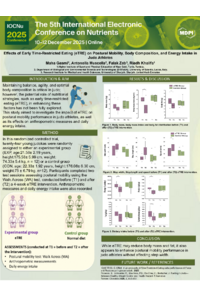
Effects of Early Time-Restricted Eating (eTRE) on Postural Mobility, Body Composition, and Energy Intake in Judo Athletes

Maha Gasmi 1

Antonella Muscella 2

Falak Zeb 3
'%3e%3cpath%20d='M12.6647%2010.9104C12.4176%2010.325%2012.0589%209.7933%2011.6088%209.34485C11.16%208.89511%2010.6283%208.53653%2010.0432%208.28891C10.038%208.28629%2010.0327%208.28498%2010.0275%208.28236C10.8437%207.69282%2011.3743%206.73252%2011.3743%205.64907C11.3743%203.85423%209.92005%202.40002%208.12522%202.40002C6.33038%202.40002%204.87618%203.85423%204.87618%205.64907C4.87618%206.73252%205.40677%207.69282%206.22296%208.28367C6.21772%208.28629%206.21248%208.2876%206.20724%208.29022C5.62031%208.53783%205.09365%208.89287%204.64167%209.34616C4.19192%209.79496%203.83334%2010.3266%203.58573%2010.9117C3.34247%2011.4846%203.21128%2012.0987%203.19925%2012.721C3.1989%2012.735%203.20135%2012.7489%203.20646%2012.7619C3.21157%2012.7749%203.21924%2012.7868%203.22901%2012.7968C3.23877%2012.8068%203.25045%2012.8148%203.26334%2012.8202C3.27623%2012.8256%203.29007%2012.8284%203.30406%2012.8284H4.09012C4.14776%2012.8284%204.19362%2012.7825%204.19493%2012.7262C4.22113%2011.7148%204.62726%2010.7676%205.34519%2010.0497C6.08802%209.30686%207.07452%208.89811%208.12522%208.89811C9.17592%208.89811%2010.1624%209.30686%2010.9052%2010.0497C11.6232%2010.7676%2012.0293%2011.7148%2012.0555%2012.7262C12.0568%2012.7839%2012.1027%2012.8284%2012.1603%2012.8284H12.9464C12.9604%2012.8284%2012.9742%2012.8256%2012.9871%2012.8202C13%2012.8148%2013.0117%2012.8068%2013.0214%2012.7968C13.0312%2012.7868%2013.0389%2012.7749%2013.044%2012.7619C13.0491%2012.7489%2013.0515%2012.735%2013.0512%2012.721C13.0381%2012.0947%2012.9084%2011.4856%2012.6647%2010.9104ZM8.12522%207.90243C7.52388%207.90243%206.95792%207.66793%206.53214%207.24215C6.10636%206.81636%205.87185%206.2504%205.87185%205.64907C5.87185%205.04773%206.10636%204.48177%206.53214%204.05599C6.95792%203.63021%207.52388%203.3957%208.12522%203.3957C8.72655%203.3957%209.29252%203.63021%209.7183%204.05599C10.1441%204.48177%2010.3786%205.04773%2010.3786%205.64907C10.3786%206.2504%2010.1441%206.81636%209.7183%207.24215C9.29252%207.66793%208.72655%207.90243%208.12522%207.90243Z'%20fill='%235D1EE1'/%3e%3c/g%3e%3c/svg%3e)
Riadh Khalifa 1
1. Biology Department, Higher Institute of Sport and Physical Education of Ksar Said, Manouba, 2010, Tunisia
2. Department of Biological and Environmental Science and Technologies (DiSTeBA), University of Salento, Lecce, 73100, Italy
3. Medical and Health Sciences Department, Research Institute for Medical and Health Sciences, University of Sharjah, Sharjah, United Arab Emirates
Abstract
Background: Maintaining balance, agility, and optimal body composition is critical in judo, but the potential role of nutritional strategies such as early time-restricted eating (eTRE) in enhancing these factors has not been fully explored.
Aims: This study aimed to investigate the impact of eTRE on postural mobility performance in judo athletes, along with changes in anthropometric measures and daily energy intake.
Methods: In this randomized controlled trial, twenty-four young judokas were randomly assigned to either an experimental group (EXP, 21.58± 2.19 years, 175.58± 5.99 cm, 74.33± 5.4 kg, n = 12) or a control group (CON, 22.33± 1.92 years, 176.08± 6.30 cm, 75 ± 6.79 kg, n=12). Participants completed two test sessions assessing postural mobility using the Walk Across (WA), conducted before (T1) and after (T2) a 4-week eTRE intervention. Anthropometric measures and daily energy intake were also recorded.
Results: At T2, the EXP group showed significant reductions in total daily energy intake, body mass, body mass index, and body fat compared with the CON group (p < 0.001 for all). In the WA test, both movement speed and step length increased from T1 to T2 in the EXP group and were significantly greater than those of the CON group. Post-intervention, movement speed was 86.65 ± 6.06 cm/s in the EXP group vs. 82.65 ± 4.95 cm/s in the CON group (p < 0.001), while step length was 75.64 ± 3.19 cm in the EXP group vs. 71.24 ± 5.15 cm in the CON group (p = 0.003). Step width showed no significant difference between the groups.
Conclusion: While eTRE may reduce body mass and fat, it also appears to enhance postural mobility performance in judo athletes without affecting step width.
Keywords
early Time-Restricted Eating
Fasting
Physical performance
Judo
Balance
Agility
Poster
Poster mdpi 2025.pdf
Nutrigenomic Modeling of Performance Phenotypes in Sport: An Evidence-Based Systematic Review
Food and beverage intake habits in handball players: relationship with gender and competitive level