Event submissions
Published
This submission belongs to the session S2. Innovations in sports supplements of the event The 5th International Online Conference on Nutrients
Published date
05 Dec, 2025
Academic Editor
'%3e%3cpath%20d='M12.6657%2010.9104C12.4185%2010.325%2012.0599%209.79327%2011.6097%209.34482C11.1609%208.89508%2010.6293%208.5365%2010.0442%208.28888C10.0389%208.28626%2010.0337%208.28495%2010.0285%208.28233C10.8446%207.69279%2011.3752%206.73249%2011.3752%205.64904C11.3752%203.8542%209.92103%202.39999%208.1262%202.39999C6.33136%202.39999%204.87715%203.8542%204.87715%205.64904C4.87715%206.73249%205.40774%207.69279%206.22393%208.28364C6.21869%208.28626%206.21345%208.28757%206.20821%208.29019C5.62129%208.5378%205.09463%208.89284%204.64265%209.34613C4.1929%209.79493%203.83432%2010.3266%203.58671%2010.9117C3.34345%2011.4845%203.21226%2012.0987%203.20023%2012.7209C3.19988%2012.7349%203.20233%2012.7488%203.20744%2012.7619C3.21255%2012.7749%203.22022%2012.7867%203.22998%2012.7968C3.23975%2012.8068%203.25142%2012.8147%203.26431%2012.8202C3.2772%2012.8256%203.29105%2012.8284%203.30504%2012.8284H4.09109C4.14874%2012.8284%204.19459%2012.7825%204.1959%2012.7262C4.2221%2011.7148%204.62823%2010.7676%205.34617%2010.0497C6.08899%209.30683%207.0755%208.89808%208.1262%208.89808C9.17689%208.89808%2010.1634%209.30683%2010.9062%2010.0497C11.6242%2010.7676%2012.0303%2011.7148%2012.0565%2012.7262C12.0578%2012.7838%2012.1037%2012.8284%2012.1613%2012.8284H12.9474C12.9613%2012.8284%2012.9752%2012.8256%2012.9881%2012.8202C13.001%2012.8147%2013.0126%2012.8068%2013.0224%2012.7968C13.0322%2012.7867%2013.0398%2012.7749%2013.0449%2012.7619C13.0501%2012.7488%2013.0525%2012.7349%2013.0522%2012.7209C13.0391%2012.0947%2012.9094%2011.4855%2012.6657%2010.9104ZM8.1262%207.9024C7.52486%207.9024%206.9589%207.6679%206.53312%207.24211C6.10733%206.81633%205.87283%206.25037%205.87283%205.64904C5.87283%205.0477%206.10733%204.48174%206.53312%204.05596C6.9589%203.63018%207.52486%203.39567%208.1262%203.39567C8.72753%203.39567%209.29349%203.63018%209.71927%204.05596C10.1451%204.48174%2010.3796%205.0477%2010.3796%205.64904C10.3796%206.25037%2010.1451%206.81633%209.71927%207.24211C9.29349%207.6679%208.72753%207.9024%208.1262%207.9024Z'%20fill='%235D1EE1'/%3e%3c/g%3e%3c/svg%3e) David Nieman
David NiemanCitation
Ángeles Sulvarán Trigueros, Viridiana del Carmen Cruz Zamudio, Fabiola Luna Vázquez, Valentín Varela Floriano, Esteban Santacruz Martínez, Julia Rodríguez Castelán, Preclinical Evaluation of the Consumption of High-Protein Vegetable-based Cookies, in Proceedings of The 5th International Online Conference on Nutrients, 10 December–12 December 2025, MDPI: Basel, Switzerland
Share
Email
Facebook
Twitter
LinkedIn
Preclinical Evaluation of the Consumption of High-Protein Vegetable-based Cookies
'%3e%3cpath%20d='M12.6647%2010.9104C12.4176%2010.325%2012.0589%209.7933%2011.6088%209.34485C11.16%208.89511%2010.6283%208.53653%2010.0432%208.28891C10.038%208.28629%2010.0327%208.28498%2010.0275%208.28236C10.8437%207.69282%2011.3743%206.73252%2011.3743%205.64907C11.3743%203.85423%209.92005%202.40002%208.12522%202.40002C6.33038%202.40002%204.87618%203.85423%204.87618%205.64907C4.87618%206.73252%205.40677%207.69282%206.22296%208.28367C6.21772%208.28629%206.21248%208.2876%206.20724%208.29022C5.62031%208.53783%205.09365%208.89287%204.64167%209.34616C4.19192%209.79496%203.83334%2010.3266%203.58573%2010.9117C3.34247%2011.4846%203.21128%2012.0987%203.19925%2012.721C3.1989%2012.735%203.20135%2012.7489%203.20646%2012.7619C3.21157%2012.7749%203.21924%2012.7868%203.22901%2012.7968C3.23877%2012.8068%203.25045%2012.8148%203.26334%2012.8202C3.27623%2012.8256%203.29007%2012.8284%203.30406%2012.8284H4.09012C4.14776%2012.8284%204.19362%2012.7825%204.19493%2012.7262C4.22113%2011.7148%204.62726%2010.7676%205.34519%2010.0497C6.08802%209.30686%207.07452%208.89811%208.12522%208.89811C9.17592%208.89811%2010.1624%209.30686%2010.9052%2010.0497C11.6232%2010.7676%2012.0293%2011.7148%2012.0555%2012.7262C12.0568%2012.7839%2012.1027%2012.8284%2012.1603%2012.8284H12.9464C12.9604%2012.8284%2012.9742%2012.8256%2012.9871%2012.8202C13%2012.8148%2013.0117%2012.8068%2013.0214%2012.7968C13.0312%2012.7868%2013.0389%2012.7749%2013.044%2012.7619C13.0491%2012.7489%2013.0515%2012.735%2013.0512%2012.721C13.0381%2012.0947%2012.9084%2011.4856%2012.6647%2010.9104ZM8.12522%207.90243C7.52388%207.90243%206.95792%207.66793%206.53214%207.24215C6.10636%206.81636%205.87185%206.2504%205.87185%205.64907C5.87185%205.04773%206.10636%204.48177%206.53214%204.05599C6.95792%203.63021%207.52388%203.3957%208.12522%203.3957C8.72655%203.3957%209.29252%203.63021%209.7183%204.05599C10.1441%204.48177%2010.3786%205.04773%2010.3786%205.64907C10.3786%206.2504%2010.1441%206.81636%209.7183%207.24215C9.29252%207.66793%208.72655%207.90243%208.12522%207.90243Z'%20fill='%235D1EE1'/%3e%3c/g%3e%3c/svg%3e)
Ángeles Sulvarán Trigueros 1
Viridiana del Carmen Cruz Zamudio 1
Fabiola Luna Vázquez 2
Valentín Varela Floriano 2,3
Esteban Santacruz Martínez 4
Julia Rodríguez Castelán 5
1. Bachelor of Nutrition and Food Science, Cristobal Colon University (UCC), Veracruz, Ver. Mexico
2. Department of Nutrition and Food Science, Cristobal Colon University(UCC), Veracruz, Ver. Mexico
3. Department of Health Sciences, Professional Development University (UNIDEP). Veracruz, Ver., Mexico
4. Department of cellular biology and physiology, Biomedic Research Institute, National Autonomous University of México (UNAM). México city, Mexico
5. Postgraduate coordination, Department of Health Sciences, Cristobal Colon University (UCC). Veracruz, Ver., Mexico
Abstract
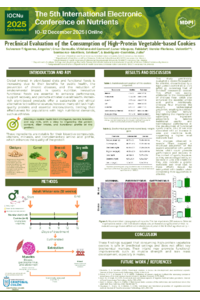
Introduction. In the current field of sports nutrition, developing functional foods through innovation is crucial for enhancing physical performance, aiding recovery, and promoting overall athlete health. Plant-based protein-rich products present a promising alternative to traditional sources, offering nutritional benefits, reducing environmental impact, and gaining acceptance among consumers seeking sustainable and ethical options. This study focused on creating high-protein plant-based cookies and conducting a preclinical evaluation of their effects.
Material and Methods. The developed cookies have a high crude protein content (13.32 g), which, according to current regulations, classifies them as a high-protein product. They also contain 12.92 g of fat, 6.78 g of fiber, and 2.9 g of ashes. The biological assessment involved 12-week-old Wistar rats (6 males and 6 females) with an average weight of 200 g, divided into two groups: one experimental group that received cookies and one control group maintained on a standard diet. The product was administered daily for 15 days at an average dose of 5.3 g/kg body weight/day of cookies, based on an estimated human intake of 60 g/day for a 70 kg person, using the Food and Drug Administration (FDA) recommended interspecies correction factor. Physiological parameters such as body weight, glucose, cholesterol, triglycerides, urea, creatinine, muscle thickness in the biceps, gastrocnemius, and abdomen, as well as grip strength, were monitored. Statistical analysis was performed with GraphPad Prism software V6.
Results. No significant changes were observed in biochemical parameters between baseline and post-treatment or compared with the control group. However, increased muscle thickness was found in the biceps and gastrocnemius of male rats, and grip strength improved in all treated animals.
Conclusions. These findings suggest that consuming high-protein vegetable cookies is safe in preclinical settings and does not affect key biochemical markers. Their intake may promote functional improvements such as muscle strength and lean mass development, especially in males.
Keywords
Vegetable protein
muscle
diet
grip strength
Poster
2025. Sulvaran. Nutrients.pdf
EFFECTS OF BETA-ALANINE SUPPLEMENTATION ON NEUROMUSCULAR AND CARDIOVASCULAR PERFORMANCE IN FEMALE RUGBY PLAYERS
Nutritional characterization of Lupinus angustifolius flour and protein isolate as sustainable plant-based ingredients for sports supplements