Event submissions
Published
This submission belongs to the session S5. Sustainable diets in sport: Balancing performance and health of the event The 5th International Online Conference on Nutrients
Published date
05 Dec, 2025
Academic Editor
'%3e%3cpath%20d='M12.6657%2010.9104C12.4185%2010.325%2012.0599%209.79327%2011.6097%209.34482C11.1609%208.89508%2010.6293%208.5365%2010.0442%208.28888C10.0389%208.28626%2010.0337%208.28495%2010.0285%208.28233C10.8446%207.69279%2011.3752%206.73249%2011.3752%205.64904C11.3752%203.8542%209.92103%202.39999%208.1262%202.39999C6.33136%202.39999%204.87715%203.8542%204.87715%205.64904C4.87715%206.73249%205.40774%207.69279%206.22393%208.28364C6.21869%208.28626%206.21345%208.28757%206.20821%208.29019C5.62129%208.5378%205.09463%208.89284%204.64265%209.34613C4.1929%209.79493%203.83432%2010.3266%203.58671%2010.9117C3.34345%2011.4845%203.21226%2012.0987%203.20023%2012.7209C3.19988%2012.7349%203.20233%2012.7488%203.20744%2012.7619C3.21255%2012.7749%203.22022%2012.7867%203.22998%2012.7968C3.23975%2012.8068%203.25142%2012.8147%203.26431%2012.8202C3.2772%2012.8256%203.29105%2012.8284%203.30504%2012.8284H4.09109C4.14874%2012.8284%204.19459%2012.7825%204.1959%2012.7262C4.2221%2011.7148%204.62823%2010.7676%205.34617%2010.0497C6.08899%209.30683%207.0755%208.89808%208.1262%208.89808C9.17689%208.89808%2010.1634%209.30683%2010.9062%2010.0497C11.6242%2010.7676%2012.0303%2011.7148%2012.0565%2012.7262C12.0578%2012.7838%2012.1037%2012.8284%2012.1613%2012.8284H12.9474C12.9613%2012.8284%2012.9752%2012.8256%2012.9881%2012.8202C13.001%2012.8147%2013.0126%2012.8068%2013.0224%2012.7968C13.0322%2012.7867%2013.0398%2012.7749%2013.0449%2012.7619C13.0501%2012.7488%2013.0525%2012.7349%2013.0522%2012.7209C13.0391%2012.0947%2012.9094%2011.4855%2012.6657%2010.9104ZM8.1262%207.9024C7.52486%207.9024%206.9589%207.6679%206.53312%207.24211C6.10733%206.81633%205.87283%206.25037%205.87283%205.64904C5.87283%205.0477%206.10733%204.48174%206.53312%204.05596C6.9589%203.63018%207.52486%203.39567%208.1262%203.39567C8.72753%203.39567%209.29349%203.63018%209.71927%204.05596C10.1451%204.48174%2010.3796%205.0477%2010.3796%205.64904C10.3796%206.25037%2010.1451%206.81633%209.71927%207.24211C9.29349%207.6679%208.72753%207.9024%208.1262%207.9024Z'%20fill='%235D1EE1'/%3e%3c/g%3e%3c/svg%3e) Mauro Lombardo
Mauro LombardoCitation
Joanna Kowalkowska, Association between severity of anxiety and dietary patterns among university students, in Proceedings of The 5th International Online Conference on Nutrients, 10 December–12 December 2025, MDPI: Basel, Switzerland
Share
Email
Facebook
Twitter
LinkedIn
Association between severity of anxiety and dietary patterns among university students

Joanna Kowalkowska 1
1. Department of Human Nutrition, Faculty of Food Science, University of Warmia and Mazury in Olsztyn, Olsztyn, Poland
Abstract
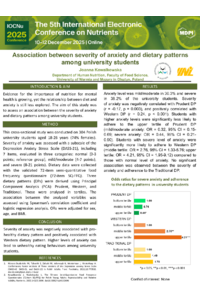
Introduction and objective: Evidence for the importance of nutrition for mental health is growing, yet the relationship between diet and anxiety is still underexplored. The aim of this study was to assess the association between the severity of anxiety and dietary patterns among university students.
Methods: This cross-sectional study was conducted on 304 Polish university students aged 18-26 years (74% female). Severity of anxiety was assessed using a subscale of the Depression Anxiety Stress Scale (DASS-21), including seven items, evaluated in three categories: normal (0-3 points; reference group), mild/moderate (4-7 points), and severe (8-21 points). Dietary data were collected using the validated 72-item semi-quantitative food frequency questionnaire (72-item SQ-FFQ). Three dietary patterns (DPs) were derived using Principal Component Analysis (PCA): Prudent, Western, and Traditional. These were analysed in tertiles. The association between the analysed variables was assessed using Spearman’s correlation coefficient and logistic regression analysis. ORs were adjusted for sex, age, and BMI.
Results: Anxiety level was mild/moderate in 30.3% and severe in 38.2% of the university students. Severity of anxiety was negatively correlated with Prudent DP (r= -0.17, p=0.003) and positively correlated with Western DP (r=0.24, p<0.001). Students with higher anxiety levels were significantly less likely to adhere to the upper tertile of Prudent DP (mild/moderate anxiety: OR = 0.32, 95% CI = 0.15-0.69; severe anxiety: OR=0.44, 95%CI=0.21-0.90). Students with severe levels of anxiety were significantly more likely to adhere to Western DP (middle tertile: OR=2.76, 95%CI=1.33-5.76; upper tertile: OR=4.21, 95%CI=1.95-9.12) compared to those with normal levels of anxiety. No significant association was observed between the severity of anxiety and adherence to the Traditional DP.
Conclusions: Severity of anxiety was negatively associated with pro-healthy dietary patterns and positively associated with Western dietary patterns. Higher levels of anxiety can lead to unhealthy eating behaviours among university students.
Keywords
anxiety
dietary patterns
food consumption frequency
young adults
Poster
MDPI_IOCNu Conference_Poster_Kowalkowska J_2025-11-08.pdf
Time-Restricted Eating versus Calorie Restriction for the Management of Metabolic Syndrome and Implications for Physical Performance: A Systematic Review and Meta-analysis
DIETARY AND HEALTH ASPECTS IN MEN EXCEEDING THE RECOMEMENDED DOSES OF DIETARY SUPPLEMENTS: A CROSS-SECTIONAL STUDY