Event submissions
Published
This submission belongs to the session S5. Sustainable diets in sport: Balancing performance and health of the event The 5th International Online Conference on Nutrients
Published date
05 Dec, 2025
Academic Editor
'%3e%3cpath%20d='M12.6657%2010.9104C12.4185%2010.325%2012.0599%209.79327%2011.6097%209.34482C11.1609%208.89508%2010.6293%208.5365%2010.0442%208.28888C10.0389%208.28626%2010.0337%208.28495%2010.0285%208.28233C10.8446%207.69279%2011.3752%206.73249%2011.3752%205.64904C11.3752%203.8542%209.92103%202.39999%208.1262%202.39999C6.33136%202.39999%204.87715%203.8542%204.87715%205.64904C4.87715%206.73249%205.40774%207.69279%206.22393%208.28364C6.21869%208.28626%206.21345%208.28757%206.20821%208.29019C5.62129%208.5378%205.09463%208.89284%204.64265%209.34613C4.1929%209.79493%203.83432%2010.3266%203.58671%2010.9117C3.34345%2011.4845%203.21226%2012.0987%203.20023%2012.7209C3.19988%2012.7349%203.20233%2012.7488%203.20744%2012.7619C3.21255%2012.7749%203.22022%2012.7867%203.22998%2012.7968C3.23975%2012.8068%203.25142%2012.8147%203.26431%2012.8202C3.2772%2012.8256%203.29105%2012.8284%203.30504%2012.8284H4.09109C4.14874%2012.8284%204.19459%2012.7825%204.1959%2012.7262C4.2221%2011.7148%204.62823%2010.7676%205.34617%2010.0497C6.08899%209.30683%207.0755%208.89808%208.1262%208.89808C9.17689%208.89808%2010.1634%209.30683%2010.9062%2010.0497C11.6242%2010.7676%2012.0303%2011.7148%2012.0565%2012.7262C12.0578%2012.7838%2012.1037%2012.8284%2012.1613%2012.8284H12.9474C12.9613%2012.8284%2012.9752%2012.8256%2012.9881%2012.8202C13.001%2012.8147%2013.0126%2012.8068%2013.0224%2012.7968C13.0322%2012.7867%2013.0398%2012.7749%2013.0449%2012.7619C13.0501%2012.7488%2013.0525%2012.7349%2013.0522%2012.7209C13.0391%2012.0947%2012.9094%2011.4855%2012.6657%2010.9104ZM8.1262%207.9024C7.52486%207.9024%206.9589%207.6679%206.53312%207.24211C6.10733%206.81633%205.87283%206.25037%205.87283%205.64904C5.87283%205.0477%206.10733%204.48174%206.53312%204.05596C6.9589%203.63018%207.52486%203.39567%208.1262%203.39567C8.72753%203.39567%209.29349%203.63018%209.71927%204.05596C10.1451%204.48174%2010.3796%205.0477%2010.3796%205.64904C10.3796%206.25037%2010.1451%206.81633%209.71927%207.24211C9.29349%207.6679%208.72753%207.9024%208.1262%207.9024Z'%20fill='%235D1EE1'/%3e%3c/g%3e%3c/svg%3e) Marika Massaro
Marika MassaroCitation
Ewa Niedzwiedzka, DIETARY AND HEALTH ASPECTS IN MEN EXCEEDING THE RECOMEMENDED DOSES OF DIETARY SUPPLEMENTS: A CROSS-SECTIONAL STUDY, in Proceedings of The 5th International Online Conference on Nutrients, 10 December–12 December 2025, MDPI: Basel, Switzerland
Share
Email
Facebook
Twitter
LinkedIn
DIETARY AND HEALTH ASPECTS IN MEN EXCEEDING THE RECOMEMENDED DOSES OF DIETARY SUPPLEMENTS: A CROSS-SECTIONAL STUDY

Ewa Niedzwiedzka 1
1. Department of Human Nutrition, Faculty of Food Sciences, University of Warmia and Mazury in Olsztyn, Sloneczna 45f, 10-718 Olsztyn, Poland
Abstract
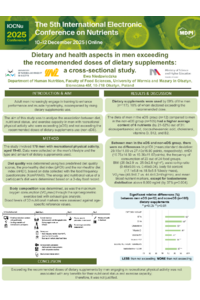
Background: Adult men increasingly engage in training to enhance performance and muscle hypertrophy, accompanied by rising dietary supplements use. Aim: The aim of this study was to analyse the association between diet, nutritional status, and exercise capacity in men with recreational physical activity who were exceeding (eDS) and not exceeding the recommended doses of dietary supplements use (non-eDS).
Methods: The study involved 170 men with recreational physical activity, aged 19-40. Data were collected on the men's lifestyle and the type and amount of dietary supplements used. Diet quality was determined using two predefined diet quality scores, the pro-healthy diet index (pHDI) and the non-healthy diet index (nHDI), based on data collected with the food frequency questionnaire (KomPAN®). The energy and nutritional value of a participant's diet were determined based on a 3-day food record. Body composition was determined, as was the maximum oxygen consumption (VO2max) through the spiroergometric exercise test with exhaust gas analysis. Blood levels of 33 nutritional markers were assessed against age-specific reference values.
Results: Dietary supplements were used by 69% of the men (n=117), 10% of whom declared exceeding the recommended dose. The diets of men in the eDS group (n=12) compared to men in the non-eDS group (n=105) had a higher average content of 6 nutrients (by 21-62%) out of 31: eicosapentaenoic acid, docosahexaenoic acid, cholesterol, vitamins D, B12, and B2. Between men in the eDS and non-eDS group, there were no differences in pHDI (mean±standard deviation: 29.15±11.60 vs 27.40±16.90points, respectively), nHDI (16.75±14.50 vs 15.36±11.07points), the frequency of consumption of 23 out of 24 food groups, BMI (26.0±2.9 vs. 25.0±2.6 kg/m²), waist-to-hip ratio (0.48±0.05 vs. 0.48±0.04), body fat content (17.1±6.8 vs. 18.5± 5.5 %body mass), VO2max (46.9±8.7 vs. 44.4±8.3ml/kg/min), and mean blood nutrient markers, except for testosterone distribution above 8,000 ng/ml (by 37%; p=0.004).
Conclusions: Exceeding the recommended doses of dietary supplements by men engaging in recreational physical activity was not associated with any benefits for their nutritional status and exercise capacity; therefore, it was not justified.
Keywords
dietary supplements
recreational physical activity
diet quality
nutritional status
body composition
Poster
Ewa Niedzwiedzka_Nutrients konf 2025_poster_28.11.2025.pdf
Association between severity of anxiety and dietary patterns among university students
Effects of a Maternal Diet Rich in Fiber and Polyphenols on the Lipid Metabolism of Mothers and Their Offspring Early and Later in Life.