Event submissions
Published
This submission belongs to the session S2. Digital Technologies and Artificial Intelligence in Prosthodontics of the event The 1st International Online Conference on Prosthesis
Published date
05 Dec, 2025
Academic Editor
'%3e%3cpath%20d='M12.6657%2010.9104C12.4185%2010.325%2012.0599%209.79327%2011.6097%209.34482C11.1609%208.89508%2010.6293%208.5365%2010.0442%208.28888C10.0389%208.28626%2010.0337%208.28495%2010.0285%208.28233C10.8446%207.69279%2011.3752%206.73249%2011.3752%205.64904C11.3752%203.8542%209.92103%202.39999%208.1262%202.39999C6.33136%202.39999%204.87715%203.8542%204.87715%205.64904C4.87715%206.73249%205.40774%207.69279%206.22393%208.28364C6.21869%208.28626%206.21345%208.28757%206.20821%208.29019C5.62129%208.5378%205.09463%208.89284%204.64265%209.34613C4.1929%209.79493%203.83432%2010.3266%203.58671%2010.9117C3.34345%2011.4845%203.21226%2012.0987%203.20023%2012.7209C3.19988%2012.7349%203.20233%2012.7488%203.20744%2012.7619C3.21255%2012.7749%203.22022%2012.7867%203.22998%2012.7968C3.23975%2012.8068%203.25142%2012.8147%203.26431%2012.8202C3.2772%2012.8256%203.29105%2012.8284%203.30504%2012.8284H4.09109C4.14874%2012.8284%204.19459%2012.7825%204.1959%2012.7262C4.2221%2011.7148%204.62823%2010.7676%205.34617%2010.0497C6.08899%209.30683%207.0755%208.89808%208.1262%208.89808C9.17689%208.89808%2010.1634%209.30683%2010.9062%2010.0497C11.6242%2010.7676%2012.0303%2011.7148%2012.0565%2012.7262C12.0578%2012.7838%2012.1037%2012.8284%2012.1613%2012.8284H12.9474C12.9613%2012.8284%2012.9752%2012.8256%2012.9881%2012.8202C13.001%2012.8147%2013.0126%2012.8068%2013.0224%2012.7968C13.0322%2012.7867%2013.0398%2012.7749%2013.0449%2012.7619C13.0501%2012.7488%2013.0525%2012.7349%2013.0522%2012.7209C13.0391%2012.0947%2012.9094%2011.4855%2012.6657%2010.9104ZM8.1262%207.9024C7.52486%207.9024%206.9589%207.6679%206.53312%207.24211C6.10733%206.81633%205.87283%206.25037%205.87283%205.64904C5.87283%205.0477%206.10733%204.48174%206.53312%204.05596C6.9589%203.63018%207.52486%203.39567%208.1262%203.39567C8.72753%203.39567%209.29349%203.63018%209.71927%204.05596C10.1451%204.48174%2010.3796%205.0477%2010.3796%205.64904C10.3796%206.25037%2010.1451%206.81633%209.71927%207.24211C9.29349%207.6679%208.72753%207.9024%208.1262%207.9024Z'%20fill='%235D1EE1'/%3e%3c/g%3e%3c/svg%3e) Marco Cicciù
Marco CicciùCitation
Roldan Castro Hernandez, David Gangitano Atilio, Alberto Moreno Pelluz, SUSTAINABLE 3D PRINTING : OPTIMIZING WASTE REDUCTION AND RECYCLING, in Proceedings of The 1st International Online Conference on Prosthesis, 10 December–12 December 2025, MDPI: Basel, Switzerland
Share
Email
Facebook
Twitter
LinkedIn
SUSTAINABLE 3D PRINTING : OPTIMIZING WASTE REDUCTION AND RECYCLING
'%3e%3cpath%20d='M12.6647%2010.9104C12.4176%2010.325%2012.0589%209.7933%2011.6088%209.34485C11.16%208.89511%2010.6283%208.53653%2010.0432%208.28891C10.038%208.28629%2010.0327%208.28498%2010.0275%208.28236C10.8437%207.69282%2011.3743%206.73252%2011.3743%205.64907C11.3743%203.85423%209.92005%202.40002%208.12522%202.40002C6.33038%202.40002%204.87618%203.85423%204.87618%205.64907C4.87618%206.73252%205.40677%207.69282%206.22296%208.28367C6.21772%208.28629%206.21248%208.2876%206.20724%208.29022C5.62031%208.53783%205.09365%208.89287%204.64167%209.34616C4.19192%209.79496%203.83334%2010.3266%203.58573%2010.9117C3.34247%2011.4846%203.21128%2012.0987%203.19925%2012.721C3.1989%2012.735%203.20135%2012.7489%203.20646%2012.7619C3.21157%2012.7749%203.21924%2012.7868%203.22901%2012.7968C3.23877%2012.8068%203.25045%2012.8148%203.26334%2012.8202C3.27623%2012.8256%203.29007%2012.8284%203.30406%2012.8284H4.09012C4.14776%2012.8284%204.19362%2012.7825%204.19493%2012.7262C4.22113%2011.7148%204.62726%2010.7676%205.34519%2010.0497C6.08802%209.30686%207.07452%208.89811%208.12522%208.89811C9.17592%208.89811%2010.1624%209.30686%2010.9052%2010.0497C11.6232%2010.7676%2012.0293%2011.7148%2012.0555%2012.7262C12.0568%2012.7839%2012.1027%2012.8284%2012.1603%2012.8284H12.9464C12.9604%2012.8284%2012.9742%2012.8256%2012.9871%2012.8202C13%2012.8148%2013.0117%2012.8068%2013.0214%2012.7968C13.0312%2012.7868%2013.0389%2012.7749%2013.044%2012.7619C13.0491%2012.7489%2013.0515%2012.735%2013.0512%2012.721C13.0381%2012.0947%2012.9084%2011.4856%2012.6647%2010.9104ZM8.12522%207.90243C7.52388%207.90243%206.95792%207.66793%206.53214%207.24215C6.10636%206.81636%205.87185%206.2504%205.87185%205.64907C5.87185%205.04773%206.10636%204.48177%206.53214%204.05599C6.95792%203.63021%207.52388%203.3957%208.12522%203.3957C8.72655%203.3957%209.29252%203.63021%209.7183%204.05599C10.1441%204.48177%2010.3786%205.04773%2010.3786%205.64907C10.3786%206.2504%2010.1441%206.81636%209.7183%207.24215C9.29252%207.66793%208.72655%207.90243%208.12522%207.90243Z'%20fill='%235D1EE1'/%3e%3c/g%3e%3c/svg%3e)
Roldan Castro Hernandez 1
David Gangitano Atilio 1
Alberto Moreno Pelluz 1
1. Department of Dentistry, Faculty of Medicine, Campus Cartagen, University San Antonio of Murcia, City Cartagena , Murcia, 30310, Spain
Abstract
Introduction: The accuracy and efficiency of dental model fabrication has experienced significant progress in recent years. However, environmental concerns, such as the use of petrochemical by-products, overproduction of plastic and waste management, have redesigned new materials that can lessen these environmental challenges and contribute to a better ecological transition. Objective: To analyze cutting-edge technology in 3D printing techniques applied to the fabrication of dental models, with a particular focus on sustainable practices. Methods: This systematic review was conducted according to PRISMA guidelines. A comprehensive literature search was conducted using the electronic academic databases PubMed, Web of Science, and Scopus. The search strategy incorporated specific keywords and MeSH terms relevant to sustainable dental 3D printing. Scientific articles reviewed and published between 2020 and 2025 were considered. Studies written in English, German and Spanish were included in the selection process. Results: A total of five in vitro studies met the inclusion criteria and contain sufficient information for this review. All studies are in vitro and are peer reviewed articles from the years 2023-2024. The materials investigated in these studies were polylactic acid (PLA), recycled PLA, recycled resins and soy-based resins. The studies employed either fused filament fabrication (FFF) or vat polymerization technology (VAT) as the main 3D printing techniques. Each study addressed sustainability as a central theme. Conclusion: The results of this systematic review show the potential of 3D dental models in the adoption of more sustainable materials such as biodegradable and/or recyclable polymers but this approach is relatively novel in the dental sector. The performance of these innovative materials has improved in terms of dimensional accuracy, efficiency and clinical application. Materials such as polylactic acid (PLA) and fused filament fabrication (FFF) are set to play a key role in the advancement of environmentally friendly dental manufacturing.
Keywords
FFF
MEX
Model Dentals
PLA
Recyclability
VAT
Poster
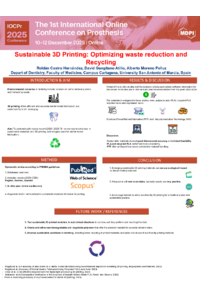
Poster Roldán Castro.pdf
What is the effect of brushing and immersion in hygiene solutions on the roughness of 3D Printed resins for base and teeth dentures?
Enhancing thermal and thermomechanical properties of 3D printed denture base resin with titanium dioxide nanotubes