Event submissions
Published
This submission belongs to the session S3. Innovations and Challenges in Dental Implants of the event The 1st International Online Conference on Prosthesis
Published date
05 Dec, 2025
Academic Editor
'%3e%3cpath%20d='M12.6657%2010.9104C12.4185%2010.325%2012.0599%209.79327%2011.6097%209.34482C11.1609%208.89508%2010.6293%208.5365%2010.0442%208.28888C10.0389%208.28626%2010.0337%208.28495%2010.0285%208.28233C10.8446%207.69279%2011.3752%206.73249%2011.3752%205.64904C11.3752%203.8542%209.92103%202.39999%208.1262%202.39999C6.33136%202.39999%204.87715%203.8542%204.87715%205.64904C4.87715%206.73249%205.40774%207.69279%206.22393%208.28364C6.21869%208.28626%206.21345%208.28757%206.20821%208.29019C5.62129%208.5378%205.09463%208.89284%204.64265%209.34613C4.1929%209.79493%203.83432%2010.3266%203.58671%2010.9117C3.34345%2011.4845%203.21226%2012.0987%203.20023%2012.7209C3.19988%2012.7349%203.20233%2012.7488%203.20744%2012.7619C3.21255%2012.7749%203.22022%2012.7867%203.22998%2012.7968C3.23975%2012.8068%203.25142%2012.8147%203.26431%2012.8202C3.2772%2012.8256%203.29105%2012.8284%203.30504%2012.8284H4.09109C4.14874%2012.8284%204.19459%2012.7825%204.1959%2012.7262C4.2221%2011.7148%204.62823%2010.7676%205.34617%2010.0497C6.08899%209.30683%207.0755%208.89808%208.1262%208.89808C9.17689%208.89808%2010.1634%209.30683%2010.9062%2010.0497C11.6242%2010.7676%2012.0303%2011.7148%2012.0565%2012.7262C12.0578%2012.7838%2012.1037%2012.8284%2012.1613%2012.8284H12.9474C12.9613%2012.8284%2012.9752%2012.8256%2012.9881%2012.8202C13.001%2012.8147%2013.0126%2012.8068%2013.0224%2012.7968C13.0322%2012.7867%2013.0398%2012.7749%2013.0449%2012.7619C13.0501%2012.7488%2013.0525%2012.7349%2013.0522%2012.7209C13.0391%2012.0947%2012.9094%2011.4855%2012.6657%2010.9104ZM8.1262%207.9024C7.52486%207.9024%206.9589%207.6679%206.53312%207.24211C6.10733%206.81633%205.87283%206.25037%205.87283%205.64904C5.87283%205.0477%206.10733%204.48174%206.53312%204.05596C6.9589%203.63018%207.52486%203.39567%208.1262%203.39567C8.72753%203.39567%209.29349%203.63018%209.71927%204.05596C10.1451%204.48174%2010.3796%205.0477%2010.3796%205.64904C10.3796%206.25037%2010.1451%206.81633%209.71927%207.24211C9.29349%207.6679%208.72753%207.9024%208.1262%207.9024Z'%20fill='%235D1EE1'/%3e%3c/g%3e%3c/svg%3e) Marco Cicciù
Marco CicciùCitation
Haseeb H. AlDary, Patent-Based Socket-Shield Technique Utilizing Bone Trephine: A Case Series, in Proceedings of The 1st International Online Conference on Prosthesis, 10 December–12 December 2025, MDPI: Basel, Switzerland
Share
Email
Facebook
Twitter
LinkedIn
Patent-Based Socket-Shield Technique Utilizing Bone Trephine: A Case Series
'%3e%3cpath%20d='M12.6647%2010.9104C12.4176%2010.325%2012.0589%209.7933%2011.6088%209.34485C11.16%208.89511%2010.6283%208.53653%2010.0432%208.28891C10.038%208.28629%2010.0327%208.28498%2010.0275%208.28236C10.8437%207.69282%2011.3743%206.73252%2011.3743%205.64907C11.3743%203.85423%209.92005%202.40002%208.12522%202.40002C6.33038%202.40002%204.87618%203.85423%204.87618%205.64907C4.87618%206.73252%205.40677%207.69282%206.22296%208.28367C6.21772%208.28629%206.21248%208.2876%206.20724%208.29022C5.62031%208.53783%205.09365%208.89287%204.64167%209.34616C4.19192%209.79496%203.83334%2010.3266%203.58573%2010.9117C3.34247%2011.4846%203.21128%2012.0987%203.19925%2012.721C3.1989%2012.735%203.20135%2012.7489%203.20646%2012.7619C3.21157%2012.7749%203.21924%2012.7868%203.22901%2012.7968C3.23877%2012.8068%203.25045%2012.8148%203.26334%2012.8202C3.27623%2012.8256%203.29007%2012.8284%203.30406%2012.8284H4.09012C4.14776%2012.8284%204.19362%2012.7825%204.19493%2012.7262C4.22113%2011.7148%204.62726%2010.7676%205.34519%2010.0497C6.08802%209.30686%207.07452%208.89811%208.12522%208.89811C9.17592%208.89811%2010.1624%209.30686%2010.9052%2010.0497C11.6232%2010.7676%2012.0293%2011.7148%2012.0555%2012.7262C12.0568%2012.7839%2012.1027%2012.8284%2012.1603%2012.8284H12.9464C12.9604%2012.8284%2012.9742%2012.8256%2012.9871%2012.8202C13%2012.8148%2013.0117%2012.8068%2013.0214%2012.7968C13.0312%2012.7868%2013.0389%2012.7749%2013.044%2012.7619C13.0491%2012.7489%2013.0515%2012.735%2013.0512%2012.721C13.0381%2012.0947%2012.9084%2011.4856%2012.6647%2010.9104ZM8.12522%207.90243C7.52388%207.90243%206.95792%207.66793%206.53214%207.24215C6.10636%206.81636%205.87185%206.2504%205.87185%205.64907C5.87185%205.04773%206.10636%204.48177%206.53214%204.05599C6.95792%203.63021%207.52388%203.3957%208.12522%203.3957C8.72655%203.3957%209.29252%203.63021%209.7183%204.05599C10.1441%204.48177%2010.3786%205.04773%2010.3786%205.64907C10.3786%206.2504%2010.1441%206.81636%209.7183%207.24215C9.29252%207.66793%208.72655%207.90243%208.12522%207.90243Z'%20fill='%235D1EE1'/%3e%3c/g%3e%3c/svg%3e)
Haseeb H. AlDary 1
1. Independent researcher, Private practice, Dr. Haseeb's dental clinic, Amman, P.O. Box 1543, 11953, Jordan
Abstract
Introduction:
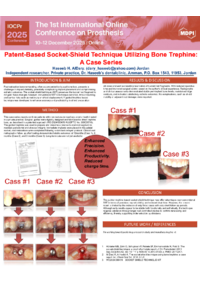
Post-extraction bone remodeling, often accompanied by buccal bone loss, presents a challenge in implant dentistry, potentially complicating implant placement and compromising esthetic outcomes. The socket-shield technique (SST) preserves the buccal root fragment to mitigate these changes; however, conventional SST is technique-sensitive, time-consuming, and carries risks such as root injury or shield displacement. A guided trephine-based technique was developed to enhance accuracy and predictability in shield preparation.
Methods:
This case series reports on three patients with nonrestorable maxillary anterior teeth treated in a private practice. Surgical guides were digitally designed and fabricated to direct trephine burs, as described in a patented approach (WO 2024/038478 A1; USPTO No. 509030716). The guided trephine was used to prepare and preserve a precise buccal root segment to maintain periodontal and alveolar integrity. Immediate implants were placed in the palatal socket, and restorations were completed following a standard delayed protocol. Clinical and radiographic follow-up after loading demonstrated stable outcomes at 12 months (Case 1), 6 months (Case 2), and 3 months (Case 3). Long-term data are not yet available.
Results:
All cases showed successful preservation of buccal root fragments, with reduced operative time and improved surgical control based on the author’s clinical experience. Radiographs and clinical assessments demonstrated stable peri-implant bone levels, maintained ridge contours, and indicated satisfactory esthetic outcomes. No complications, such as shield mobility or adjacent root damage, were reported.
Conclusions:
The guided trephine-based socket-shield technique may offer advantages over conventional SST in terms of precision, reproducibility, and reduced chair time. However, the present report is limited by the inclusion of only three cases with very short follow-up periods. Although early results appear to be stable both functionally and esthetically, the technique requires validation through larger, well-controlled studies to confirm its reliability and efficiency, thereby supporting wider adoption by clinicians.
Keywords
Socket Shield
Computer Guided
Bone Trephine
Patented Kit
Poster
Poster Haseeb AlDary.pdf
The Effect of Surface Modifications on the Biocompatibility of PEEK Dental Implant Material
Internal Sinus Elevation with Osseodensification and i-PRF Sticky Bone Graft: A Case Report