Event submissions
Published
This submission belongs to the session S2. Digital Technologies and Artificial Intelligence in Prosthodontics of the event The 1st International Online Conference on Prosthesis
Published date
05 Dec, 2025
Academic Editor
'%3e%3cpath%20d='M12.6657%2010.9104C12.4185%2010.325%2012.0599%209.79327%2011.6097%209.34482C11.1609%208.89508%2010.6293%208.5365%2010.0442%208.28888C10.0389%208.28626%2010.0337%208.28495%2010.0285%208.28233C10.8446%207.69279%2011.3752%206.73249%2011.3752%205.64904C11.3752%203.8542%209.92103%202.39999%208.1262%202.39999C6.33136%202.39999%204.87715%203.8542%204.87715%205.64904C4.87715%206.73249%205.40774%207.69279%206.22393%208.28364C6.21869%208.28626%206.21345%208.28757%206.20821%208.29019C5.62129%208.5378%205.09463%208.89284%204.64265%209.34613C4.1929%209.79493%203.83432%2010.3266%203.58671%2010.9117C3.34345%2011.4845%203.21226%2012.0987%203.20023%2012.7209C3.19988%2012.7349%203.20233%2012.7488%203.20744%2012.7619C3.21255%2012.7749%203.22022%2012.7867%203.22998%2012.7968C3.23975%2012.8068%203.25142%2012.8147%203.26431%2012.8202C3.2772%2012.8256%203.29105%2012.8284%203.30504%2012.8284H4.09109C4.14874%2012.8284%204.19459%2012.7825%204.1959%2012.7262C4.2221%2011.7148%204.62823%2010.7676%205.34617%2010.0497C6.08899%209.30683%207.0755%208.89808%208.1262%208.89808C9.17689%208.89808%2010.1634%209.30683%2010.9062%2010.0497C11.6242%2010.7676%2012.0303%2011.7148%2012.0565%2012.7262C12.0578%2012.7838%2012.1037%2012.8284%2012.1613%2012.8284H12.9474C12.9613%2012.8284%2012.9752%2012.8256%2012.9881%2012.8202C13.001%2012.8147%2013.0126%2012.8068%2013.0224%2012.7968C13.0322%2012.7867%2013.0398%2012.7749%2013.0449%2012.7619C13.0501%2012.7488%2013.0525%2012.7349%2013.0522%2012.7209C13.0391%2012.0947%2012.9094%2011.4855%2012.6657%2010.9104ZM8.1262%207.9024C7.52486%207.9024%206.9589%207.6679%206.53312%207.24211C6.10733%206.81633%205.87283%206.25037%205.87283%205.64904C5.87283%205.0477%206.10733%204.48174%206.53312%204.05596C6.9589%203.63018%207.52486%203.39567%208.1262%203.39567C8.72753%203.39567%209.29349%203.63018%209.71927%204.05596C10.1451%204.48174%2010.3796%205.0477%2010.3796%205.64904C10.3796%206.25037%2010.1451%206.81633%209.71927%207.24211C9.29349%207.6679%208.72753%207.9024%208.1262%207.9024Z'%20fill='%235D1EE1'/%3e%3c/g%3e%3c/svg%3e) Roberto Sorrentino
Roberto SorrentinoCitation
Vincenzo Vallefuoco, Gennaro Ruggiero, Annamaria Mastrosimone, Vito Cirillo, Giulia de Durante, Ruben Maria Paino, Roberto Sorrentino, Fernando Zarone, Evaluating artificial surface bridging in intraoral scans: A comparative in vitro study of six IO scanners, in Proceedings of The 1st International Online Conference on Prosthesis, 10 December–12 December 2025, MDPI: Basel, Switzerland
Share
Email
Facebook
Twitter
LinkedIn
Evaluating artificial surface bridging in intraoral scans: A comparative in vitro study of six IO scanners
'%3e%3cpath%20d='M12.6647%2010.9104C12.4176%2010.325%2012.0589%209.7933%2011.6088%209.34485C11.16%208.89511%2010.6283%208.53653%2010.0432%208.28891C10.038%208.28629%2010.0327%208.28498%2010.0275%208.28236C10.8437%207.69282%2011.3743%206.73252%2011.3743%205.64907C11.3743%203.85423%209.92005%202.40002%208.12522%202.40002C6.33038%202.40002%204.87618%203.85423%204.87618%205.64907C4.87618%206.73252%205.40677%207.69282%206.22296%208.28367C6.21772%208.28629%206.21248%208.2876%206.20724%208.29022C5.62031%208.53783%205.09365%208.89287%204.64167%209.34616C4.19192%209.79496%203.83334%2010.3266%203.58573%2010.9117C3.34247%2011.4846%203.21128%2012.0987%203.19925%2012.721C3.1989%2012.735%203.20135%2012.7489%203.20646%2012.7619C3.21157%2012.7749%203.21924%2012.7868%203.22901%2012.7968C3.23877%2012.8068%203.25045%2012.8148%203.26334%2012.8202C3.27623%2012.8256%203.29007%2012.8284%203.30406%2012.8284H4.09012C4.14776%2012.8284%204.19362%2012.7825%204.19493%2012.7262C4.22113%2011.7148%204.62726%2010.7676%205.34519%2010.0497C6.08802%209.30686%207.07452%208.89811%208.12522%208.89811C9.17592%208.89811%2010.1624%209.30686%2010.9052%2010.0497C11.6232%2010.7676%2012.0293%2011.7148%2012.0555%2012.7262C12.0568%2012.7839%2012.1027%2012.8284%2012.1603%2012.8284H12.9464C12.9604%2012.8284%2012.9742%2012.8256%2012.9871%2012.8202C13%2012.8148%2013.0117%2012.8068%2013.0214%2012.7968C13.0312%2012.7868%2013.0389%2012.7749%2013.044%2012.7619C13.0491%2012.7489%2013.0515%2012.735%2013.0512%2012.721C13.0381%2012.0947%2012.9084%2011.4856%2012.6647%2010.9104ZM8.12522%207.90243C7.52388%207.90243%206.95792%207.66793%206.53214%207.24215C6.10636%206.81636%205.87185%206.2504%205.87185%205.64907C5.87185%205.04773%206.10636%204.48177%206.53214%204.05599C6.95792%203.63021%207.52388%203.3957%208.12522%203.3957C8.72655%203.3957%209.29252%203.63021%209.7183%204.05599C10.1441%204.48177%2010.3786%205.04773%2010.3786%205.64907C10.3786%206.2504%2010.1441%206.81636%209.7183%207.24215C9.29252%207.66793%208.72655%207.90243%208.12522%207.90243Z'%20fill='%235D1EE1'/%3e%3c/g%3e%3c/svg%3e)
Vincenzo Vallefuoco 1

Gennaro Ruggiero 1
Annamaria Mastrosimone 1
Vito Cirillo 1
Giulia de Durante 1
Ruben Maria Paino 1

Roberto Sorrentino 1

Fernando Zarone 1
1. Department of Neuroscience, Reproductive and Odontostomatological Sciences, University of Naples Federico II, Naples, 80131, Italy
Abstract
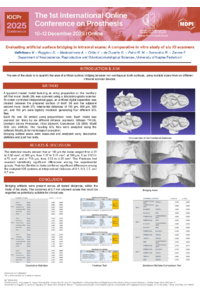
Aim: The aim of this study is to quantify the artificial surface bridging area between non-contiguous tooth surfaces using multiple scans from six different intraoral scanner devices.
Materials and Methods: A typodont master model with an onlay preparation on the maxillary left first molar (tooth 26) was scanned using a laboratory-grade scanner. To obtain controlled interproximal gaps, an artificial digital separation was created between the prepared surface of tooth 26 and the adjacent second molar (tooth 27). Interdental distances of 100 µm, 300 µm, 500 µm, and 700 µm were digitally modeled, generating six different intraoral scanners: 3Shape TRIOS, Dentsply Sirona Primescan, iTero Element, Carestream CS 3800, Medit i900, and SIRIOS. Each model was scanned ten times, producing four different STL files, which were then 3D printed using polyurethane resin. The resulting STL files were analyzed using MeshLab software for metrological evaluation. Bridging surface areas were measured and analyzed using descriptive statistics and post hoc tests.
Results: The statistical results showed that, at 100 µm, the mean ranged from 4.35 to 5.60 mm²; at 300 µm, from 1.57 to 5.11 mm²; at 500 µm, from 2.00 to 4.75 mm²; and at 700 µm, from 2.03 to 4.35 mm². The Friedman test revealed statistically significant differences among the experimental groups. Post hoc Bonferroni tests confirmed significant differences between the analyzed intraoral scanners at interproximal distances of 0.1, 0.3, 0.5, and 0.7 mm.
Conclusion: Bridging artifacts were present at all tested distances within the study limits. The outcomes at 0.7 mm showed values that could be regarded as potentially suitable for clinical use.
Keywords
Surface Bridging
Intraoral Scanners
Digital Dentistry
Poster
Poster Vincenzo Vallefuoco.pdf
3D Facial Imaging: A Comparative Study of Modern Scanning Techniques
A Full Digital Workflow for Immediate Removable Denture Fabrication and Overdenture Rehabilitation in Elderly Patients: A Proof of Concept for Maxilla and Mandible