Event submissions
Published
This submission belongs to the session S1. Biostimulation and Biocontrol Strategies of the event The 5th International Electronic Conference on Agronomy
Published date
11 Dec, 2025
Academic Editor
'%3e%3cpath%20d='M12.6657%2010.9104C12.4185%2010.325%2012.0599%209.79327%2011.6097%209.34482C11.1609%208.89508%2010.6293%208.5365%2010.0442%208.28888C10.0389%208.28626%2010.0337%208.28495%2010.0285%208.28233C10.8446%207.69279%2011.3752%206.73249%2011.3752%205.64904C11.3752%203.8542%209.92103%202.39999%208.1262%202.39999C6.33136%202.39999%204.87715%203.8542%204.87715%205.64904C4.87715%206.73249%205.40774%207.69279%206.22393%208.28364C6.21869%208.28626%206.21345%208.28757%206.20821%208.29019C5.62129%208.5378%205.09463%208.89284%204.64265%209.34613C4.1929%209.79493%203.83432%2010.3266%203.58671%2010.9117C3.34345%2011.4845%203.21226%2012.0987%203.20023%2012.7209C3.19988%2012.7349%203.20233%2012.7488%203.20744%2012.7619C3.21255%2012.7749%203.22022%2012.7867%203.22998%2012.7968C3.23975%2012.8068%203.25142%2012.8147%203.26431%2012.8202C3.2772%2012.8256%203.29105%2012.8284%203.30504%2012.8284H4.09109C4.14874%2012.8284%204.19459%2012.7825%204.1959%2012.7262C4.2221%2011.7148%204.62823%2010.7676%205.34617%2010.0497C6.08899%209.30683%207.0755%208.89808%208.1262%208.89808C9.17689%208.89808%2010.1634%209.30683%2010.9062%2010.0497C11.6242%2010.7676%2012.0303%2011.7148%2012.0565%2012.7262C12.0578%2012.7838%2012.1037%2012.8284%2012.1613%2012.8284H12.9474C12.9613%2012.8284%2012.9752%2012.8256%2012.9881%2012.8202C13.001%2012.8147%2013.0126%2012.8068%2013.0224%2012.7968C13.0322%2012.7867%2013.0398%2012.7749%2013.0449%2012.7619C13.0501%2012.7488%2013.0525%2012.7349%2013.0522%2012.7209C13.0391%2012.0947%2012.9094%2011.4855%2012.6657%2010.9104ZM8.1262%207.9024C7.52486%207.9024%206.9589%207.6679%206.53312%207.24211C6.10733%206.81633%205.87283%206.25037%205.87283%205.64904C5.87283%205.0477%206.10733%204.48174%206.53312%204.05596C6.9589%203.63018%207.52486%203.39567%208.1262%203.39567C8.72753%203.39567%209.29349%203.63018%209.71927%204.05596C10.1451%204.48174%2010.3796%205.0477%2010.3796%205.64904C10.3796%206.25037%2010.1451%206.81633%209.71927%207.24211C9.29349%207.6679%208.72753%207.9024%208.1262%207.9024Z'%20fill='%235D1EE1'/%3e%3c/g%3e%3c/svg%3e) Monica Boscaiu
Monica BoscaiuCitation
Vasileios Papantzikos, Postharvest performance and antioxidant capacity of kiwi fruits under the application of a glycine-betaine-based biostimulant during the growing season., in Proceedings of The 5th International Electronic Conference on Agronomy, 15 December–18 December 2025, MDPI: Basel, Switzerland
Share
Email
Facebook
Twitter
LinkedIn
Postharvest performance and antioxidant capacity of kiwi fruits under the application of a glycine-betaine-based biostimulant during the growing season.

Vasileios Papantzikos 1
1. Department of Agriculture, University of Ioannina, Arta Campus, 47100, Greece
Abstract
The demand for high-quality agricultural products is increasing; however, this requirement is becoming challenging due to climate change, which causes abiotic stresses. In this research, we studied the performance of the kiwi fruit, Actinidia deliciosavar. "Hayward", 60 days after their storage for two different cultivation periods, in which a glycine-betaine biostimulant (GB) was applied to the kiwi trees via irrigation. The experiment was carried out in a kiwi orchard where two treatments were arranged: one treatment where the biostimulant was applied (GB) and a control treatment (C) that was biostimulant-free. Postharvest analysis was performed at the Productive Agriculture and Plant Health Laboratory of the Department of Agriculture of the University of Ioannina by measuring the fresh and dry weight of kiwi fruits (g), their soluble solids content (%), and titratable acidity (%). To assess the antioxidant traits of kiwi fruits, the DPPH (%) and ascorbic acid content (mg DW−1) were recorded. The data analysis revealed that GB treatment was beneficial for kiwi fruits during storage, enhancing their antioxidant capacity as indicated by their higher ascorbic acid content (vitamin C) compared to the control. This qualitative difference may be beneficial for the commercial requirements of kiwifruit cultivation and promising for kiwi metabolism, strengthening their cultivation under the abiotic conditions of climate change. This prompts us to further investigate the application of amino acid biostimulants. This result complements the literature on the implementation of biostimulants, as reports regarding their application in kiwifruit cultivation are limited. This study took "Hayward" kiwifruits as the research object and found that the glycine-betaine (GB) biostimulant had a positive effect on kiwifruits during storage. This provides an optional solution for meeting the commercial needs of kiwifruit cultivation and improving the adaptability of kiwifruit cultivation under abiotic stress conditions.
Keywords
Biostimulant
kiwi
postharvest
Poster
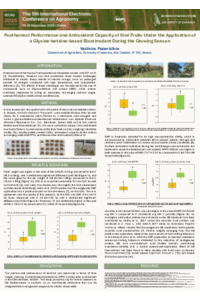
POSTER IECAG 2025.pdf
Evaluating the Effects of Microalgal Extracts on the Germination and Phenolic Contents of Ayocote Bean (Phaseolus coccineus) Seeds
Harnessing synergistic PGPR consortia to boost legumes' resiliency to salt stress