Event submissions
Published
This submission belongs to the session S1. Biostimulation and Biocontrol Strategies of the event The 5th International Electronic Conference on Agronomy
Published date
11 Dec, 2025
Academic Editor
'%3e%3cpath%20d='M12.6657%2010.9104C12.4185%2010.325%2012.0599%209.79327%2011.6097%209.34482C11.1609%208.89508%2010.6293%208.5365%2010.0442%208.28888C10.0389%208.28626%2010.0337%208.28495%2010.0285%208.28233C10.8446%207.69279%2011.3752%206.73249%2011.3752%205.64904C11.3752%203.8542%209.92103%202.39999%208.1262%202.39999C6.33136%202.39999%204.87715%203.8542%204.87715%205.64904C4.87715%206.73249%205.40774%207.69279%206.22393%208.28364C6.21869%208.28626%206.21345%208.28757%206.20821%208.29019C5.62129%208.5378%205.09463%208.89284%204.64265%209.34613C4.1929%209.79493%203.83432%2010.3266%203.58671%2010.9117C3.34345%2011.4845%203.21226%2012.0987%203.20023%2012.7209C3.19988%2012.7349%203.20233%2012.7488%203.20744%2012.7619C3.21255%2012.7749%203.22022%2012.7867%203.22998%2012.7968C3.23975%2012.8068%203.25142%2012.8147%203.26431%2012.8202C3.2772%2012.8256%203.29105%2012.8284%203.30504%2012.8284H4.09109C4.14874%2012.8284%204.19459%2012.7825%204.1959%2012.7262C4.2221%2011.7148%204.62823%2010.7676%205.34617%2010.0497C6.08899%209.30683%207.0755%208.89808%208.1262%208.89808C9.17689%208.89808%2010.1634%209.30683%2010.9062%2010.0497C11.6242%2010.7676%2012.0303%2011.7148%2012.0565%2012.7262C12.0578%2012.7838%2012.1037%2012.8284%2012.1613%2012.8284H12.9474C12.9613%2012.8284%2012.9752%2012.8256%2012.9881%2012.8202C13.001%2012.8147%2013.0126%2012.8068%2013.0224%2012.7968C13.0322%2012.7867%2013.0398%2012.7749%2013.0449%2012.7619C13.0501%2012.7488%2013.0525%2012.7349%2013.0522%2012.7209C13.0391%2012.0947%2012.9094%2011.4855%2012.6657%2010.9104ZM8.1262%207.9024C7.52486%207.9024%206.9589%207.6679%206.53312%207.24211C6.10733%206.81633%205.87283%206.25037%205.87283%205.64904C5.87283%205.0477%206.10733%204.48174%206.53312%204.05596C6.9589%203.63018%207.52486%203.39567%208.1262%203.39567C8.72753%203.39567%209.29349%203.63018%209.71927%204.05596C10.1451%204.48174%2010.3796%205.0477%2010.3796%205.64904C10.3796%206.25037%2010.1451%206.81633%209.71927%207.24211C9.29349%207.6679%208.72753%207.9024%208.1262%207.9024Z'%20fill='%235D1EE1'/%3e%3c/g%3e%3c/svg%3e) Monica Boscaiu
Monica BoscaiuCitation
Amira Hachana, Amir Souissi, Imen Hemissi, Hatem Zgallai, Anissa Riahi, Asma Bouatrous, Hanen Arfaoui, Mohamed Annabi, Harnessing synergistic PGPR consortia to boost legumes' resiliency to salt stress, in Proceedings of The 5th International Electronic Conference on Agronomy, 15 December–18 December 2025, MDPI: Basel, Switzerland
Share
Email
Facebook
Twitter
LinkedIn
Harnessing synergistic PGPR consortia to boost legumes' resiliency to salt stress
'%3e%3cpath%20d='M12.6647%2010.9104C12.4176%2010.325%2012.0589%209.7933%2011.6088%209.34485C11.16%208.89511%2010.6283%208.53653%2010.0432%208.28891C10.038%208.28629%2010.0327%208.28498%2010.0275%208.28236C10.8437%207.69282%2011.3743%206.73252%2011.3743%205.64907C11.3743%203.85423%209.92005%202.40002%208.12522%202.40002C6.33038%202.40002%204.87618%203.85423%204.87618%205.64907C4.87618%206.73252%205.40677%207.69282%206.22296%208.28367C6.21772%208.28629%206.21248%208.2876%206.20724%208.29022C5.62031%208.53783%205.09365%208.89287%204.64167%209.34616C4.19192%209.79496%203.83334%2010.3266%203.58573%2010.9117C3.34247%2011.4846%203.21128%2012.0987%203.19925%2012.721C3.1989%2012.735%203.20135%2012.7489%203.20646%2012.7619C3.21157%2012.7749%203.21924%2012.7868%203.22901%2012.7968C3.23877%2012.8068%203.25045%2012.8148%203.26334%2012.8202C3.27623%2012.8256%203.29007%2012.8284%203.30406%2012.8284H4.09012C4.14776%2012.8284%204.19362%2012.7825%204.19493%2012.7262C4.22113%2011.7148%204.62726%2010.7676%205.34519%2010.0497C6.08802%209.30686%207.07452%208.89811%208.12522%208.89811C9.17592%208.89811%2010.1624%209.30686%2010.9052%2010.0497C11.6232%2010.7676%2012.0293%2011.7148%2012.0555%2012.7262C12.0568%2012.7839%2012.1027%2012.8284%2012.1603%2012.8284H12.9464C12.9604%2012.8284%2012.9742%2012.8256%2012.9871%2012.8202C13%2012.8148%2013.0117%2012.8068%2013.0214%2012.7968C13.0312%2012.7868%2013.0389%2012.7749%2013.044%2012.7619C13.0491%2012.7489%2013.0515%2012.735%2013.0512%2012.721C13.0381%2012.0947%2012.9084%2011.4856%2012.6647%2010.9104ZM8.12522%207.90243C7.52388%207.90243%206.95792%207.66793%206.53214%207.24215C6.10636%206.81636%205.87185%206.2504%205.87185%205.64907C5.87185%205.04773%206.10636%204.48177%206.53214%204.05599C6.95792%203.63021%207.52388%203.3957%208.12522%203.3957C8.72655%203.3957%209.29252%203.63021%209.7183%204.05599C10.1441%204.48177%2010.3786%205.04773%2010.3786%205.64907C10.3786%206.2504%2010.1441%206.81636%209.7183%207.24215C9.29252%207.66793%208.72655%207.90243%208.12522%207.90243Z'%20fill='%235D1EE1'/%3e%3c/g%3e%3c/svg%3e)
Amira Hachana 1
Amir Souissi 2
Imen Hemissi 1
Hatem Zgallai 1
Anissa Riahi 3,4
Asma Bouatrous 5
Hanen Arfaoui 1
Mohamed Annabi 1
1. Laboratory of Agricultural Sciences and Techniques, National Institute of Agricultural Research of Tunisia, University of Carthage, Tunis, 1004, Tunisia
2. Swift Current Research and Development Centre, Agriculture and Agri-Food Canada, Swift Current, Saskatchewan, S9H 3X2, Canada
3. Laboratory of Horticultural Sciences, National Institute of Agricultural Research of Tunisia, University of Carthage, Tunis, 1004, Tunisia
4. Higher School of Agriculture of Kef, University of Jendouba, Kef, 7119, Tunisia
5. Higher Institute of Biotechnology of Beja, University of Jendouba, Beja, 9000, Tunisia
Abstract
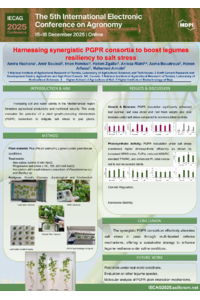
Increasing drought and rising water and soil salinity pose significant challenges to both agricultural productivity and nutrition security in the Mediterranean region. Pea crop (Pisum sativum L.), which is vital for sustainable agriculture, is highly sensitive to salt stress, leading to substantial yield losses due to osmotic and oxidative damage and to the degradation of key physiological processes. Pea plants were grown in pots filled with sterile soil under greenhouse conditions. Plants were subjected to two salinity conditions: non-saline control (0 mM NaCl) and progressively increasing salt concentration (100, 150, and 200 mM NaCl). The trial included an uninoculated control and a treatment inoculated with a consortium of salt-tolerant Pseudomonas sp. and Bacillus sp. strains.
The results demonstrated that salt stress significantly reduced plant growth, biomass accumulation, and nitrogen content in uninoculated plants, while increasing electrolyte leakage and tissue sodium concentration. In contrast, consortium inoculation under salt stress resulted in significantly higher total biomass, leaf number, and leaf area than all other treatments. Furthermore, consortium inoculation increased photosynthetic activity compared with uninoculated plants, as indicated by a significantly higher SPAD index and the maintenance of a high maximum quantum yield of photosystem II, suggesting limited photo-inhibition. Additionally, under salt stress, our consortium enhanced osmotic regulation, resulting in a 3.2-fold increase in proline content, and improved membrane stability, with a 38% reduction in electrolyte leakage compared to the uninoculated treatment.
Overall, synergistic PGPR consortium effectively mitigates salt stress in peas through a multi-faceted defense mechanism, representing a promising sustainable strategy to enhance legume resilience under saline conditions.
Keywords
PGPR consortium
Salt stress
Pisum sativum L.
Photosynthetic efficiency
Osmotic regulation.
Poster
Poster.pdf
Postharvest performance and antioxidant capacity of kiwi fruits under the application of a glycine-betaine-based biostimulant during the growing season.
Evaluating the biostimulant potential of brown seaweed extracts on tomato (Solanum lycopersicum) germination and early growth for sustainable crop production