Event submissions
Published
This submission belongs to the session S2. Breeding and Selection Technologies of the event The 5th International Electronic Conference on Agronomy
Published date
11 Dec, 2025
Academic Editor
'%3e%3cpath%20d='M12.6657%2010.9104C12.4185%2010.325%2012.0599%209.79327%2011.6097%209.34482C11.1609%208.89508%2010.6293%208.5365%2010.0442%208.28888C10.0389%208.28626%2010.0337%208.28495%2010.0285%208.28233C10.8446%207.69279%2011.3752%206.73249%2011.3752%205.64904C11.3752%203.8542%209.92103%202.39999%208.1262%202.39999C6.33136%202.39999%204.87715%203.8542%204.87715%205.64904C4.87715%206.73249%205.40774%207.69279%206.22393%208.28364C6.21869%208.28626%206.21345%208.28757%206.20821%208.29019C5.62129%208.5378%205.09463%208.89284%204.64265%209.34613C4.1929%209.79493%203.83432%2010.3266%203.58671%2010.9117C3.34345%2011.4845%203.21226%2012.0987%203.20023%2012.7209C3.19988%2012.7349%203.20233%2012.7488%203.20744%2012.7619C3.21255%2012.7749%203.22022%2012.7867%203.22998%2012.7968C3.23975%2012.8068%203.25142%2012.8147%203.26431%2012.8202C3.2772%2012.8256%203.29105%2012.8284%203.30504%2012.8284H4.09109C4.14874%2012.8284%204.19459%2012.7825%204.1959%2012.7262C4.2221%2011.7148%204.62823%2010.7676%205.34617%2010.0497C6.08899%209.30683%207.0755%208.89808%208.1262%208.89808C9.17689%208.89808%2010.1634%209.30683%2010.9062%2010.0497C11.6242%2010.7676%2012.0303%2011.7148%2012.0565%2012.7262C12.0578%2012.7838%2012.1037%2012.8284%2012.1613%2012.8284H12.9474C12.9613%2012.8284%2012.9752%2012.8256%2012.9881%2012.8202C13.001%2012.8147%2013.0126%2012.8068%2013.0224%2012.7968C13.0322%2012.7867%2013.0398%2012.7749%2013.0449%2012.7619C13.0501%2012.7488%2013.0525%2012.7349%2013.0522%2012.7209C13.0391%2012.0947%2012.9094%2011.4855%2012.6657%2010.9104ZM8.1262%207.9024C7.52486%207.9024%206.9589%207.6679%206.53312%207.24211C6.10733%206.81633%205.87283%206.25037%205.87283%205.64904C5.87283%205.0477%206.10733%204.48174%206.53312%204.05596C6.9589%203.63018%207.52486%203.39567%208.1262%203.39567C8.72753%203.39567%209.29349%203.63018%209.71927%204.05596C10.1451%204.48174%2010.3796%205.0477%2010.3796%205.64904C10.3796%206.25037%2010.1451%206.81633%209.71927%207.24211C9.29349%207.6679%208.72753%207.9024%208.1262%207.9024Z'%20fill='%235D1EE1'/%3e%3c/g%3e%3c/svg%3e) Jaime Prohens
Jaime ProhensCitation
Tetiana Miroshnichenko, Tetiana Ivchenko, Natalia Bashtan, Hanna Mozgovska, In vitro assessment of tomato rootstock–scion compatibility, in Proceedings of The 5th International Electronic Conference on Agronomy, 15 December–18 December 2025, MDPI: Basel, Switzerland
Share
Email
Facebook
Twitter
LinkedIn
In vitro assessment of tomato rootstock–scion compatibility
'%3e%3cpath%20d='M12.6647%2010.9104C12.4176%2010.325%2012.0589%209.7933%2011.6088%209.34485C11.16%208.89511%2010.6283%208.53653%2010.0432%208.28891C10.038%208.28629%2010.0327%208.28498%2010.0275%208.28236C10.8437%207.69282%2011.3743%206.73252%2011.3743%205.64907C11.3743%203.85423%209.92005%202.40002%208.12522%202.40002C6.33038%202.40002%204.87618%203.85423%204.87618%205.64907C4.87618%206.73252%205.40677%207.69282%206.22296%208.28367C6.21772%208.28629%206.21248%208.2876%206.20724%208.29022C5.62031%208.53783%205.09365%208.89287%204.64167%209.34616C4.19192%209.79496%203.83334%2010.3266%203.58573%2010.9117C3.34247%2011.4846%203.21128%2012.0987%203.19925%2012.721C3.1989%2012.735%203.20135%2012.7489%203.20646%2012.7619C3.21157%2012.7749%203.21924%2012.7868%203.22901%2012.7968C3.23877%2012.8068%203.25045%2012.8148%203.26334%2012.8202C3.27623%2012.8256%203.29007%2012.8284%203.30406%2012.8284H4.09012C4.14776%2012.8284%204.19362%2012.7825%204.19493%2012.7262C4.22113%2011.7148%204.62726%2010.7676%205.34519%2010.0497C6.08802%209.30686%207.07452%208.89811%208.12522%208.89811C9.17592%208.89811%2010.1624%209.30686%2010.9052%2010.0497C11.6232%2010.7676%2012.0293%2011.7148%2012.0555%2012.7262C12.0568%2012.7839%2012.1027%2012.8284%2012.1603%2012.8284H12.9464C12.9604%2012.8284%2012.9742%2012.8256%2012.9871%2012.8202C13%2012.8148%2013.0117%2012.8068%2013.0214%2012.7968C13.0312%2012.7868%2013.0389%2012.7749%2013.044%2012.7619C13.0491%2012.7489%2013.0515%2012.735%2013.0512%2012.721C13.0381%2012.0947%2012.9084%2011.4856%2012.6647%2010.9104ZM8.12522%207.90243C7.52388%207.90243%206.95792%207.66793%206.53214%207.24215C6.10636%206.81636%205.87185%206.2504%205.87185%205.64907C5.87185%205.04773%206.10636%204.48177%206.53214%204.05599C6.95792%203.63021%207.52388%203.3957%208.12522%203.3957C8.72655%203.3957%209.29252%203.63021%209.7183%204.05599C10.1441%204.48177%2010.3786%205.04773%2010.3786%205.64907C10.3786%206.2504%2010.1441%206.81636%209.7183%207.24215C9.29252%207.66793%208.72655%207.90243%208.12522%207.90243Z'%20fill='%235D1EE1'/%3e%3c/g%3e%3c/svg%3e)
Tetiana Miroshnichenko 1
Tetiana Ivchenko 1
Natalia Bashtan 1
Hanna Mozgovska 1
1. Laboratory of Biotechnology, Genetics and Genetic Resources, Institute of Vegetable and Melon Growing of NAAS of Ukraine, Merefa 62478, Ukraine
Abstract
The selection of vigorous, disease-resistant tomato rootstocks with high compatibility with cultivated scions is an important objective in tomato breeding.
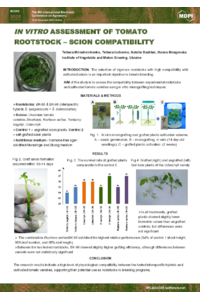
This study aimed to assess the compatibility between experimental rootstocks and cultivated tomato varieties using in vitro micrografting techniques. The rootstocks included two interspecific hybrids, BK-88 (T-5 × Solanum habrochaites) and BK-96 (K-7311 × S. habrochaites). The scions were the Ukrainian tomato varieties Smakolyk, Rozheve sertse, Yantarny bogatyr, and Udavchyk. Sterilized seeds were germinated on hormone-free Murashige and Skoog (MS) medium, and 14-day-old seedlings were used for grafting according to a developed in vitro micrografting protocol. Grafted plants were cultivated for three weeks in 250 ml jars on fresh agar-solidified MS medium. Controls included ungrafted plants (control 1) and self-grafted plants (control 2) for each scion variety. The percentage of viable grafts, shoot height, leaf number, and root length were evaluated. Graft union formation occurred on average within 10–14 days. The mean survival rate of grafted plants ranged from 94% to 97%, comparable to the self-grafted control. The lowest survival (94%) was observed for the combination Yantarny bogatyr/BK-88. In all treatments, grafted plants showed slightly lower biometric values than ungrafted controls, but differences were not statistically significant. The combination Rozheve sertse/BK-96 exhibited the highest relative performance (94% of control shoot height, 99% leaf number, and 95% root length). Between the two tested rootstocks, BK-96 showed slightly higher grafting efficiency, although differences between variants were not statistically significant.
These results indicate a high level of physiological compatibility between the tested interspecific hybrids and cultivated tomato varieties, supporting their potential use as rootstocks in breeding programs.
Keywords
tomato
grafting
rootstock
scion
interspecific hybrid
compatibility
in vitro
Poster
Poster_Miroshnichenko_IECAG2025.pdf
In silico evolutionary analysis of plant alpha amylase from monocot to dicot: A plausible explanation for stability and diversity
Molecular Characterization and Bioactivity Assessment of Ghost Pepper Metabolites: Novel Approaches for Sustainable Pathogen Control in Horticultural Systems