Event submissions
Published
This submission belongs to the session S2. Breeding and Selection Technologies of the event The 5th International Electronic Conference on Agronomy
Published date
11 Dec, 2025
Academic Editor
'%3e%3cpath%20d='M12.6657%2010.9104C12.4185%2010.325%2012.0599%209.79327%2011.6097%209.34482C11.1609%208.89508%2010.6293%208.5365%2010.0442%208.28888C10.0389%208.28626%2010.0337%208.28495%2010.0285%208.28233C10.8446%207.69279%2011.3752%206.73249%2011.3752%205.64904C11.3752%203.8542%209.92103%202.39999%208.1262%202.39999C6.33136%202.39999%204.87715%203.8542%204.87715%205.64904C4.87715%206.73249%205.40774%207.69279%206.22393%208.28364C6.21869%208.28626%206.21345%208.28757%206.20821%208.29019C5.62129%208.5378%205.09463%208.89284%204.64265%209.34613C4.1929%209.79493%203.83432%2010.3266%203.58671%2010.9117C3.34345%2011.4845%203.21226%2012.0987%203.20023%2012.7209C3.19988%2012.7349%203.20233%2012.7488%203.20744%2012.7619C3.21255%2012.7749%203.22022%2012.7867%203.22998%2012.7968C3.23975%2012.8068%203.25142%2012.8147%203.26431%2012.8202C3.2772%2012.8256%203.29105%2012.8284%203.30504%2012.8284H4.09109C4.14874%2012.8284%204.19459%2012.7825%204.1959%2012.7262C4.2221%2011.7148%204.62823%2010.7676%205.34617%2010.0497C6.08899%209.30683%207.0755%208.89808%208.1262%208.89808C9.17689%208.89808%2010.1634%209.30683%2010.9062%2010.0497C11.6242%2010.7676%2012.0303%2011.7148%2012.0565%2012.7262C12.0578%2012.7838%2012.1037%2012.8284%2012.1613%2012.8284H12.9474C12.9613%2012.8284%2012.9752%2012.8256%2012.9881%2012.8202C13.001%2012.8147%2013.0126%2012.8068%2013.0224%2012.7968C13.0322%2012.7867%2013.0398%2012.7749%2013.0449%2012.7619C13.0501%2012.7488%2013.0525%2012.7349%2013.0522%2012.7209C13.0391%2012.0947%2012.9094%2011.4855%2012.6657%2010.9104ZM8.1262%207.9024C7.52486%207.9024%206.9589%207.6679%206.53312%207.24211C6.10733%206.81633%205.87283%206.25037%205.87283%205.64904C5.87283%205.0477%206.10733%204.48174%206.53312%204.05596C6.9589%203.63018%207.52486%203.39567%208.1262%203.39567C8.72753%203.39567%209.29349%203.63018%209.71927%204.05596C10.1451%204.48174%2010.3796%205.0477%2010.3796%205.64904C10.3796%206.25037%2010.1451%206.81633%209.71927%207.24211C9.29349%207.6679%208.72753%207.9024%208.1262%207.9024Z'%20fill='%235D1EE1'/%3e%3c/g%3e%3c/svg%3e) Jaime Prohens
Jaime ProhensCitation
Hanane EL Wazziki, Khadija KHOUAKHI, Optimized method for screening wild Aegilops tauschii and Triticum dicoccoides for resistance to dry root rots caused by Fusarium culmorum, in Proceedings of The 5th International Electronic Conference on Agronomy, 15 December–18 December 2025, MDPI: Basel, Switzerland
Share
Email
Facebook
Twitter
LinkedIn
Optimized method for screening wild Aegilops tauschii and Triticum dicoccoides for resistance to dry root rots caused by Fusarium culmorum
'%3e%3cpath%20d='M12.6647%2010.9104C12.4176%2010.325%2012.0589%209.7933%2011.6088%209.34485C11.16%208.89511%2010.6283%208.53653%2010.0432%208.28891C10.038%208.28629%2010.0327%208.28498%2010.0275%208.28236C10.8437%207.69282%2011.3743%206.73252%2011.3743%205.64907C11.3743%203.85423%209.92005%202.40002%208.12522%202.40002C6.33038%202.40002%204.87618%203.85423%204.87618%205.64907C4.87618%206.73252%205.40677%207.69282%206.22296%208.28367C6.21772%208.28629%206.21248%208.2876%206.20724%208.29022C5.62031%208.53783%205.09365%208.89287%204.64167%209.34616C4.19192%209.79496%203.83334%2010.3266%203.58573%2010.9117C3.34247%2011.4846%203.21128%2012.0987%203.19925%2012.721C3.1989%2012.735%203.20135%2012.7489%203.20646%2012.7619C3.21157%2012.7749%203.21924%2012.7868%203.22901%2012.7968C3.23877%2012.8068%203.25045%2012.8148%203.26334%2012.8202C3.27623%2012.8256%203.29007%2012.8284%203.30406%2012.8284H4.09012C4.14776%2012.8284%204.19362%2012.7825%204.19493%2012.7262C4.22113%2011.7148%204.62726%2010.7676%205.34519%2010.0497C6.08802%209.30686%207.07452%208.89811%208.12522%208.89811C9.17592%208.89811%2010.1624%209.30686%2010.9052%2010.0497C11.6232%2010.7676%2012.0293%2011.7148%2012.0555%2012.7262C12.0568%2012.7839%2012.1027%2012.8284%2012.1603%2012.8284H12.9464C12.9604%2012.8284%2012.9742%2012.8256%2012.9871%2012.8202C13%2012.8148%2013.0117%2012.8068%2013.0214%2012.7968C13.0312%2012.7868%2013.0389%2012.7749%2013.044%2012.7619C13.0491%2012.7489%2013.0515%2012.735%2013.0512%2012.721C13.0381%2012.0947%2012.9084%2011.4856%2012.6647%2010.9104ZM8.12522%207.90243C7.52388%207.90243%206.95792%207.66793%206.53214%207.24215C6.10636%206.81636%205.87185%206.2504%205.87185%205.64907C5.87185%205.04773%206.10636%204.48177%206.53214%204.05599C6.95792%203.63021%207.52388%203.3957%208.12522%203.3957C8.72655%203.3957%209.29252%203.63021%209.7183%204.05599C10.1441%204.48177%2010.3786%205.04773%2010.3786%205.64907C10.3786%206.2504%2010.1441%206.81636%209.7183%207.24215C9.29252%207.66793%208.72655%207.90243%208.12522%207.90243Z'%20fill='%235D1EE1'/%3e%3c/g%3e%3c/svg%3e)
Hanane EL Wazziki 1
Khadija KHOUAKHI 2
1. Laboratory of Cereal Pathology, Regional Center of Agricultural Research of Settat, National Institute of Agricultural Research (INRA), Avenue Ennasr, BP 415 Rabat Principal, Rabat 10090, Morocco
2. Laboratory of Genetic Improvement and Biotechnology, Regional Center of Agricultural Research of Settat, National Institute of Agricultural Research (INRA), Avenue Ennasr, BP 415 Rabat Principal, Rabat 10090, Morocco
Abstract
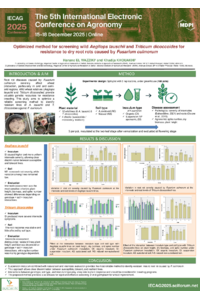
Dry root rots caused by Fusarium culmorum are an increasing constraint to wheat production in Moroccan semi-arid regions. Wild relatives such as Aegilops tauschii and Triticum dicoccoides represent valuable sources of resistance. Developing a reliable screening method is crucial for identifying promising breeding lines. Six accessions from each wild species were evaluated under controlled conditions using a split-plot design with three replications, where soil type (sterilized vs. natural) was assigned to main plots and inoculum type (organic vs. spore suspension) to subplots. For each accession in each treatment, one pot containing five plants was established per block. Plants were inoculated at the two-leaf stage after vernalization, and disease severity was assessed at flowering. Root and internode infection, spike number, dry biomass, and plant height were measured to integrate both pathological and agronomic responses. Results showed that methodological choices strongly influenced the ability to discriminate between resistant and susceptible lines. Internode assessment was the most sensitive criterion, revealing clear genetic variability both within and between species. Suspension inoculum consistently generated higher and more uniform disease pressure than organic inoculum. At the same time, soil type influenced resistance expression differently across species: in A. tauschii, non-sterilized soil amplified root severity, whereas in T. dicoccoides responses were stable across soil types. Agronomic traits further supported the approach. In A. tauschii, spike number depended on genotype × inoculum and genotype × soil interactions, while in T. dicoccoides it was largely genotype-dependent. Biomass also varied with genotype × inoculum interactions. Plant height exhibited the most complex pattern: in A. tauschii, it was primarily driven by genotype × inoculum interactions, whereas in T. dicoccoides, it was influenced by the combined effects of genotype, soil type, and inoculum. Overall, combining suspension inoculum, non-sterilized soil, and internode evaluation provides a robust screening method for identifying resistant germplasm in wheat improvement programs.
Keywords
Fusarium culmorum
Aegilops tauschii
Triticum dicoccoides
Inoculum type
Soil type
Agronomic traits
Screening method
Poster
Optimized method for screening wild Aegilops tauschii and Triticum dicoccoides for resistance to dry root rots caused by Fusarium culmorum.pdf
Molecular Characterization and Bioactivity Assessment of Ghost Pepper Metabolites: Novel Approaches for Sustainable Pathogen Control in Horticultural Systems
Effect of Light Intensity on Growth of Tomato Rootstocks in Controlled Environments