Event submissions
Published
This submission belongs to the session S6. Basic Plant Science of the event The 5th International Electronic Conference on Agronomy
Published date
11 Dec, 2025
Academic Editor
'%3e%3cpath%20d='M12.6657%2010.9104C12.4185%2010.325%2012.0599%209.79327%2011.6097%209.34482C11.1609%208.89508%2010.6293%208.5365%2010.0442%208.28888C10.0389%208.28626%2010.0337%208.28495%2010.0285%208.28233C10.8446%207.69279%2011.3752%206.73249%2011.3752%205.64904C11.3752%203.8542%209.92103%202.39999%208.1262%202.39999C6.33136%202.39999%204.87715%203.8542%204.87715%205.64904C4.87715%206.73249%205.40774%207.69279%206.22393%208.28364C6.21869%208.28626%206.21345%208.28757%206.20821%208.29019C5.62129%208.5378%205.09463%208.89284%204.64265%209.34613C4.1929%209.79493%203.83432%2010.3266%203.58671%2010.9117C3.34345%2011.4845%203.21226%2012.0987%203.20023%2012.7209C3.19988%2012.7349%203.20233%2012.7488%203.20744%2012.7619C3.21255%2012.7749%203.22022%2012.7867%203.22998%2012.7968C3.23975%2012.8068%203.25142%2012.8147%203.26431%2012.8202C3.2772%2012.8256%203.29105%2012.8284%203.30504%2012.8284H4.09109C4.14874%2012.8284%204.19459%2012.7825%204.1959%2012.7262C4.2221%2011.7148%204.62823%2010.7676%205.34617%2010.0497C6.08899%209.30683%207.0755%208.89808%208.1262%208.89808C9.17689%208.89808%2010.1634%209.30683%2010.9062%2010.0497C11.6242%2010.7676%2012.0303%2011.7148%2012.0565%2012.7262C12.0578%2012.7838%2012.1037%2012.8284%2012.1613%2012.8284H12.9474C12.9613%2012.8284%2012.9752%2012.8256%2012.9881%2012.8202C13.001%2012.8147%2013.0126%2012.8068%2013.0224%2012.7968C13.0322%2012.7867%2013.0398%2012.7749%2013.0449%2012.7619C13.0501%2012.7488%2013.0525%2012.7349%2013.0522%2012.7209C13.0391%2012.0947%2012.9094%2011.4855%2012.6657%2010.9104ZM8.1262%207.9024C7.52486%207.9024%206.9589%207.6679%206.53312%207.24211C6.10733%206.81633%205.87283%206.25037%205.87283%205.64904C5.87283%205.0477%206.10733%204.48174%206.53312%204.05596C6.9589%203.63018%207.52486%203.39567%208.1262%203.39567C8.72753%203.39567%209.29349%203.63018%209.71927%204.05596C10.1451%204.48174%2010.3796%205.0477%2010.3796%205.64904C10.3796%206.25037%2010.1451%206.81633%209.71927%207.24211C9.29349%207.6679%208.72753%207.9024%208.1262%207.9024Z'%20fill='%235D1EE1'/%3e%3c/g%3e%3c/svg%3e) Othmane Merah
Othmane MerahCitation
- Sutrisno, Marta Joanna Monder, Ewa Skutnik, Julita Rabiza-Świder, Vase Life and Sepal Anatomy Characteristics of Cut Hydrangea Cultivars, in Proceedings of The 5th International Electronic Conference on Agronomy, 15 December–18 December 2025, MDPI: Basel, Switzerland
Share
Email
Facebook
Twitter
LinkedIn
Vase Life and Sepal Anatomy Characteristics of Cut Hydrangea Cultivars
'%3e%3cpath%20d='M12.6647%2010.9104C12.4176%2010.325%2012.0589%209.7933%2011.6088%209.34485C11.16%208.89511%2010.6283%208.53653%2010.0432%208.28891C10.038%208.28629%2010.0327%208.28498%2010.0275%208.28236C10.8437%207.69282%2011.3743%206.73252%2011.3743%205.64907C11.3743%203.85423%209.92005%202.40002%208.12522%202.40002C6.33038%202.40002%204.87618%203.85423%204.87618%205.64907C4.87618%206.73252%205.40677%207.69282%206.22296%208.28367C6.21772%208.28629%206.21248%208.2876%206.20724%208.29022C5.62031%208.53783%205.09365%208.89287%204.64167%209.34616C4.19192%209.79496%203.83334%2010.3266%203.58573%2010.9117C3.34247%2011.4846%203.21128%2012.0987%203.19925%2012.721C3.1989%2012.735%203.20135%2012.7489%203.20646%2012.7619C3.21157%2012.7749%203.21924%2012.7868%203.22901%2012.7968C3.23877%2012.8068%203.25045%2012.8148%203.26334%2012.8202C3.27623%2012.8256%203.29007%2012.8284%203.30406%2012.8284H4.09012C4.14776%2012.8284%204.19362%2012.7825%204.19493%2012.7262C4.22113%2011.7148%204.62726%2010.7676%205.34519%2010.0497C6.08802%209.30686%207.07452%208.89811%208.12522%208.89811C9.17592%208.89811%2010.1624%209.30686%2010.9052%2010.0497C11.6232%2010.7676%2012.0293%2011.7148%2012.0555%2012.7262C12.0568%2012.7839%2012.1027%2012.8284%2012.1603%2012.8284H12.9464C12.9604%2012.8284%2012.9742%2012.8256%2012.9871%2012.8202C13%2012.8148%2013.0117%2012.8068%2013.0214%2012.7968C13.0312%2012.7868%2013.0389%2012.7749%2013.044%2012.7619C13.0491%2012.7489%2013.0515%2012.735%2013.0512%2012.721C13.0381%2012.0947%2012.9084%2011.4856%2012.6647%2010.9104ZM8.12522%207.90243C7.52388%207.90243%206.95792%207.66793%206.53214%207.24215C6.10636%206.81636%205.87185%206.2504%205.87185%205.64907C5.87185%205.04773%206.10636%204.48177%206.53214%204.05599C6.95792%203.63021%207.52388%203.3957%208.12522%203.3957C8.72655%203.3957%209.29252%203.63021%209.7183%204.05599C10.1441%204.48177%2010.3786%205.04773%2010.3786%205.64907C10.3786%206.2504%2010.1441%206.81636%209.7183%207.24215C9.29252%207.66793%208.72655%207.90243%208.12522%207.90243Z'%20fill='%235D1EE1'/%3e%3c/g%3e%3c/svg%3e)
- Sutrisno 1
Marta Joanna Monder 1
Ewa Skutnik 1
Julita Rabiza-Świder 1
1. Department of Ornamental Plants, Institute of Horticultural Sciences, Warsaw University of Life Sciences, Warsaw, St. Nowoursynowska 166, 02-787 Warsaw, Poland
Abstract
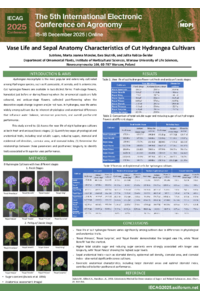
The postharvest longevity of cut hydrangea flowers is a critical determinant of their commercial value, which is largely influenced by cultivar-specific physiological and anatomical traits. This study evaluated the vase life and sepal anatomical characteristics of eight cut hydrangea cultivars (‘Royal Anastasia’, ‘Royal Benefit’, ‘Royal King’, ‘Royal Opera’, ‘Royal Palace’, ‘Royal Parade’, ‘Royal Princess’, and ‘Royal Surprise’). Vase life was assessed at both fresh and antique/classic stages, while sepal traits, including total soluble sugars, reducing sugars, epidermal and stomatal densities, stomatal area, and stomatal index, were quantified. Significant differences were observed among cultivars. ‘Royal Princess’ and ‘Royal Surprise’ exhibited the longest overall vase life (22.7 and 21.7 days, respectively), while ‘Royal Parade’ also maintained extended vase longevity (20.9 days). In contrast, ‘Royal Benefit’ had the shortest vase life (10.6 days). Higher total soluble sugar and reducing sugar contents were strongly associated with prolonged vase life, with ‘Royal Palace’ recording the highest mean soluble sugar (236.01 mg g⁻¹ FW) and reducing sugar (203.12 mg g⁻¹ FW) levels. Sepal anatomical features also varied significantly: ‘Royal King’ and ‘Royal Princess’ had the largest stomatal areas (441.56 and 445.31 μm², respectively), while ‘Royal Anastasia’ showed the highest stomatal (37.27 mm⁻²) and epidermal (690.24 mm⁻²) cell densities. ‘Royal Surprise’ recorded the highest stomatal index (7.24%). Overall, extended vase life was closely linked to high sugar content and favourable sepal anatomical traits, suggesting that these parameters can serve as indicators for selecting hydrangea cultivars with superior postharvest performance.
Keywords
postharvest longevity
stomatal density
epidermal cell density
stomatal index
stomatal area
postharvest performance
Poster
sciforum-152431.pdf
Mitigating Combined Salinity and Drought Stress in Chickpea (Cicer arietinum L.) through Biochar Amendment
Improving the nutritional value and growth of Eschscholzia californica Cham. through iodine biofortification