Event submissions
Published
This submission belongs to the session S6. Basic Plant Science of the event The 5th International Electronic Conference on Agronomy
Published date
11 Dec, 2025
Academic Editor
'%3e%3cpath%20d='M12.6657%2010.9104C12.4185%2010.325%2012.0599%209.79327%2011.6097%209.34482C11.1609%208.89508%2010.6293%208.5365%2010.0442%208.28888C10.0389%208.28626%2010.0337%208.28495%2010.0285%208.28233C10.8446%207.69279%2011.3752%206.73249%2011.3752%205.64904C11.3752%203.8542%209.92103%202.39999%208.1262%202.39999C6.33136%202.39999%204.87715%203.8542%204.87715%205.64904C4.87715%206.73249%205.40774%207.69279%206.22393%208.28364C6.21869%208.28626%206.21345%208.28757%206.20821%208.29019C5.62129%208.5378%205.09463%208.89284%204.64265%209.34613C4.1929%209.79493%203.83432%2010.3266%203.58671%2010.9117C3.34345%2011.4845%203.21226%2012.0987%203.20023%2012.7209C3.19988%2012.7349%203.20233%2012.7488%203.20744%2012.7619C3.21255%2012.7749%203.22022%2012.7867%203.22998%2012.7968C3.23975%2012.8068%203.25142%2012.8147%203.26431%2012.8202C3.2772%2012.8256%203.29105%2012.8284%203.30504%2012.8284H4.09109C4.14874%2012.8284%204.19459%2012.7825%204.1959%2012.7262C4.2221%2011.7148%204.62823%2010.7676%205.34617%2010.0497C6.08899%209.30683%207.0755%208.89808%208.1262%208.89808C9.17689%208.89808%2010.1634%209.30683%2010.9062%2010.0497C11.6242%2010.7676%2012.0303%2011.7148%2012.0565%2012.7262C12.0578%2012.7838%2012.1037%2012.8284%2012.1613%2012.8284H12.9474C12.9613%2012.8284%2012.9752%2012.8256%2012.9881%2012.8202C13.001%2012.8147%2013.0126%2012.8068%2013.0224%2012.7968C13.0322%2012.7867%2013.0398%2012.7749%2013.0449%2012.7619C13.0501%2012.7488%2013.0525%2012.7349%2013.0522%2012.7209C13.0391%2012.0947%2012.9094%2011.4855%2012.6657%2010.9104ZM8.1262%207.9024C7.52486%207.9024%206.9589%207.6679%206.53312%207.24211C6.10733%206.81633%205.87283%206.25037%205.87283%205.64904C5.87283%205.0477%206.10733%204.48174%206.53312%204.05596C6.9589%203.63018%207.52486%203.39567%208.1262%203.39567C8.72753%203.39567%209.29349%203.63018%209.71927%204.05596C10.1451%204.48174%2010.3796%205.0477%2010.3796%205.64904C10.3796%206.25037%2010.1451%206.81633%209.71927%207.24211C9.29349%207.6679%208.72753%207.9024%208.1262%207.9024Z'%20fill='%235D1EE1'/%3e%3c/g%3e%3c/svg%3e) Othmane Merah
Othmane MerahCitation
Marta Liszka-Skoczylas, Łukasz Skoczylas, Iwona Ledwożyw-Smoleń, Sylwester Smoleń, Maciej Gustab, Iodine biofortification of Eschscholzia californica Cham. and its effect on the mineral composition of plants, in Proceedings of The 5th International Electronic Conference on Agronomy, 15 December–18 December 2025, MDPI: Basel, Switzerland
Share
Email
Facebook
Twitter
LinkedIn
Iodine biofortification of Eschscholzia californica Cham. and its effect on the mineral composition of plants
'%3e%3cpath%20d='M12.6647%2010.9104C12.4176%2010.325%2012.0589%209.7933%2011.6088%209.34485C11.16%208.89511%2010.6283%208.53653%2010.0432%208.28891C10.038%208.28629%2010.0327%208.28498%2010.0275%208.28236C10.8437%207.69282%2011.3743%206.73252%2011.3743%205.64907C11.3743%203.85423%209.92005%202.40002%208.12522%202.40002C6.33038%202.40002%204.87618%203.85423%204.87618%205.64907C4.87618%206.73252%205.40677%207.69282%206.22296%208.28367C6.21772%208.28629%206.21248%208.2876%206.20724%208.29022C5.62031%208.53783%205.09365%208.89287%204.64167%209.34616C4.19192%209.79496%203.83334%2010.3266%203.58573%2010.9117C3.34247%2011.4846%203.21128%2012.0987%203.19925%2012.721C3.1989%2012.735%203.20135%2012.7489%203.20646%2012.7619C3.21157%2012.7749%203.21924%2012.7868%203.22901%2012.7968C3.23877%2012.8068%203.25045%2012.8148%203.26334%2012.8202C3.27623%2012.8256%203.29007%2012.8284%203.30406%2012.8284H4.09012C4.14776%2012.8284%204.19362%2012.7825%204.19493%2012.7262C4.22113%2011.7148%204.62726%2010.7676%205.34519%2010.0497C6.08802%209.30686%207.07452%208.89811%208.12522%208.89811C9.17592%208.89811%2010.1624%209.30686%2010.9052%2010.0497C11.6232%2010.7676%2012.0293%2011.7148%2012.0555%2012.7262C12.0568%2012.7839%2012.1027%2012.8284%2012.1603%2012.8284H12.9464C12.9604%2012.8284%2012.9742%2012.8256%2012.9871%2012.8202C13%2012.8148%2013.0117%2012.8068%2013.0214%2012.7968C13.0312%2012.7868%2013.0389%2012.7749%2013.044%2012.7619C13.0491%2012.7489%2013.0515%2012.735%2013.0512%2012.721C13.0381%2012.0947%2012.9084%2011.4856%2012.6647%2010.9104ZM8.12522%207.90243C7.52388%207.90243%206.95792%207.66793%206.53214%207.24215C6.10636%206.81636%205.87185%206.2504%205.87185%205.64907C5.87185%205.04773%206.10636%204.48177%206.53214%204.05599C6.95792%203.63021%207.52388%203.3957%208.12522%203.3957C8.72655%203.3957%209.29252%203.63021%209.7183%204.05599C10.1441%204.48177%2010.3786%205.04773%2010.3786%205.64907C10.3786%206.2504%2010.1441%206.81636%209.7183%207.24215C9.29252%207.66793%208.72655%207.90243%208.12522%207.90243Z'%20fill='%235D1EE1'/%3e%3c/g%3e%3c/svg%3e)
Marta Liszka-Skoczylas 1
Łukasz Skoczylas 1
Iwona Ledwożyw-Smoleń 2
Sylwester Smoleń 2
Maciej Gustab 2
1. Faculty of Food Technology, University of Agriculture in Krakow, al. Mickiewicza 21, 31-120 Krakow, Poland
2. Faculty of Biotechnology And Horticulture, University of Agriculture in Krakow, al. Mickiewicza 21, 31-120 Krakow, Poland
Abstract
One of the greatest challenges facing global health policy is the burden of chronic non-communicable diseases caused by nutrient deficiencies. Plants' biofortification has been proposed as a method of introducing essential nutrients into the human diet. An increased level of one element can affect the content of others in the plant and, thus, the health-promoting properties of plant materials.
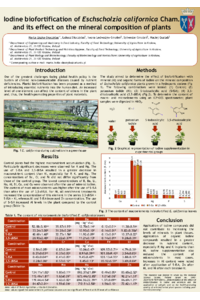
The study aimed to determine the effect of biofortification with mineral (KI) and organic forms of iodine: 5-iodosalicylic acid (5-ISA) and 3,5-diiodosalicylic acid (3,5-diISA) on the mineral composition of Eschscholzia californica plants grown in a hydroponic system. The following combinations were tested: (1) Control; (2) KI; (3) 5-ISA; (4) 3,5-diISA.
To determine the content of macro- and microelements (P, K, Ca, Mg, S, Al, Ba, B, Be, Bi, Co, Cr, Cu, Fe, Li, Mn, Mo, Na, Ni, Zn) using an ICP-OES spectrometer, plant samples were digested in HNO3.
Control plants had the highest macronutrient accumulation. Particularly significant decreases were observed for K and Mg. The use of 5-ISA and 3,5-diISA resulted in a greater decrease in macronutrient content than KI, especially for P, K, and Mg. The concentrations of Be, Cr, and Fe did not differ significantly from those of the control group. The lowest concentrations of B, Ba, Li, Na, Al, Bi, Co, and Cu were observed after the use of mineral iodine. The content of most micronutrients was higher after the use of 5-ISA than after the use of 3,5-diISA. For Ni, all enrichment treatments increased the concentration of this element in the series 3,5-diISA > 5-ISA > KI, whereas KI and 5-ISA increased Zn concentration. The use of 5-ISA increased Al levels in the plant compared to the control group.
Keywords
biofortification
mineral composition
iodine
Poster
PosterMDPILiszka-Skoczylas.pdf
Improving the nutritional value and growth of Eschscholzia californica Cham. through iodine biofortification
Antioxidant properties of California poppy (Eschscholzia californica Cham) plants biofortified with iodine