Event submissions
Published
This submission belongs to the session S1. Biostimulation and Biocontrol Strategies of the event The 5th International Electronic Conference on Agronomy
Published date
11 Dec, 2025
Academic Editor
'%3e%3cpath%20d='M12.6657%2010.9104C12.4185%2010.325%2012.0599%209.79327%2011.6097%209.34482C11.1609%208.89508%2010.6293%208.5365%2010.0442%208.28888C10.0389%208.28626%2010.0337%208.28495%2010.0285%208.28233C10.8446%207.69279%2011.3752%206.73249%2011.3752%205.64904C11.3752%203.8542%209.92103%202.39999%208.1262%202.39999C6.33136%202.39999%204.87715%203.8542%204.87715%205.64904C4.87715%206.73249%205.40774%207.69279%206.22393%208.28364C6.21869%208.28626%206.21345%208.28757%206.20821%208.29019C5.62129%208.5378%205.09463%208.89284%204.64265%209.34613C4.1929%209.79493%203.83432%2010.3266%203.58671%2010.9117C3.34345%2011.4845%203.21226%2012.0987%203.20023%2012.7209C3.19988%2012.7349%203.20233%2012.7488%203.20744%2012.7619C3.21255%2012.7749%203.22022%2012.7867%203.22998%2012.7968C3.23975%2012.8068%203.25142%2012.8147%203.26431%2012.8202C3.2772%2012.8256%203.29105%2012.8284%203.30504%2012.8284H4.09109C4.14874%2012.8284%204.19459%2012.7825%204.1959%2012.7262C4.2221%2011.7148%204.62823%2010.7676%205.34617%2010.0497C6.08899%209.30683%207.0755%208.89808%208.1262%208.89808C9.17689%208.89808%2010.1634%209.30683%2010.9062%2010.0497C11.6242%2010.7676%2012.0303%2011.7148%2012.0565%2012.7262C12.0578%2012.7838%2012.1037%2012.8284%2012.1613%2012.8284H12.9474C12.9613%2012.8284%2012.9752%2012.8256%2012.9881%2012.8202C13.001%2012.8147%2013.0126%2012.8068%2013.0224%2012.7968C13.0322%2012.7867%2013.0398%2012.7749%2013.0449%2012.7619C13.0501%2012.7488%2013.0525%2012.7349%2013.0522%2012.7209C13.0391%2012.0947%2012.9094%2011.4855%2012.6657%2010.9104ZM8.1262%207.9024C7.52486%207.9024%206.9589%207.6679%206.53312%207.24211C6.10733%206.81633%205.87283%206.25037%205.87283%205.64904C5.87283%205.0477%206.10733%204.48174%206.53312%204.05596C6.9589%203.63018%207.52486%203.39567%208.1262%203.39567C8.72753%203.39567%209.29349%203.63018%209.71927%204.05596C10.1451%204.48174%2010.3796%205.0477%2010.3796%205.64904C10.3796%206.25037%2010.1451%206.81633%209.71927%207.24211C9.29349%207.6679%208.72753%207.9024%208.1262%207.9024Z'%20fill='%235D1EE1'/%3e%3c/g%3e%3c/svg%3e) Monica Boscaiu
Monica BoscaiuCitation
Matilde Rodrigues, M. Beatriz P.P. Oliveira, Celestino Santos Buelga, José Pinela, Plant-based biostimulants for sustainable crop performance, in Proceedings of The 5th International Electronic Conference on Agronomy, 15 December–18 December 2025, MDPI: Basel, Switzerland
Share
Email
Facebook
Twitter
LinkedIn
Plant-based biostimulants for sustainable crop performance

Matilde Rodrigues 1,2,3

M. Beatriz P.P. Oliveira 2

Celestino Santos Buelga 3

José Pinela 1,4
1. CIMO, La SusTEC, Polytechnique Institute of Bragança, Campus de Santa Apolónia, 5300-253 Bragança, Portugal
2. LAQV/REQUIMTE, Department of Chemical Sciences, Faculty of Pharmacy, University of Porto, Rua Jorge Viterbo Ferreira, 228, 4050-313 Porto, Portugal
3. GIP-USAL, Faculty of Pharmacy, University of Salamanca, Campus Miguel de Unamuno s/n, 37007 Salamanca, Spain
4. National Institute for Agricultural and Veterinary Research (INIAV, I.P.), Rua dos Lágidos, Lugar da Madalena, 4485-655 Vairão - Vila do Conde, Portugal
Abstract
Modern agriculture faces mounting challenges from climate change, soil degradation, and the overuse of synthetic agrochemicals, which contribute to environmental pollution, biodiversity loss, and the emergence of more resistant pests and diseases. Plant-derived biostimulants have emerged as sustainable tools to improve crop productivity while mitigating ecological impacts. Unlike conventional fertilizers that primarily supply nutrients, biostimulants act through diverse physiological and molecular mechanisms, including phytohormone regulation (e.g., auxin-like activity), activation of antioxidant defenses, and modulation of the soil microbiome. These actions enhance nutrient use efficiency, strengthen tolerance to abiotic stresses such as drought and salinity, and improve crop quality traits. Plant extracts rich in bioactive compounds, such as polyphenols and signaling compounds, have demonstrated strong potential to stimulate root development, increase photosynthetic activity in crops like tomato and wheat, and promote soil health. Despite these benefits, several barriers hinder their large-scale adoption, including the need for standardized extracts, consistent field performance across diverse conditions, and harmonized regulatory frameworks. This review highlights successful applications of plant-based biostimulants in major food crops and explores recent innovations in their production from agri-food by-products, with particular focus on advanced extraction methods (intensified by enzymes, microwaves, and ultrasound) and formulation strategies (such as emulsification). Ultimately, this work underscores the role of plant-derived biostimulants in fostering more sustainable and resilient agricultural systems, aligning with global food security and safety goals.
Keywords
Agriculture
Plant-based biostimulants
Sustainable crop
Poster
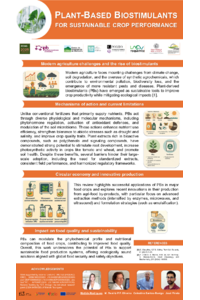
Poster_Agronomy_Matilde Rodrigues.pdf
Antioxidant properties of California poppy (Eschscholzia californica Cham) plants biofortified with iodine
Plant Extracts as Dual-Action Agents: Biostimulation and Biocontrol Strategies for Sustainable Crop Production