Event submissions
Published
This submission belongs to the session S6. Basic Plant Science of the event The 5th International Electronic Conference on Agronomy
Published date
11 Dec, 2025
Academic Editor
'%3e%3cpath%20d='M12.6657%2010.9104C12.4185%2010.325%2012.0599%209.79327%2011.6097%209.34482C11.1609%208.89508%2010.6293%208.5365%2010.0442%208.28888C10.0389%208.28626%2010.0337%208.28495%2010.0285%208.28233C10.8446%207.69279%2011.3752%206.73249%2011.3752%205.64904C11.3752%203.8542%209.92103%202.39999%208.1262%202.39999C6.33136%202.39999%204.87715%203.8542%204.87715%205.64904C4.87715%206.73249%205.40774%207.69279%206.22393%208.28364C6.21869%208.28626%206.21345%208.28757%206.20821%208.29019C5.62129%208.5378%205.09463%208.89284%204.64265%209.34613C4.1929%209.79493%203.83432%2010.3266%203.58671%2010.9117C3.34345%2011.4845%203.21226%2012.0987%203.20023%2012.7209C3.19988%2012.7349%203.20233%2012.7488%203.20744%2012.7619C3.21255%2012.7749%203.22022%2012.7867%203.22998%2012.7968C3.23975%2012.8068%203.25142%2012.8147%203.26431%2012.8202C3.2772%2012.8256%203.29105%2012.8284%203.30504%2012.8284H4.09109C4.14874%2012.8284%204.19459%2012.7825%204.1959%2012.7262C4.2221%2011.7148%204.62823%2010.7676%205.34617%2010.0497C6.08899%209.30683%207.0755%208.89808%208.1262%208.89808C9.17689%208.89808%2010.1634%209.30683%2010.9062%2010.0497C11.6242%2010.7676%2012.0303%2011.7148%2012.0565%2012.7262C12.0578%2012.7838%2012.1037%2012.8284%2012.1613%2012.8284H12.9474C12.9613%2012.8284%2012.9752%2012.8256%2012.9881%2012.8202C13.001%2012.8147%2013.0126%2012.8068%2013.0224%2012.7968C13.0322%2012.7867%2013.0398%2012.7749%2013.0449%2012.7619C13.0501%2012.7488%2013.0525%2012.7349%2013.0522%2012.7209C13.0391%2012.0947%2012.9094%2011.4855%2012.6657%2010.9104ZM8.1262%207.9024C7.52486%207.9024%206.9589%207.6679%206.53312%207.24211C6.10733%206.81633%205.87283%206.25037%205.87283%205.64904C5.87283%205.0477%206.10733%204.48174%206.53312%204.05596C6.9589%203.63018%207.52486%203.39567%208.1262%203.39567C8.72753%203.39567%209.29349%203.63018%209.71927%204.05596C10.1451%204.48174%2010.3796%205.0477%2010.3796%205.64904C10.3796%206.25037%2010.1451%206.81633%209.71927%207.24211C9.29349%207.6679%208.72753%207.9024%208.1262%207.9024Z'%20fill='%235D1EE1'/%3e%3c/g%3e%3c/svg%3e) Oscar Vicente
Oscar VicenteCitation
Anna Górka, Julia Kiper, Content of Selected Essential and Toxic Metals in Adaptogenic Plants Supporting Post-COVID-19 Recovery, in Proceedings of The 5th International Electronic Conference on Agronomy, 15 December–18 December 2025, MDPI: Basel, Switzerland
Share
Email
Facebook
Twitter
LinkedIn
Content of Selected Essential and Toxic Metals in Adaptogenic Plants Supporting Post-COVID-19 Recovery
'%3e%3cpath%20d='M12.6647%2010.9104C12.4176%2010.325%2012.0589%209.7933%2011.6088%209.34485C11.16%208.89511%2010.6283%208.53653%2010.0432%208.28891C10.038%208.28629%2010.0327%208.28498%2010.0275%208.28236C10.8437%207.69282%2011.3743%206.73252%2011.3743%205.64907C11.3743%203.85423%209.92005%202.40002%208.12522%202.40002C6.33038%202.40002%204.87618%203.85423%204.87618%205.64907C4.87618%206.73252%205.40677%207.69282%206.22296%208.28367C6.21772%208.28629%206.21248%208.2876%206.20724%208.29022C5.62031%208.53783%205.09365%208.89287%204.64167%209.34616C4.19192%209.79496%203.83334%2010.3266%203.58573%2010.9117C3.34247%2011.4846%203.21128%2012.0987%203.19925%2012.721C3.1989%2012.735%203.20135%2012.7489%203.20646%2012.7619C3.21157%2012.7749%203.21924%2012.7868%203.22901%2012.7968C3.23877%2012.8068%203.25045%2012.8148%203.26334%2012.8202C3.27623%2012.8256%203.29007%2012.8284%203.30406%2012.8284H4.09012C4.14776%2012.8284%204.19362%2012.7825%204.19493%2012.7262C4.22113%2011.7148%204.62726%2010.7676%205.34519%2010.0497C6.08802%209.30686%207.07452%208.89811%208.12522%208.89811C9.17592%208.89811%2010.1624%209.30686%2010.9052%2010.0497C11.6232%2010.7676%2012.0293%2011.7148%2012.0555%2012.7262C12.0568%2012.7839%2012.1027%2012.8284%2012.1603%2012.8284H12.9464C12.9604%2012.8284%2012.9742%2012.8256%2012.9871%2012.8202C13%2012.8148%2013.0117%2012.8068%2013.0214%2012.7968C13.0312%2012.7868%2013.0389%2012.7749%2013.044%2012.7619C13.0491%2012.7489%2013.0515%2012.735%2013.0512%2012.721C13.0381%2012.0947%2012.9084%2011.4856%2012.6647%2010.9104ZM8.12522%207.90243C7.52388%207.90243%206.95792%207.66793%206.53214%207.24215C6.10636%206.81636%205.87185%206.2504%205.87185%205.64907C5.87185%205.04773%206.10636%204.48177%206.53214%204.05599C6.95792%203.63021%207.52388%203.3957%208.12522%203.3957C8.72655%203.3957%209.29252%203.63021%209.7183%204.05599C10.1441%204.48177%2010.3786%205.04773%2010.3786%205.64907C10.3786%206.2504%2010.1441%206.81636%209.7183%207.24215C9.29252%207.66793%208.72655%207.90243%208.12522%207.90243Z'%20fill='%235D1EE1'/%3e%3c/g%3e%3c/svg%3e)
Anna Górka 1
Julia Kiper 1
1. Faculty of Biotechnology, University of Rzeszow, Rzeszów, 35-310, Poland
Abstract
Introduction:
The COVID-19 pandemic, which began in late 2019, has drawn global attention to natural methods of supporting health during recovery. Adaptogens — plant-derived substances enhancing resilience to stress and boosting immunity — may play a vital role in post-infection rehabilitation. This study aimed to determine the content of essential (Mn, Mg, Cu, K, Na, Fe) and toxic (Cr, Cd, Pb, Sr) elements in selected adaptogenic plants used in recovery after SARS-CoV-2 infection.
Methods:
Six plant materials — Withania somnifera (ashwagandha), Centella asiatica (gotu kola), Schisandra chinensis (schisandra), Lycium barbarum (goji berries), Lepidium meyenii (maca), and Glycyrrhiza glabra (licorice root) — were analyzed. Elemental concentrations were determined using atomic absorption spectroscopy (ContrAA 700, Analytik Jena). Results were compared with literature data and international safety limits for heavy metals in herbal products.
Results:
Gotu kola exhibited the highest concentrations of most elements, including Fe (1274.76 mg/kg), Mn (251.95 mg/kg), K (21866.10 mg/kg), Na (2895.86 mg/kg), Cu (12.35 mg/kg), and Cr (29.09 mg/kg). Licorice root showed the highest Sr content (68.90 mg/kg). Cd levels slightly exceeded the permissible limit (1 mg/kg) in gotu kola (1.735 mg/kg) and maca (1.023 mg/kg). Pb concentrations in all plants were below 3.0 mg/kg. The lowest Fe content was found in goji berries (39.61 mg/kg), while schisandra had the lowest Na (25.12 mg/kg) and Sr (2.42 mg/kg) levels.
Conclusions:
The elemental analysis confirmed notable variability among the tested adaptogens, reflecting differences in their origin, cultivation conditions, and possible environmental exposure. Although Cd concentrations in gotu kola and maca slightly exceeded regulatory thresholds, overall heavy metal levels remained within safe limits for human consumption when adhering to recommended dosages. The high mineral content in certain species, particularly gotu kola, indicates their potential contribution to dietary mineral intake during convalescence. These findings highlight the importance of monitoring elemental composition in medicinal plants to ensure both safety and therapeutic effectiveness.
Keywords
adaptogens
metal content
Poster
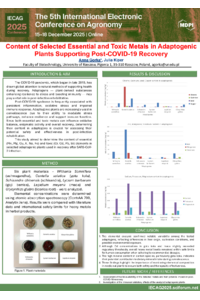
Poster IECAG 2025.pdf
Characterization of EST-SSR markers associated with oil biosynthesis in Castor (Ricinus communis L.)
Optimized Micropropagation for the Production of Disease-Free Planting Materials of Zingiber officinale Roscoe ‘Bentong’