Event submissions
Published
This submission belongs to the session S2. Breeding and Selection Technologies of the event The 5th International Electronic Conference on Agronomy
Published date
11 Dec, 2025
Academic Editor
'%3e%3cpath%20d='M12.6657%2010.9104C12.4185%2010.325%2012.0599%209.79327%2011.6097%209.34482C11.1609%208.89508%2010.6293%208.5365%2010.0442%208.28888C10.0389%208.28626%2010.0337%208.28495%2010.0285%208.28233C10.8446%207.69279%2011.3752%206.73249%2011.3752%205.64904C11.3752%203.8542%209.92103%202.39999%208.1262%202.39999C6.33136%202.39999%204.87715%203.8542%204.87715%205.64904C4.87715%206.73249%205.40774%207.69279%206.22393%208.28364C6.21869%208.28626%206.21345%208.28757%206.20821%208.29019C5.62129%208.5378%205.09463%208.89284%204.64265%209.34613C4.1929%209.79493%203.83432%2010.3266%203.58671%2010.9117C3.34345%2011.4845%203.21226%2012.0987%203.20023%2012.7209C3.19988%2012.7349%203.20233%2012.7488%203.20744%2012.7619C3.21255%2012.7749%203.22022%2012.7867%203.22998%2012.7968C3.23975%2012.8068%203.25142%2012.8147%203.26431%2012.8202C3.2772%2012.8256%203.29105%2012.8284%203.30504%2012.8284H4.09109C4.14874%2012.8284%204.19459%2012.7825%204.1959%2012.7262C4.2221%2011.7148%204.62823%2010.7676%205.34617%2010.0497C6.08899%209.30683%207.0755%208.89808%208.1262%208.89808C9.17689%208.89808%2010.1634%209.30683%2010.9062%2010.0497C11.6242%2010.7676%2012.0303%2011.7148%2012.0565%2012.7262C12.0578%2012.7838%2012.1037%2012.8284%2012.1613%2012.8284H12.9474C12.9613%2012.8284%2012.9752%2012.8256%2012.9881%2012.8202C13.001%2012.8147%2013.0126%2012.8068%2013.0224%2012.7968C13.0322%2012.7867%2013.0398%2012.7749%2013.0449%2012.7619C13.0501%2012.7488%2013.0525%2012.7349%2013.0522%2012.7209C13.0391%2012.0947%2012.9094%2011.4855%2012.6657%2010.9104ZM8.1262%207.9024C7.52486%207.9024%206.9589%207.6679%206.53312%207.24211C6.10733%206.81633%205.87283%206.25037%205.87283%205.64904C5.87283%205.0477%206.10733%204.48174%206.53312%204.05596C6.9589%203.63018%207.52486%203.39567%208.1262%203.39567C8.72753%203.39567%209.29349%203.63018%209.71927%204.05596C10.1451%204.48174%2010.3796%205.0477%2010.3796%205.64904C10.3796%206.25037%2010.1451%206.81633%209.71927%207.24211C9.29349%207.6679%208.72753%207.9024%208.1262%207.9024Z'%20fill='%235D1EE1'/%3e%3c/g%3e%3c/svg%3e) Jaime Prohens
Jaime ProhensCitation
Cristovao Domingos Francisco Bolacha, Paola Silva, Amade Muitia, Maria Carvalho, ANALYSIS OF ROSETTA DISEASE RESISTANCE IN ADVANCED GROUNDNUT LINES IN NORTHERN MOZAMBIQUE, in Proceedings of The 5th International Electronic Conference on Agronomy, 15 December–18 December 2025, MDPI: Basel, Switzerland
Share
Email
Facebook
Twitter
LinkedIn
ANALYSIS OF ROSETTA DISEASE RESISTANCE IN ADVANCED GROUNDNUT LINES IN NORTHERN MOZAMBIQUE
'%3e%3cpath%20d='M12.6647%2010.9104C12.4176%2010.325%2012.0589%209.7933%2011.6088%209.34485C11.16%208.89511%2010.6283%208.53653%2010.0432%208.28891C10.038%208.28629%2010.0327%208.28498%2010.0275%208.28236C10.8437%207.69282%2011.3743%206.73252%2011.3743%205.64907C11.3743%203.85423%209.92005%202.40002%208.12522%202.40002C6.33038%202.40002%204.87618%203.85423%204.87618%205.64907C4.87618%206.73252%205.40677%207.69282%206.22296%208.28367C6.21772%208.28629%206.21248%208.2876%206.20724%208.29022C5.62031%208.53783%205.09365%208.89287%204.64167%209.34616C4.19192%209.79496%203.83334%2010.3266%203.58573%2010.9117C3.34247%2011.4846%203.21128%2012.0987%203.19925%2012.721C3.1989%2012.735%203.20135%2012.7489%203.20646%2012.7619C3.21157%2012.7749%203.21924%2012.7868%203.22901%2012.7968C3.23877%2012.8068%203.25045%2012.8148%203.26334%2012.8202C3.27623%2012.8256%203.29007%2012.8284%203.30406%2012.8284H4.09012C4.14776%2012.8284%204.19362%2012.7825%204.19493%2012.7262C4.22113%2011.7148%204.62726%2010.7676%205.34519%2010.0497C6.08802%209.30686%207.07452%208.89811%208.12522%208.89811C9.17592%208.89811%2010.1624%209.30686%2010.9052%2010.0497C11.6232%2010.7676%2012.0293%2011.7148%2012.0555%2012.7262C12.0568%2012.7839%2012.1027%2012.8284%2012.1603%2012.8284H12.9464C12.9604%2012.8284%2012.9742%2012.8256%2012.9871%2012.8202C13%2012.8148%2013.0117%2012.8068%2013.0214%2012.7968C13.0312%2012.7868%2013.0389%2012.7749%2013.044%2012.7619C13.0491%2012.7489%2013.0515%2012.735%2013.0512%2012.721C13.0381%2012.0947%2012.9084%2011.4856%2012.6647%2010.9104ZM8.12522%207.90243C7.52388%207.90243%206.95792%207.66793%206.53214%207.24215C6.10636%206.81636%205.87185%206.2504%205.87185%205.64907C5.87185%205.04773%206.10636%204.48177%206.53214%204.05599C6.95792%203.63021%207.52388%203.3957%208.12522%203.3957C8.72655%203.3957%209.29252%203.63021%209.7183%204.05599C10.1441%204.48177%2010.3786%205.04773%2010.3786%205.64907C10.3786%206.2504%2010.1441%206.81636%209.7183%207.24215C9.29252%207.66793%208.72655%207.90243%208.12522%207.90243Z'%20fill='%235D1EE1'/%3e%3c/g%3e%3c/svg%3e)
Cristovao Domingos Francisco Bolacha 1,2
Paola Silva 2
Amade Muitia 1
Maria Carvalho 1
1. Nampula Agronomic Station - Groundnut Breeding Program, Agricultural Research Institute of Mozambique, Nampula 3100, Mozambique
2. Department of Crop Production - Soil and Water Crop Laboratory, Faculty of Agronomic Sciences, University of Chile, Santiago 8820808, Chile
Abstract
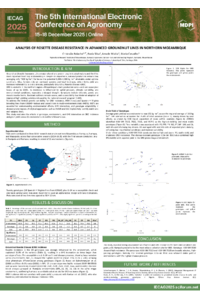
Groundnut Rosette Disease (GRD) is one of the most severe biotic constraints limiting groundnut (Arachis hypogaea L.) production in sub-Saharan Africa, often causing devastating yield losses in smallholder farming systems. This study evaluated the resistance to GRD and grain yield performance of 20 advanced groundnut lines across 11 diverse environments in northern Mozambique over four growing seasons (2014–2018). Trials were conducted using an alpha-lattice design with two replications per location, each comprising four incomplete blocks. Traits assessed included phenological development (days to emergence, flowering, and harvest), plant establishment (number of emerged and harvested plants), yield components (pods per square meter, maturity percentage, 100-seed weight, grain percentage, pod yield, grain yield), and GRD incidence. Data were subjected to combined analysis of variance, genotype-by-environment (G×E) interaction assessment, stability analysis, AMMI and SREG biplot models, and principal component analysis. Significant G×E effects were observed, indicating that environmental factors played a dominant role in trait expression. GRD incidence was most pronounced in the NPL_15 environment, where the susceptible check JL-24 showed 70% infection. In contrast, advanced lines 7508, 7533, and 7566 consistently exhibited high resistance, with only 2% incidence. Yield performance was not consistently correlated with GRD incidence, but high grain yields were associated with superior plant stand at harvest, pod density, and grain recovery percentage. Line 7510 demonstrated broad adaptation across test sites, whereas lines 96714 and 7539 displayed specific adaptation to Namapa and Mapupulo environments, respectively. These findings highlight promising resistant genotypes for deployment in breeding programs targeting GRD-endemic regions of Mozambique.
Keywords
GxE interaction
GRV
adaptation
Mozambique
Poster
Poster MDPI.pdf
Synergistic Application of Melatonin and Myo-Inositol Strengthens Root Development, Plant Growth Responses, and Drought Tolerance in Western Himalayan Apple Rootstocks
Ethnobotanical Meta-Screening of Dual-Action Allelopathic Biostimulants: From Traditional Mediterranean Knowledge to Precision Bioformulations