Event submissions
Published
This submission belongs to the session S1. Biostimulation and Biocontrol Strategies of the event The 5th International Electronic Conference on Agronomy
Published date
11 Dec, 2025
Academic Editor
'%3e%3cpath%20d='M12.6657%2010.9104C12.4185%2010.325%2012.0599%209.79327%2011.6097%209.34482C11.1609%208.89508%2010.6293%208.5365%2010.0442%208.28888C10.0389%208.28626%2010.0337%208.28495%2010.0285%208.28233C10.8446%207.69279%2011.3752%206.73249%2011.3752%205.64904C11.3752%203.8542%209.92103%202.39999%208.1262%202.39999C6.33136%202.39999%204.87715%203.8542%204.87715%205.64904C4.87715%206.73249%205.40774%207.69279%206.22393%208.28364C6.21869%208.28626%206.21345%208.28757%206.20821%208.29019C5.62129%208.5378%205.09463%208.89284%204.64265%209.34613C4.1929%209.79493%203.83432%2010.3266%203.58671%2010.9117C3.34345%2011.4845%203.21226%2012.0987%203.20023%2012.7209C3.19988%2012.7349%203.20233%2012.7488%203.20744%2012.7619C3.21255%2012.7749%203.22022%2012.7867%203.22998%2012.7968C3.23975%2012.8068%203.25142%2012.8147%203.26431%2012.8202C3.2772%2012.8256%203.29105%2012.8284%203.30504%2012.8284H4.09109C4.14874%2012.8284%204.19459%2012.7825%204.1959%2012.7262C4.2221%2011.7148%204.62823%2010.7676%205.34617%2010.0497C6.08899%209.30683%207.0755%208.89808%208.1262%208.89808C9.17689%208.89808%2010.1634%209.30683%2010.9062%2010.0497C11.6242%2010.7676%2012.0303%2011.7148%2012.0565%2012.7262C12.0578%2012.7838%2012.1037%2012.8284%2012.1613%2012.8284H12.9474C12.9613%2012.8284%2012.9752%2012.8256%2012.9881%2012.8202C13.001%2012.8147%2013.0126%2012.8068%2013.0224%2012.7968C13.0322%2012.7867%2013.0398%2012.7749%2013.0449%2012.7619C13.0501%2012.7488%2013.0525%2012.7349%2013.0522%2012.7209C13.0391%2012.0947%2012.9094%2011.4855%2012.6657%2010.9104ZM8.1262%207.9024C7.52486%207.9024%206.9589%207.6679%206.53312%207.24211C6.10733%206.81633%205.87283%206.25037%205.87283%205.64904C5.87283%205.0477%206.10733%204.48174%206.53312%204.05596C6.9589%203.63018%207.52486%203.39567%208.1262%203.39567C8.72753%203.39567%209.29349%203.63018%209.71927%204.05596C10.1451%204.48174%2010.3796%205.0477%2010.3796%205.64904C10.3796%206.25037%2010.1451%206.81633%209.71927%207.24211C9.29349%207.6679%208.72753%207.9024%208.1262%207.9024Z'%20fill='%235D1EE1'/%3e%3c/g%3e%3c/svg%3e) Monica Boscaiu
Monica BoscaiuCitation
Shefali Vinod Ramteke, Prof. Dr. Pritish Kumar Varadwaj, Dr. Vineet Tiwari, UAV Biostimulant Spraying in Tall Sugarcane: Field Efficacy and Rotor–Canopy Airflow Modeling, in Proceedings of The 5th International Electronic Conference on Agronomy, 15 December–18 December 2025, MDPI: Basel, Switzerland
Share
Email
Facebook
Twitter
LinkedIn
UAV Biostimulant Spraying in Tall Sugarcane: Field Efficacy and Rotor–Canopy Airflow Modeling

Shefali Vinod Ramteke 1
'%3e%3cpath%20d='M12.6647%2010.9104C12.4176%2010.325%2012.0589%209.7933%2011.6088%209.34485C11.16%208.89511%2010.6283%208.53653%2010.0432%208.28891C10.038%208.28629%2010.0327%208.28498%2010.0275%208.28236C10.8437%207.69282%2011.3743%206.73252%2011.3743%205.64907C11.3743%203.85423%209.92005%202.40002%208.12522%202.40002C6.33038%202.40002%204.87618%203.85423%204.87618%205.64907C4.87618%206.73252%205.40677%207.69282%206.22296%208.28367C6.21772%208.28629%206.21248%208.2876%206.20724%208.29022C5.62031%208.53783%205.09365%208.89287%204.64167%209.34616C4.19192%209.79496%203.83334%2010.3266%203.58573%2010.9117C3.34247%2011.4846%203.21128%2012.0987%203.19925%2012.721C3.1989%2012.735%203.20135%2012.7489%203.20646%2012.7619C3.21157%2012.7749%203.21924%2012.7868%203.22901%2012.7968C3.23877%2012.8068%203.25045%2012.8148%203.26334%2012.8202C3.27623%2012.8256%203.29007%2012.8284%203.30406%2012.8284H4.09012C4.14776%2012.8284%204.19362%2012.7825%204.19493%2012.7262C4.22113%2011.7148%204.62726%2010.7676%205.34519%2010.0497C6.08802%209.30686%207.07452%208.89811%208.12522%208.89811C9.17592%208.89811%2010.1624%209.30686%2010.9052%2010.0497C11.6232%2010.7676%2012.0293%2011.7148%2012.0555%2012.7262C12.0568%2012.7839%2012.1027%2012.8284%2012.1603%2012.8284H12.9464C12.9604%2012.8284%2012.9742%2012.8256%2012.9871%2012.8202C13%2012.8148%2013.0117%2012.8068%2013.0214%2012.7968C13.0312%2012.7868%2013.0389%2012.7749%2013.044%2012.7619C13.0491%2012.7489%2013.0515%2012.735%2013.0512%2012.721C13.0381%2012.0947%2012.9084%2011.4856%2012.6647%2010.9104ZM8.12522%207.90243C7.52388%207.90243%206.95792%207.66793%206.53214%207.24215C6.10636%206.81636%205.87185%206.2504%205.87185%205.64907C5.87185%205.04773%206.10636%204.48177%206.53214%204.05599C6.95792%203.63021%207.52388%203.3957%208.12522%203.3957C8.72655%203.3957%209.29252%203.63021%209.7183%204.05599C10.1441%204.48177%2010.3786%205.04773%2010.3786%205.64907C10.3786%206.2504%2010.1441%206.81636%209.7183%207.24215C9.29252%207.66793%208.72655%207.90243%208.12522%207.90243Z'%20fill='%235D1EE1'/%3e%3c/g%3e%3c/svg%3e)
Prof. Dr. Pritish Kumar Varadwaj 1
Dr. Vineet Tiwari 2
1. Department of Applied Sciences, Indian Institute of Information Technology Allahabad, Prayagraj 211015, India
2. Department of Management Studies, Indian Institute of Information Technology Allahabad, Prayagraj 211015, India
Abstract
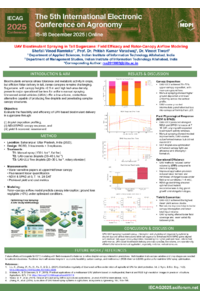
Biostimulants can improve crop vigor, yet delivering them efficiently in tall, dense canopies remains challenging. We conducted a randomized field experiment in sugarcane (Saharanpur, India; 2023) to compare UAV spraying with manual knapsack application for a seaweed-based foliar biostimulant at matched active ingredient rates. A micro-UAV generated NDVI maps to schedule two spray windows (Grand Growth and Elongation). Three treatments were tested: T1 manual (150 L ha⁻¹, flat-fan), T2 UAV–coarse (30–40 L ha⁻¹, pressure nozzles, VMD ≈250–300 µm), and T3 UAV–fine/ULV (20–30 L ha⁻¹, rotary atomizers, VMD ≈120–150 µm). Deposition and penetration were quantified with water-sensitive cards and a fluorescent tracer at upper/mid/lower strata; canopy response was tracked by SPAD and NDVI at 0, 7, 14, and 28 DAT; and yield and operational metrics were recorded. To interpret deposition patterns, we added a lightweight rotor–canopy airflow model: a momentum-disk downwash coupled to a porous-media canopy (sugarcane leaf-area density 2–4 m² m⁻³) and a Lagrangian droplet settling–advection calculation for 120–300 µm droplets at 2.5–3.0 m AGL and 3–4 m s⁻¹. The model predicted higher residence time and interception for 120–150 µm droplets in the upper/mid canopy and guided flight-line overlap/height settings. Field results were consistent: UAV–ULV achieved more uniform mid/upper coverage at a ≥70% lower carrier volume versus manual, with comparable or improved NDVI/SPAD gains at 7–14 DAT, minimal off-target drift under 1–4 m s⁻¹ winds, and maintained or higher yield and net return. NDVI-guided, airflow-informed UAV biostimulant delivery appears technically feasible and operationally efficient for tall sugarcane canopies.
Keywords
biostimulants
NDVI
UAV spraying
rotary atomizer
canopy porosity
deposition
sugarcane
precision agriculture
Poster
IECAG 2025 Conf Dec.pdf
Iodine biofortification of Eschscholzia californica Cham. plants with the use of various iodine compounds and their effect on the biosynthesis of selected alkaloids
Morphological characterization of Persea americana Mill. var. ‘Hass’ selections outstanding in fruit yield and quality