Event submissions
Published
This submission belongs to the session S1. Biostimulation and Biocontrol Strategies of the event The 5th International Electronic Conference on Agronomy
Published date
11 Dec, 2025
Academic Editor
'%3e%3cpath%20d='M12.6657%2010.9104C12.4185%2010.325%2012.0599%209.79327%2011.6097%209.34482C11.1609%208.89508%2010.6293%208.5365%2010.0442%208.28888C10.0389%208.28626%2010.0337%208.28495%2010.0285%208.28233C10.8446%207.69279%2011.3752%206.73249%2011.3752%205.64904C11.3752%203.8542%209.92103%202.39999%208.1262%202.39999C6.33136%202.39999%204.87715%203.8542%204.87715%205.64904C4.87715%206.73249%205.40774%207.69279%206.22393%208.28364C6.21869%208.28626%206.21345%208.28757%206.20821%208.29019C5.62129%208.5378%205.09463%208.89284%204.64265%209.34613C4.1929%209.79493%203.83432%2010.3266%203.58671%2010.9117C3.34345%2011.4845%203.21226%2012.0987%203.20023%2012.7209C3.19988%2012.7349%203.20233%2012.7488%203.20744%2012.7619C3.21255%2012.7749%203.22022%2012.7867%203.22998%2012.7968C3.23975%2012.8068%203.25142%2012.8147%203.26431%2012.8202C3.2772%2012.8256%203.29105%2012.8284%203.30504%2012.8284H4.09109C4.14874%2012.8284%204.19459%2012.7825%204.1959%2012.7262C4.2221%2011.7148%204.62823%2010.7676%205.34617%2010.0497C6.08899%209.30683%207.0755%208.89808%208.1262%208.89808C9.17689%208.89808%2010.1634%209.30683%2010.9062%2010.0497C11.6242%2010.7676%2012.0303%2011.7148%2012.0565%2012.7262C12.0578%2012.7838%2012.1037%2012.8284%2012.1613%2012.8284H12.9474C12.9613%2012.8284%2012.9752%2012.8256%2012.9881%2012.8202C13.001%2012.8147%2013.0126%2012.8068%2013.0224%2012.7968C13.0322%2012.7867%2013.0398%2012.7749%2013.0449%2012.7619C13.0501%2012.7488%2013.0525%2012.7349%2013.0522%2012.7209C13.0391%2012.0947%2012.9094%2011.4855%2012.6657%2010.9104ZM8.1262%207.9024C7.52486%207.9024%206.9589%207.6679%206.53312%207.24211C6.10733%206.81633%205.87283%206.25037%205.87283%205.64904C5.87283%205.0477%206.10733%204.48174%206.53312%204.05596C6.9589%203.63018%207.52486%203.39567%208.1262%203.39567C8.72753%203.39567%209.29349%203.63018%209.71927%204.05596C10.1451%204.48174%2010.3796%205.0477%2010.3796%205.64904C10.3796%206.25037%2010.1451%206.81633%209.71927%207.24211C9.29349%207.6679%208.72753%207.9024%208.1262%207.9024Z'%20fill='%235D1EE1'/%3e%3c/g%3e%3c/svg%3e) Monica Boscaiu
Monica BoscaiuCitation
Rodrigo Jiménez-Rivera, Nicolás Vargas-Flores, Jonathan Alfredo Fernandez-Mendiola, Fernando Ortiz-Salgado, Elisa Dominguez-Hernandez, Martha Elena Domínguez Hernandez, Functional Data Analysis of Foliar Biostimulant Effects on Cucumber (Cucumis sativus) Yield Dynamics in Hydroponic Greenhouse Cultivation, in Proceedings of The 5th International Electronic Conference on Agronomy, 15 December–18 December 2025, MDPI: Basel, Switzerland
Share
Email
Facebook
Twitter
LinkedIn
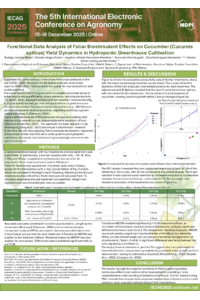
Functional Data Analysis of Foliar Biostimulant Effects on Cucumber (Cucumis sativus) Yield Dynamics in Hydroponic Greenhouse Cultivation
'%3e%3cpath%20d='M12.6647%2010.9104C12.4176%2010.325%2012.0589%209.7933%2011.6088%209.34485C11.16%208.89511%2010.6283%208.53653%2010.0432%208.28891C10.038%208.28629%2010.0327%208.28498%2010.0275%208.28236C10.8437%207.69282%2011.3743%206.73252%2011.3743%205.64907C11.3743%203.85423%209.92005%202.40002%208.12522%202.40002C6.33038%202.40002%204.87618%203.85423%204.87618%205.64907C4.87618%206.73252%205.40677%207.69282%206.22296%208.28367C6.21772%208.28629%206.21248%208.2876%206.20724%208.29022C5.62031%208.53783%205.09365%208.89287%204.64167%209.34616C4.19192%209.79496%203.83334%2010.3266%203.58573%2010.9117C3.34247%2011.4846%203.21128%2012.0987%203.19925%2012.721C3.1989%2012.735%203.20135%2012.7489%203.20646%2012.7619C3.21157%2012.7749%203.21924%2012.7868%203.22901%2012.7968C3.23877%2012.8068%203.25045%2012.8148%203.26334%2012.8202C3.27623%2012.8256%203.29007%2012.8284%203.30406%2012.8284H4.09012C4.14776%2012.8284%204.19362%2012.7825%204.19493%2012.7262C4.22113%2011.7148%204.62726%2010.7676%205.34519%2010.0497C6.08802%209.30686%207.07452%208.89811%208.12522%208.89811C9.17592%208.89811%2010.1624%209.30686%2010.9052%2010.0497C11.6232%2010.7676%2012.0293%2011.7148%2012.0555%2012.7262C12.0568%2012.7839%2012.1027%2012.8284%2012.1603%2012.8284H12.9464C12.9604%2012.8284%2012.9742%2012.8256%2012.9871%2012.8202C13%2012.8148%2013.0117%2012.8068%2013.0214%2012.7968C13.0312%2012.7868%2013.0389%2012.7749%2013.044%2012.7619C13.0491%2012.7489%2013.0515%2012.735%2013.0512%2012.721C13.0381%2012.0947%2012.9084%2011.4856%2012.6647%2010.9104ZM8.12522%207.90243C7.52388%207.90243%206.95792%207.66793%206.53214%207.24215C6.10636%206.81636%205.87185%206.2504%205.87185%205.64907C5.87185%205.04773%206.10636%204.48177%206.53214%204.05599C6.95792%203.63021%207.52388%203.3957%208.12522%203.3957C8.72655%203.3957%209.29252%203.63021%209.7183%204.05599C10.1441%204.48177%2010.3786%205.04773%2010.3786%205.64907C10.3786%206.2504%2010.1441%206.81636%209.7183%207.24215C9.29252%207.66793%208.72655%207.90243%208.12522%207.90243Z'%20fill='%235D1EE1'/%3e%3c/g%3e%3c/svg%3e)
Rodrigo Jiménez-Rivera 1
Nicolás Vargas-Flores 1
Jonathan Alfredo Fernandez-Mendiola 1
Fernando Ortiz-Salgado 1
Elisa Dominguez-Hernandez 2,3

Martha Elena Domínguez Hernandez 1
1. Department of Agricultural Sciences, Faculty of Higher Studies Cuautitlán, National Autonomous University of Mexico, Cuautitlán Izcalli 54714, Mexico
2. Department of Mathematics, Faculty of Higher Studies Cuautitlán, National Autonomous University of Mexico, Cuautitlán Izcalli 54714, Mexico
3. Graduate Programme in Systems Engineering, Research and Graduate Studies Section, Higher School of Mechanical and Electrical Engineering, National Polytechnic Institute, Gustavo A. Madero 07738, Mexico
Abstract
This study evaluated the effect of foliar application of biostimulants on cucumber crops (Cucumis sativus var. Centauro) under greenhouse conditions in a hydroponic system with a substrate. Applications were made every 15 days after transplanting to analyze the influence of biostimulants on fruit productivity over four cuts. Treatments were as follows: T1 (control, water), T2 (algal extract with bioactive compounds from Ascophyllum nodosum, N, K, B and Zn), T3 (foliar formulation with a high concentration of Mg, B and Zn), and T4 (a mixture of T2 and T3). Additionally, a nutrient solution with 14N, 1.5P, 7K, 8Ca, 2.5Mg and 3S was supplied during the production cycle. This study also applied Functional Data Analysis (FDA) to evaluate the dynamic responses of accumulated cucumber yield. Raw data were converted into continuous functions and functional principal component analysis (FPCA) was used to decompose yield trajectories into principal components for each treatment. FDA revealed significant (p = 0.04) treatment effects, with biostimulant treatments exhibiting shapes similar to each other but different from T1. Functional principal component analysis (FPCA) identified one major variation mode (94.3% variance) linked to an increased response or acceleration between the second and third cut, particularly for T4. Functional ANOVA also confirmed significant (p < 0.01) treatment effects between these cuts, which was not observed with traditional repeated-measures ANOVA, as total harvest weight per cut was not affected by the application of biostimulants (P≥0.9). T4 (algal extract + Mg-B-Zn) maximized yield via early-phase acceleration. FDA captured continuous yield dynamics, revealing inflection points commonly missed by traditional methods.
Keywords
functional responses
productivity
biostimulant
sustainable agriculture
yield curve
Poster
sciforum-145365.pdf
Morphological characterization of Persea americana Mill. var. ‘Hass’ selections outstanding in fruit yield and quality
New insights on the production of grafted walnut plants