Event submissions
Published
This submission belongs to the session S2. Breeding and Selection Technologies of the event The 5th International Electronic Conference on Agronomy
Published date
11 Dec, 2025
Academic Editor
'%3e%3cpath%20d='M12.6657%2010.9104C12.4185%2010.325%2012.0599%209.79327%2011.6097%209.34482C11.1609%208.89508%2010.6293%208.5365%2010.0442%208.28888C10.0389%208.28626%2010.0337%208.28495%2010.0285%208.28233C10.8446%207.69279%2011.3752%206.73249%2011.3752%205.64904C11.3752%203.8542%209.92103%202.39999%208.1262%202.39999C6.33136%202.39999%204.87715%203.8542%204.87715%205.64904C4.87715%206.73249%205.40774%207.69279%206.22393%208.28364C6.21869%208.28626%206.21345%208.28757%206.20821%208.29019C5.62129%208.5378%205.09463%208.89284%204.64265%209.34613C4.1929%209.79493%203.83432%2010.3266%203.58671%2010.9117C3.34345%2011.4845%203.21226%2012.0987%203.20023%2012.7209C3.19988%2012.7349%203.20233%2012.7488%203.20744%2012.7619C3.21255%2012.7749%203.22022%2012.7867%203.22998%2012.7968C3.23975%2012.8068%203.25142%2012.8147%203.26431%2012.8202C3.2772%2012.8256%203.29105%2012.8284%203.30504%2012.8284H4.09109C4.14874%2012.8284%204.19459%2012.7825%204.1959%2012.7262C4.2221%2011.7148%204.62823%2010.7676%205.34617%2010.0497C6.08899%209.30683%207.0755%208.89808%208.1262%208.89808C9.17689%208.89808%2010.1634%209.30683%2010.9062%2010.0497C11.6242%2010.7676%2012.0303%2011.7148%2012.0565%2012.7262C12.0578%2012.7838%2012.1037%2012.8284%2012.1613%2012.8284H12.9474C12.9613%2012.8284%2012.9752%2012.8256%2012.9881%2012.8202C13.001%2012.8147%2013.0126%2012.8068%2013.0224%2012.7968C13.0322%2012.7867%2013.0398%2012.7749%2013.0449%2012.7619C13.0501%2012.7488%2013.0525%2012.7349%2013.0522%2012.7209C13.0391%2012.0947%2012.9094%2011.4855%2012.6657%2010.9104ZM8.1262%207.9024C7.52486%207.9024%206.9589%207.6679%206.53312%207.24211C6.10733%206.81633%205.87283%206.25037%205.87283%205.64904C5.87283%205.0477%206.10733%204.48174%206.53312%204.05596C6.9589%203.63018%207.52486%203.39567%208.1262%203.39567C8.72753%203.39567%209.29349%203.63018%209.71927%204.05596C10.1451%204.48174%2010.3796%205.0477%2010.3796%205.64904C10.3796%206.25037%2010.1451%206.81633%209.71927%207.24211C9.29349%207.6679%208.72753%207.9024%208.1262%207.9024Z'%20fill='%235D1EE1'/%3e%3c/g%3e%3c/svg%3e) Jaime Prohens
Jaime ProhensCitation
Pedro Miguel Santos Marques Tavares, Agusto Peixe, Augusto Ribeiro, Hélia Cardoso, Rita Pires, New insights on the production of grafted walnut plants, in Proceedings of The 5th International Electronic Conference on Agronomy, 15 December–18 December 2025, MDPI: Basel, Switzerland
Share
Email
Facebook
Twitter
LinkedIn
New insights on the production of grafted walnut plants
'%3e%3cpath%20d='M12.6647%2010.9104C12.4176%2010.325%2012.0589%209.7933%2011.6088%209.34485C11.16%208.89511%2010.6283%208.53653%2010.0432%208.28891C10.038%208.28629%2010.0327%208.28498%2010.0275%208.28236C10.8437%207.69282%2011.3743%206.73252%2011.3743%205.64907C11.3743%203.85423%209.92005%202.40002%208.12522%202.40002C6.33038%202.40002%204.87618%203.85423%204.87618%205.64907C4.87618%206.73252%205.40677%207.69282%206.22296%208.28367C6.21772%208.28629%206.21248%208.2876%206.20724%208.29022C5.62031%208.53783%205.09365%208.89287%204.64167%209.34616C4.19192%209.79496%203.83334%2010.3266%203.58573%2010.9117C3.34247%2011.4846%203.21128%2012.0987%203.19925%2012.721C3.1989%2012.735%203.20135%2012.7489%203.20646%2012.7619C3.21157%2012.7749%203.21924%2012.7868%203.22901%2012.7968C3.23877%2012.8068%203.25045%2012.8148%203.26334%2012.8202C3.27623%2012.8256%203.29007%2012.8284%203.30406%2012.8284H4.09012C4.14776%2012.8284%204.19362%2012.7825%204.19493%2012.7262C4.22113%2011.7148%204.62726%2010.7676%205.34519%2010.0497C6.08802%209.30686%207.07452%208.89811%208.12522%208.89811C9.17592%208.89811%2010.1624%209.30686%2010.9052%2010.0497C11.6232%2010.7676%2012.0293%2011.7148%2012.0555%2012.7262C12.0568%2012.7839%2012.1027%2012.8284%2012.1603%2012.8284H12.9464C12.9604%2012.8284%2012.9742%2012.8256%2012.9871%2012.8202C13%2012.8148%2013.0117%2012.8068%2013.0214%2012.7968C13.0312%2012.7868%2013.0389%2012.7749%2013.044%2012.7619C13.0491%2012.7489%2013.0515%2012.735%2013.0512%2012.721C13.0381%2012.0947%2012.9084%2011.4856%2012.6647%2010.9104ZM8.12522%207.90243C7.52388%207.90243%206.95792%207.66793%206.53214%207.24215C6.10636%206.81636%205.87185%206.2504%205.87185%205.64907C5.87185%205.04773%206.10636%204.48177%206.53214%204.05599C6.95792%203.63021%207.52388%203.3957%208.12522%203.3957C8.72655%203.3957%209.29252%203.63021%209.7183%204.05599C10.1441%204.48177%2010.3786%205.04773%2010.3786%205.64907C10.3786%206.2504%2010.1441%206.81636%209.7183%207.24215C9.29252%207.66793%208.72655%207.90243%208.12522%207.90243Z'%20fill='%235D1EE1'/%3e%3c/g%3e%3c/svg%3e)
Pedro Miguel Santos Marques Tavares 1

Agusto Peixe 2
Augusto Ribeiro 3

Hélia Cardoso 2
Rita Pires 2,4
1. Cerfundão- Embalamento e Comercialização de Cereja da Cova da Beira, LDA., MACB Zona Industrial do Fundão, Apartado 91, 6230-348 Fundão, Portugal;
2. Mediterranean Institute for Agriculture, Environment and Development (MED), CHANGE – Global Change and Sustainability Institute, University of Évora, Mitra Campus, P.O. Box 94, Évora 7002-554, Portugal
3. Microplant Lda., University of Évora, Mitra Campus, P.O. Box 94, Évora 7006-554, Portugal
4. IIFA (Institute for Research and Advanced Training), University of Évora, Mitra Campus, Ap. 94, 7002-554 Évora, Portugal
Abstract
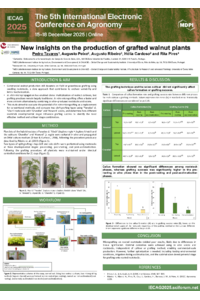
The commercial production of walnut plants still relies on field or greenhouse grafting using seedling plants as rootstocks. This is a time-consuming process, requiring at least two years to produce a grafted plant, and often results in orchard heterogeneity, thereby complicating mechanization procedures. In recent years, in vitro micropropagation has enabled the clonal propagation of walnut cultivars and rootstocks; however, grafting practices remain largely dependent on traditional nursery methods. In vitro micrografting, based on the use of in vitro produced rootstocks and scions, may significantly reduce the time required to produce a grafted walnut plant. In this study, in vitro regenerated shoots of ‘Paradox’ (Juglans hindsii × Juglans regia) cl. ‘Vlach’ were used as rootstocks for micrografting, while J. regia cvs. ‘Chandler’ and ‘Howard’ were used as scions. Two cleft grafting types, top and side, were tested across three developmental stages of the rootstock (pre-rooting, post-rooting, and post-acclimatization). The results showed that for both cleft grafting methods and for the two cultivars, no statistically significant differences were found. In contrast, statistically significant differences emerged among the different phases in which micrografting was performed. The highest grafting success was achieved with cv. ‘Howard’ using the side cleft method during the pre-rooting phase of rootstock development. Although further optimization is required, the results highlight the potential of in vitro micrografting as an alternative to conventional grafting methods.
Keywords
asexual propagation
Juglans sp.
nursery
tissue culture
micrografting.
Poster
Tavares et al._Poster IECAG2025.pdf
Functional Data Analysis of Foliar Biostimulant Effects on Cucumber (Cucumis sativus) Yield Dynamics in Hydroponic Greenhouse Cultivation
Patterns of Natural Egg Parasitism by Telenomus sp. (Hymenoptera: Scelionidae) on Stink Bug Pests in Argentine Rice Fields