Event submissions
Published
This submission belongs to the session S6. Basic Plant Science of the event The 5th International Electronic Conference on Agronomy
Published date
11 Dec, 2025
Academic Editor
'%3e%3cpath%20d='M12.6657%2010.9104C12.4185%2010.325%2012.0599%209.79327%2011.6097%209.34482C11.1609%208.89508%2010.6293%208.5365%2010.0442%208.28888C10.0389%208.28626%2010.0337%208.28495%2010.0285%208.28233C10.8446%207.69279%2011.3752%206.73249%2011.3752%205.64904C11.3752%203.8542%209.92103%202.39999%208.1262%202.39999C6.33136%202.39999%204.87715%203.8542%204.87715%205.64904C4.87715%206.73249%205.40774%207.69279%206.22393%208.28364C6.21869%208.28626%206.21345%208.28757%206.20821%208.29019C5.62129%208.5378%205.09463%208.89284%204.64265%209.34613C4.1929%209.79493%203.83432%2010.3266%203.58671%2010.9117C3.34345%2011.4845%203.21226%2012.0987%203.20023%2012.7209C3.19988%2012.7349%203.20233%2012.7488%203.20744%2012.7619C3.21255%2012.7749%203.22022%2012.7867%203.22998%2012.7968C3.23975%2012.8068%203.25142%2012.8147%203.26431%2012.8202C3.2772%2012.8256%203.29105%2012.8284%203.30504%2012.8284H4.09109C4.14874%2012.8284%204.19459%2012.7825%204.1959%2012.7262C4.2221%2011.7148%204.62823%2010.7676%205.34617%2010.0497C6.08899%209.30683%207.0755%208.89808%208.1262%208.89808C9.17689%208.89808%2010.1634%209.30683%2010.9062%2010.0497C11.6242%2010.7676%2012.0303%2011.7148%2012.0565%2012.7262C12.0578%2012.7838%2012.1037%2012.8284%2012.1613%2012.8284H12.9474C12.9613%2012.8284%2012.9752%2012.8256%2012.9881%2012.8202C13.001%2012.8147%2013.0126%2012.8068%2013.0224%2012.7968C13.0322%2012.7867%2013.0398%2012.7749%2013.0449%2012.7619C13.0501%2012.7488%2013.0525%2012.7349%2013.0522%2012.7209C13.0391%2012.0947%2012.9094%2011.4855%2012.6657%2010.9104ZM8.1262%207.9024C7.52486%207.9024%206.9589%207.6679%206.53312%207.24211C6.10733%206.81633%205.87283%206.25037%205.87283%205.64904C5.87283%205.0477%206.10733%204.48174%206.53312%204.05596C6.9589%203.63018%207.52486%203.39567%208.1262%203.39567C8.72753%203.39567%209.29349%203.63018%209.71927%204.05596C10.1451%204.48174%2010.3796%205.0477%2010.3796%205.64904C10.3796%206.25037%2010.1451%206.81633%209.71927%207.24211C9.29349%207.6679%208.72753%207.9024%208.1262%207.9024Z'%20fill='%235D1EE1'/%3e%3c/g%3e%3c/svg%3e) Othmane Merah
Othmane MerahCitation
Khendo Flowers, Chao-Hsien Lin, Pearl Pei-Chun Chang, Antimicrobial Potential of Crop-Derived Extracts of Echinacea purpurea and Chenopodium formosanum against Oral Pathogens, in Proceedings of The 5th International Electronic Conference on Agronomy, 15 December–18 December 2025, MDPI: Basel, Switzerland
Share
Email
Facebook
Twitter
LinkedIn
Antimicrobial Potential of Crop-Derived Extracts of Echinacea purpurea and Chenopodium formosanum against Oral Pathogens
'%3e%3cpath%20d='M12.6647%2010.9104C12.4176%2010.325%2012.0589%209.7933%2011.6088%209.34485C11.16%208.89511%2010.6283%208.53653%2010.0432%208.28891C10.038%208.28629%2010.0327%208.28498%2010.0275%208.28236C10.8437%207.69282%2011.3743%206.73252%2011.3743%205.64907C11.3743%203.85423%209.92005%202.40002%208.12522%202.40002C6.33038%202.40002%204.87618%203.85423%204.87618%205.64907C4.87618%206.73252%205.40677%207.69282%206.22296%208.28367C6.21772%208.28629%206.21248%208.2876%206.20724%208.29022C5.62031%208.53783%205.09365%208.89287%204.64167%209.34616C4.19192%209.79496%203.83334%2010.3266%203.58573%2010.9117C3.34247%2011.4846%203.21128%2012.0987%203.19925%2012.721C3.1989%2012.735%203.20135%2012.7489%203.20646%2012.7619C3.21157%2012.7749%203.21924%2012.7868%203.22901%2012.7968C3.23877%2012.8068%203.25045%2012.8148%203.26334%2012.8202C3.27623%2012.8256%203.29007%2012.8284%203.30406%2012.8284H4.09012C4.14776%2012.8284%204.19362%2012.7825%204.19493%2012.7262C4.22113%2011.7148%204.62726%2010.7676%205.34519%2010.0497C6.08802%209.30686%207.07452%208.89811%208.12522%208.89811C9.17592%208.89811%2010.1624%209.30686%2010.9052%2010.0497C11.6232%2010.7676%2012.0293%2011.7148%2012.0555%2012.7262C12.0568%2012.7839%2012.1027%2012.8284%2012.1603%2012.8284H12.9464C12.9604%2012.8284%2012.9742%2012.8256%2012.9871%2012.8202C13%2012.8148%2013.0117%2012.8068%2013.0214%2012.7968C13.0312%2012.7868%2013.0389%2012.7749%2013.044%2012.7619C13.0491%2012.7489%2013.0515%2012.735%2013.0512%2012.721C13.0381%2012.0947%2012.9084%2011.4856%2012.6647%2010.9104ZM8.12522%207.90243C7.52388%207.90243%206.95792%207.66793%206.53214%207.24215C6.10636%206.81636%205.87185%206.2504%205.87185%205.64907C5.87185%205.04773%206.10636%204.48177%206.53214%204.05599C6.95792%203.63021%207.52388%203.3957%208.12522%203.3957C8.72655%203.3957%209.29252%203.63021%209.7183%204.05599C10.1441%204.48177%2010.3786%205.04773%2010.3786%205.64907C10.3786%206.2504%2010.1441%206.81636%209.7183%207.24215C9.29252%207.66793%208.72655%207.90243%208.12522%207.90243Z'%20fill='%235D1EE1'/%3e%3c/g%3e%3c/svg%3e)
Khendo Flowers 1
Chao-Hsien Lin 2

Pearl Pei-Chun Chang 1,3
1. Department of Tropical Agriculture and International Cooperation, National Pingtung University of Science and Technology, Pingtung, 912301, Taiwan
2. Department of Cosmetic Science, Chia Nan University of Pharmacy and Science, Tainan 71710, Taiwan
3. Department of Biological Science and Technology, National Pingtung University of Science and Technology, Pingtung 912301, Taiwan
Abstract
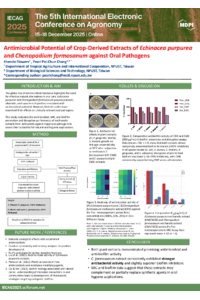
Antimicrobial resistance has emerged as one of the most pressing global health threats, reducing the effectiveness of conventional antibiotics and increasing the prevalence of untreatable infections. In response, researchers are turning to natural sources, particularly crop plants or their by-products, known for their antimicrobial potential. Exploring these crop-derived compounds not only addresses the urgent need for novel therapeutic options but also contributes to the valorization of agricultural resources for human health applications. This study investigated the in vitro antimicrobial activity of methanolic extracts prepared from Echinacea purpurea flowers and Chenopodium formosanum (djulis) seed husks against major human oral pathogens. Plant materials were macerated in 100% methanol, filtered, and concentrated by rotary evaporation. Antimicrobial activity was assessed using the disk diffusion method, with ampicillin and ketoconazole serving as positive controls for bacteria and fungi, respectively. Triplicate experiments were analyzed by one-way ANOVA and Tukey’s post hoc test. The methanolic extract of C. formosanum husk (CFH) demonstrated stronger antibacterial activity than the E. purpurea flower (EPF). At full strength (100%), both extracts produced the largest inhibition zones, with Staphylococcus aureus being the most susceptible (EPF: 21.6 ± 0.49 mm; CFH: 24.2 ± 0.85 mm). Escherichia coli and Porphyromonas gingivalis showed no inhibition at 25% EPF, whereas concentrations ≥ 50% of both extracts significantly inhibited E. coli, Streptococcus mutans, and P. gingivalis. Candida albicans exhibited marked resistance to both extracts. Statistical analysis confirmed significant (p < 0.05) differences in antimicrobial effects depending on extract type, microbial strain, and concentration. These results highlight the potential of crop-derived methanolic extracts as promising natural antimicrobial agents, contributing to sustainable approaches for managing microbial infections.
Keywords
Antimicrobial resistance
ethnobotanical
phytochemicals
plant extracts
purple coneflower
quinoa
Poster
sciforum-145042.pdf
Patterns of Natural Egg Parasitism by Telenomus sp. (Hymenoptera: Scelionidae) on Stink Bug Pests in Argentine Rice Fields
Unravelling the Proteomic landscape of Olive Somatic Embryogenesis through LC-MS/MS