Event submissions
Published
This submission belongs to the session S1. Biostimulation and Biocontrol Strategies of the event The 5th International Electronic Conference on Agronomy
Published date
11 Dec, 2025
Academic Editor
'%3e%3cpath%20d='M12.6657%2010.9104C12.4185%2010.325%2012.0599%209.79327%2011.6097%209.34482C11.1609%208.89508%2010.6293%208.5365%2010.0442%208.28888C10.0389%208.28626%2010.0337%208.28495%2010.0285%208.28233C10.8446%207.69279%2011.3752%206.73249%2011.3752%205.64904C11.3752%203.8542%209.92103%202.39999%208.1262%202.39999C6.33136%202.39999%204.87715%203.8542%204.87715%205.64904C4.87715%206.73249%205.40774%207.69279%206.22393%208.28364C6.21869%208.28626%206.21345%208.28757%206.20821%208.29019C5.62129%208.5378%205.09463%208.89284%204.64265%209.34613C4.1929%209.79493%203.83432%2010.3266%203.58671%2010.9117C3.34345%2011.4845%203.21226%2012.0987%203.20023%2012.7209C3.19988%2012.7349%203.20233%2012.7488%203.20744%2012.7619C3.21255%2012.7749%203.22022%2012.7867%203.22998%2012.7968C3.23975%2012.8068%203.25142%2012.8147%203.26431%2012.8202C3.2772%2012.8256%203.29105%2012.8284%203.30504%2012.8284H4.09109C4.14874%2012.8284%204.19459%2012.7825%204.1959%2012.7262C4.2221%2011.7148%204.62823%2010.7676%205.34617%2010.0497C6.08899%209.30683%207.0755%208.89808%208.1262%208.89808C9.17689%208.89808%2010.1634%209.30683%2010.9062%2010.0497C11.6242%2010.7676%2012.0303%2011.7148%2012.0565%2012.7262C12.0578%2012.7838%2012.1037%2012.8284%2012.1613%2012.8284H12.9474C12.9613%2012.8284%2012.9752%2012.8256%2012.9881%2012.8202C13.001%2012.8147%2013.0126%2012.8068%2013.0224%2012.7968C13.0322%2012.7867%2013.0398%2012.7749%2013.0449%2012.7619C13.0501%2012.7488%2013.0525%2012.7349%2013.0522%2012.7209C13.0391%2012.0947%2012.9094%2011.4855%2012.6657%2010.9104ZM8.1262%207.9024C7.52486%207.9024%206.9589%207.6679%206.53312%207.24211C6.10733%206.81633%205.87283%206.25037%205.87283%205.64904C5.87283%205.0477%206.10733%204.48174%206.53312%204.05596C6.9589%203.63018%207.52486%203.39567%208.1262%203.39567C8.72753%203.39567%209.29349%203.63018%209.71927%204.05596C10.1451%204.48174%2010.3796%205.0477%2010.3796%205.64904C10.3796%206.25037%2010.1451%206.81633%209.71927%207.24211C9.29349%207.6679%208.72753%207.9024%208.1262%207.9024Z'%20fill='%235D1EE1'/%3e%3c/g%3e%3c/svg%3e) Mercedes Verdeguer
Mercedes VerdeguerCitation
Alejandro Camors, Melanie Desiree Desirée Gomez Herrera, Alfonso Lovato Echeverria, Maria Victoria Traffano-Schiffo, Maria VIctoria Avanza, Fungal flora in cowpea crops in the province of Corrientes, Argentina, in Proceedings of The 5th International Electronic Conference on Agronomy, 15 December–18 December 2025, MDPI: Basel, Switzerland
Share
Email
Facebook
Twitter
LinkedIn
Fungal flora in cowpea crops in the province of Corrientes, Argentina
'%3e%3cpath%20d='M12.6647%2010.9104C12.4176%2010.325%2012.0589%209.7933%2011.6088%209.34485C11.16%208.89511%2010.6283%208.53653%2010.0432%208.28891C10.038%208.28629%2010.0327%208.28498%2010.0275%208.28236C10.8437%207.69282%2011.3743%206.73252%2011.3743%205.64907C11.3743%203.85423%209.92005%202.40002%208.12522%202.40002C6.33038%202.40002%204.87618%203.85423%204.87618%205.64907C4.87618%206.73252%205.40677%207.69282%206.22296%208.28367C6.21772%208.28629%206.21248%208.2876%206.20724%208.29022C5.62031%208.53783%205.09365%208.89287%204.64167%209.34616C4.19192%209.79496%203.83334%2010.3266%203.58573%2010.9117C3.34247%2011.4846%203.21128%2012.0987%203.19925%2012.721C3.1989%2012.735%203.20135%2012.7489%203.20646%2012.7619C3.21157%2012.7749%203.21924%2012.7868%203.22901%2012.7968C3.23877%2012.8068%203.25045%2012.8148%203.26334%2012.8202C3.27623%2012.8256%203.29007%2012.8284%203.30406%2012.8284H4.09012C4.14776%2012.8284%204.19362%2012.7825%204.19493%2012.7262C4.22113%2011.7148%204.62726%2010.7676%205.34519%2010.0497C6.08802%209.30686%207.07452%208.89811%208.12522%208.89811C9.17592%208.89811%2010.1624%209.30686%2010.9052%2010.0497C11.6232%2010.7676%2012.0293%2011.7148%2012.0555%2012.7262C12.0568%2012.7839%2012.1027%2012.8284%2012.1603%2012.8284H12.9464C12.9604%2012.8284%2012.9742%2012.8256%2012.9871%2012.8202C13%2012.8148%2013.0117%2012.8068%2013.0214%2012.7968C13.0312%2012.7868%2013.0389%2012.7749%2013.044%2012.7619C13.0491%2012.7489%2013.0515%2012.735%2013.0512%2012.721C13.0381%2012.0947%2012.9084%2011.4856%2012.6647%2010.9104ZM8.12522%207.90243C7.52388%207.90243%206.95792%207.66793%206.53214%207.24215C6.10636%206.81636%205.87185%206.2504%205.87185%205.64907C5.87185%205.04773%206.10636%204.48177%206.53214%204.05599C6.95792%203.63021%207.52388%203.3957%208.12522%203.3957C8.72655%203.3957%209.29252%203.63021%209.7183%204.05599C10.1441%204.48177%2010.3786%205.04773%2010.3786%205.64907C10.3786%206.2504%2010.1441%206.81636%209.7183%207.24215C9.29252%207.66793%208.72655%207.90243%208.12522%207.90243Z'%20fill='%235D1EE1'/%3e%3c/g%3e%3c/svg%3e)
Alejandro Camors 1
Melanie Desiree Desirée Gomez Herrera 2
Alfonso Lovato Echeverria 3
Maria Victoria Traffano-Schiffo 4
Maria VIctoria Avanza 4
1. Faculty of Exact, Natural Sciences and Surveying, National University of the Northeast (UNNE), Corrientes 3400, Argentina
2. Faculty of Agricultural Engineering, National University of the Northeast (UNNE), National Scientific and Technical Research Council (CONICET), Corrientes 3400, Argentina
3. Faculty of Agricultural Engineering, Department of Plant Protection, National University of the Northeast (UNNE), Corrientes 3400, Argentina
4. Institute of basic and applied chemistry (IQUIBA NEA UNNE CONICET), National University of the Northeast (UNNE) Roca Campus, Corrientes 3400, Argentina
Abstract
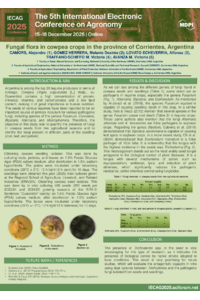
Argentina is among the top 20 legume producers in terms of tonnage. Cowpea (Vigna unguiculata [L.] Walp., cv. Cuarentón) contains a high concentration of protein, minerals, vitamins, and carbohydrates and a low lipid content, making it of great importance in human nutrition. The seeds of various legumes have been reported to be an important source of primary inoculum for various pathogenic fungi, including species of the genera Fusarium, Curvularia, Bipolaris, Alternaria, and Macrophomina, etc. Therefore, the objective of this study was to quantify the presence of fungi in cowpea seeds from two agricultural seasons and to identify the fungi present in different parts of the seedling (root, leaf, and petiole). The plant material was sown in Petri dishes with potato glucose agar with the addition of an antibiotic (streptomycin) to avoid bacterial contamination. For the seeds, 200 seeds of the Cuarentón variety were used. The results obtained were as follows: seeds from the 22/23 campaign: Trichoderma (11.5%), Fusarium (9%), Sordaria (4%), Alternaria (4%), Penicillium (3.5%), Aspergillus (2%), Bipolaris (0.5%), and Nigrospora (0.5%). Seed Campaign 23/24: Trichoderma (22%), Fusarium (7%), Curvularia (3%), Aspergillus (1.5%), and Nigrospora (0.5%). The fungi found in the sowing of the different parts of the seedling are the following: root: Fusarium and Exserohilum; leaves: Alternaria, Fusarium and Cladosporium; and petiole: Alternaria and Bipolaris. It is noteworthy that the genus Trichoderma is the fungus with the highest incidence levels in both campaigns. This microorganism stands out for being an excellent antagonist of fungal pathogens. Its use in the biological control of diseases is an indispensable tool today in the integrated management of pests and diseases of different crops. This work makes a first contribution to the search for native fungal antagonists in cowpea crops, in order to improve the control of fungal diseases.
Keywords
Trichoderma
cowpea
pathogenic fungi
Poster
sciforum-144900.pdf
Comparative Genomic Analysis of Three Pseudomonas Strains Reveals Biosynthetic Potential Underlying Antifungal Activity Against Phytopathogens
Spatiotemporal Dynamics of Ecological Health in Punjab (2001–2023): Integrated Remote Sensing Approach for Sustainable Paddy Cultivation