Event submissions
Published
This submission belongs to the session S3. "New" Crops for Adaptation to Climate Change of the event The 5th International Electronic Conference on Agronomy
Published date
11 Dec, 2025
Academic Editor
'%3e%3cpath%20d='M12.6657%2010.9104C12.4185%2010.325%2012.0599%209.79327%2011.6097%209.34482C11.1609%208.89508%2010.6293%208.5365%2010.0442%208.28888C10.0389%208.28626%2010.0337%208.28495%2010.0285%208.28233C10.8446%207.69279%2011.3752%206.73249%2011.3752%205.64904C11.3752%203.8542%209.92103%202.39999%208.1262%202.39999C6.33136%202.39999%204.87715%203.8542%204.87715%205.64904C4.87715%206.73249%205.40774%207.69279%206.22393%208.28364C6.21869%208.28626%206.21345%208.28757%206.20821%208.29019C5.62129%208.5378%205.09463%208.89284%204.64265%209.34613C4.1929%209.79493%203.83432%2010.3266%203.58671%2010.9117C3.34345%2011.4845%203.21226%2012.0987%203.20023%2012.7209C3.19988%2012.7349%203.20233%2012.7488%203.20744%2012.7619C3.21255%2012.7749%203.22022%2012.7867%203.22998%2012.7968C3.23975%2012.8068%203.25142%2012.8147%203.26431%2012.8202C3.2772%2012.8256%203.29105%2012.8284%203.30504%2012.8284H4.09109C4.14874%2012.8284%204.19459%2012.7825%204.1959%2012.7262C4.2221%2011.7148%204.62823%2010.7676%205.34617%2010.0497C6.08899%209.30683%207.0755%208.89808%208.1262%208.89808C9.17689%208.89808%2010.1634%209.30683%2010.9062%2010.0497C11.6242%2010.7676%2012.0303%2011.7148%2012.0565%2012.7262C12.0578%2012.7838%2012.1037%2012.8284%2012.1613%2012.8284H12.9474C12.9613%2012.8284%2012.9752%2012.8256%2012.9881%2012.8202C13.001%2012.8147%2013.0126%2012.8068%2013.0224%2012.7968C13.0322%2012.7867%2013.0398%2012.7749%2013.0449%2012.7619C13.0501%2012.7488%2013.0525%2012.7349%2013.0522%2012.7209C13.0391%2012.0947%2012.9094%2011.4855%2012.6657%2010.9104ZM8.1262%207.9024C7.52486%207.9024%206.9589%207.6679%206.53312%207.24211C6.10733%206.81633%205.87283%206.25037%205.87283%205.64904C5.87283%205.0477%206.10733%204.48174%206.53312%204.05596C6.9589%203.63018%207.52486%203.39567%208.1262%203.39567C8.72753%203.39567%209.29349%203.63018%209.71927%204.05596C10.1451%204.48174%2010.3796%205.0477%2010.3796%205.64904C10.3796%206.25037%2010.1451%206.81633%209.71927%207.24211C9.29349%207.6679%208.72753%207.9024%208.1262%207.9024Z'%20fill='%235D1EE1'/%3e%3c/g%3e%3c/svg%3e) Oscar Vicente
Oscar VicenteCitation
Teresa R. Freitas, João A. Santos, Paula Paredes, Helder Fraga, How Climate Change Could Affect Drought Risk in Portugal’s Traditional and Super-Intensive Olive Orchards, in Proceedings of The 5th International Electronic Conference on Agronomy, 15 December–18 December 2025, MDPI: Basel, Switzerland
Share
Email
Facebook
Twitter
LinkedIn
How Climate Change Could Affect Drought Risk in Portugal’s Traditional and Super-Intensive Olive Orchards

Teresa R. Freitas 1

João A. Santos 1

Paula Paredes 2

Helder Fraga 1
1. Centre for the Research and Technology of Agroenvironmental and Biological Sciences, CITAB, Inov4Agro, Universidade de Trás-os-Montes e Alto Douro, UTAD, Quinta de Prados, Vila Real 5000-801, Portugal
2. Linking Landscape, Environment, Agriculture and Food Research Center, LEAF, Associated Laboratory TERRA, Instituto Superior de Agronomia, Universidade de Lisboa, Tapada da Ajuda, Lisboa 1349–017, Portugal
Abstract
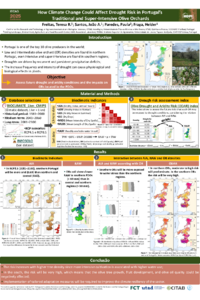
Portugal, a leading producer of olive oil, boasts six Protected Designation of Origin (PDO) regions, each characterised by distinct olive orchard (OR) densities, ranging from traditional to super-intensive. Although the analysis of drought and aridity conditions has been widely addressed, the impacts of these factors have not been analysed in relation to OR densities. To address this gap, a new metric, the Olive Drought and Aridity Risk Index (ODAR), was developed to assess future risk levels for each OR by quantifying the combined effects of climate and soil water availability, weighted by OR density. To achieve this, drought and aridity indicators were analysed for both a historical baseline (ERA5: 1981–2000) and two future periods (2041–2060 and 2081–2100) under two anthropogenic forcing scenarios (RCP4.5 and RCP8.5). A seven-member ensemble of global climate models was employed for the projections to address inter-model variability and reduce single-model uncertainties. From Spearman’s correlation analysis, Annual Mean Aridity (AIA) was identified as the most representative indicator of climatic exposure for OR. Readily Available Soil Water (RAW, in mm) was used to represent the soil’s water-holding capacity available to olive trees. ODAR was calculated as the Euclidean distance between each future scenario/period and the historical period, using the weighted AIA and RAW indices according to OR densities. Future projections indicate that central and northern PDOs will be characterised by intermediate conditions (AIA ≈ 0.60 and RAW > 90 mm), exhibiting variable risk levels ranging from low to high. In the southern PDO, where AIA is projected to reach 0.69 and RAW is expected to fall below 60 mm, the risk will be very high, potentially jeopardising olive tree growth, fruit development, and olive oil quality. These findings underscore the need for targeted adaptation strategies to strengthen the climate resilience of olive production in Portugal’s PDO regions.
Keywords
Climate change
Drought indicators
Olive orchard density
Water viability
Poster
poster_iecag.pdf
Leveraging Chickpea (Cicer arietinum) as a Resilient Crop for Diversified Agricultural Systems in a Warming Climate
Spatio-Temporal Analysis of Agricultural Sugarcane Areas in La Granja, La Carlota, Negros Occidental, Philippines During Different Phenological Stages