Event submissions
Published
This submission belongs to the session S7. Precision and Digital Agriculture of the event The 5th International Electronic Conference on Agronomy
Published date
11 Dec, 2025
Academic Editor
'%3e%3cpath%20d='M12.6657%2010.9104C12.4185%2010.325%2012.0599%209.79327%2011.6097%209.34482C11.1609%208.89508%2010.6293%208.5365%2010.0442%208.28888C10.0389%208.28626%2010.0337%208.28495%2010.0285%208.28233C10.8446%207.69279%2011.3752%206.73249%2011.3752%205.64904C11.3752%203.8542%209.92103%202.39999%208.1262%202.39999C6.33136%202.39999%204.87715%203.8542%204.87715%205.64904C4.87715%206.73249%205.40774%207.69279%206.22393%208.28364C6.21869%208.28626%206.21345%208.28757%206.20821%208.29019C5.62129%208.5378%205.09463%208.89284%204.64265%209.34613C4.1929%209.79493%203.83432%2010.3266%203.58671%2010.9117C3.34345%2011.4845%203.21226%2012.0987%203.20023%2012.7209C3.19988%2012.7349%203.20233%2012.7488%203.20744%2012.7619C3.21255%2012.7749%203.22022%2012.7867%203.22998%2012.7968C3.23975%2012.8068%203.25142%2012.8147%203.26431%2012.8202C3.2772%2012.8256%203.29105%2012.8284%203.30504%2012.8284H4.09109C4.14874%2012.8284%204.19459%2012.7825%204.1959%2012.7262C4.2221%2011.7148%204.62823%2010.7676%205.34617%2010.0497C6.08899%209.30683%207.0755%208.89808%208.1262%208.89808C9.17689%208.89808%2010.1634%209.30683%2010.9062%2010.0497C11.6242%2010.7676%2012.0303%2011.7148%2012.0565%2012.7262C12.0578%2012.7838%2012.1037%2012.8284%2012.1613%2012.8284H12.9474C12.9613%2012.8284%2012.9752%2012.8256%2012.9881%2012.8202C13.001%2012.8147%2013.0126%2012.8068%2013.0224%2012.7968C13.0322%2012.7867%2013.0398%2012.7749%2013.0449%2012.7619C13.0501%2012.7488%2013.0525%2012.7349%2013.0522%2012.7209C13.0391%2012.0947%2012.9094%2011.4855%2012.6657%2010.9104ZM8.1262%207.9024C7.52486%207.9024%206.9589%207.6679%206.53312%207.24211C6.10733%206.81633%205.87283%206.25037%205.87283%205.64904C5.87283%205.0477%206.10733%204.48174%206.53312%204.05596C6.9589%203.63018%207.52486%203.39567%208.1262%203.39567C8.72753%203.39567%209.29349%203.63018%209.71927%204.05596C10.1451%204.48174%2010.3796%205.0477%2010.3796%205.64904C10.3796%206.25037%2010.1451%206.81633%209.71927%207.24211C9.29349%207.6679%208.72753%207.9024%208.1262%207.9024Z'%20fill='%235D1EE1'/%3e%3c/g%3e%3c/svg%3e) Oscar Vicente
Oscar VicenteCitation
Fahim Shakil Rahman, Pocket Agronomist: Smart Card-Based Precision Farming System, in Proceedings of The 5th International Electronic Conference on Agronomy, 15 December–18 December 2025, MDPI: Basel, Switzerland
Share
Email
Facebook
Twitter
LinkedIn
Pocket Agronomist: Smart Card-Based Precision Farming System

Fahim Shakil Rahman 1
1. Agricultural Science, Daffodil International University, Dhaka, Mirpur, Dhaka-1216, Bangladesh
Abstract
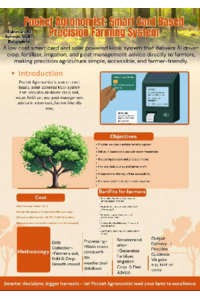
Introduction: Smallholder farmers face challenges in adopting precision agriculture due to high costs, lack of digital literacy, and limited access to advanced technologies. Existing solutions such as drones, IoT devices, and satellite imaging are effective but remain impractical in resource-limited settings. This project introduces a low-cost, farmer-friendly smart card system that delivers personalized precision agronomy advice through shared community kiosks.
Methodology: 1) Each farmer receives a Smart Agronomy Card, storing soil, land, and crop data. 2) Farmers insert the card into a solar-powered kiosk/device. 3)The device integrates the following: 4)soil data, 5) satellite weather information, and 6) AI crop growth models. 7) Weekly recommendations are delivered via text, audio (local language), or printed slips. 8)The data are then aggregated to build a digital agronomy map for community-level insights.
Tools: Smart Agronomy Cards, solar-powered shared kiosks/devices, AI-based advisory software, cloud database for soil and crop records, and weather data integration APIs (Application Programming Interfaces) are all utilized in this study.
Budget (Approximately):
(1) Smart card per farmer: $2–3. (2) Shared solar-powered kiosk: $250–300 per village. (3)Software and AI integration: $2,000–3,000 (one-time purchase). (4) Maintenance and training: minimal (community-managed).
Benefit for Farmers: Personalized advice without the need for smartphones or internet, reduced fertilizer and water costs (20–30% savings), improved crop yield, reduced pest/disease losses, accessible in their local languages (which leads to trust and easy adoption), and the community model reduces individual cost burden. One kiosk can serve 50–100 hectares of farmland. For example, a village with 200 smallholder farmers (each with 0.2–0.5 ha) can all use one kiosk.
Problems: A) Farmer literacy and digital skills. B) Limited access to kiosks. C) Data accuracy and reliability. D) Infrastructure challenges. E) Farmer trust and adoption. F) Maintenance and technical support. G) Scalability.
Time: Prototype development: 6–8 months. Field testing: 1 cropping season (4–6 months). Full deployment in a region: 1–2 years.
Results: 1) Increased input efficiency and crop yield. 2) Lower production costs for smallholder farmers. 3) Creation of a digital agronomy network at grassroots level. 4)Scalable model for national and international adoption.
Keywords
Lowcost precision farming
Smart card based system
Shared solar powered kiosks
AI driven recommendations
Text
print
or voice guidance
Community driven data
Reduces input waste
Improves yield & profit
Scalable & farmer friendly
Offline f
Poster
IMG-20250902-WA0001(1).pdf
Integrating Genomics, Molecular Breeding, and Predictive Bio-Nano Systems to Develop Novel Crops for Marginal Lands
VitiNet—An open-set framework for OOD-robust grape leaf disease classification