Event submissions
Published
This submission belongs to the session S1. Biostimulation and Biocontrol Strategies of the event The 5th International Electronic Conference on Agronomy
Published date
11 Dec, 2025
Academic Editor
'%3e%3cpath%20d='M12.6657%2010.9104C12.4185%2010.325%2012.0599%209.79327%2011.6097%209.34482C11.1609%208.89508%2010.6293%208.5365%2010.0442%208.28888C10.0389%208.28626%2010.0337%208.28495%2010.0285%208.28233C10.8446%207.69279%2011.3752%206.73249%2011.3752%205.64904C11.3752%203.8542%209.92103%202.39999%208.1262%202.39999C6.33136%202.39999%204.87715%203.8542%204.87715%205.64904C4.87715%206.73249%205.40774%207.69279%206.22393%208.28364C6.21869%208.28626%206.21345%208.28757%206.20821%208.29019C5.62129%208.5378%205.09463%208.89284%204.64265%209.34613C4.1929%209.79493%203.83432%2010.3266%203.58671%2010.9117C3.34345%2011.4845%203.21226%2012.0987%203.20023%2012.7209C3.19988%2012.7349%203.20233%2012.7488%203.20744%2012.7619C3.21255%2012.7749%203.22022%2012.7867%203.22998%2012.7968C3.23975%2012.8068%203.25142%2012.8147%203.26431%2012.8202C3.2772%2012.8256%203.29105%2012.8284%203.30504%2012.8284H4.09109C4.14874%2012.8284%204.19459%2012.7825%204.1959%2012.7262C4.2221%2011.7148%204.62823%2010.7676%205.34617%2010.0497C6.08899%209.30683%207.0755%208.89808%208.1262%208.89808C9.17689%208.89808%2010.1634%209.30683%2010.9062%2010.0497C11.6242%2010.7676%2012.0303%2011.7148%2012.0565%2012.7262C12.0578%2012.7838%2012.1037%2012.8284%2012.1613%2012.8284H12.9474C12.9613%2012.8284%2012.9752%2012.8256%2012.9881%2012.8202C13.001%2012.8147%2013.0126%2012.8068%2013.0224%2012.7968C13.0322%2012.7867%2013.0398%2012.7749%2013.0449%2012.7619C13.0501%2012.7488%2013.0525%2012.7349%2013.0522%2012.7209C13.0391%2012.0947%2012.9094%2011.4855%2012.6657%2010.9104ZM8.1262%207.9024C7.52486%207.9024%206.9589%207.6679%206.53312%207.24211C6.10733%206.81633%205.87283%206.25037%205.87283%205.64904C5.87283%205.0477%206.10733%204.48174%206.53312%204.05596C6.9589%203.63018%207.52486%203.39567%208.1262%203.39567C8.72753%203.39567%209.29349%203.63018%209.71927%204.05596C10.1451%204.48174%2010.3796%205.0477%2010.3796%205.64904C10.3796%206.25037%2010.1451%206.81633%209.71927%207.24211C9.29349%207.6679%208.72753%207.9024%208.1262%207.9024Z'%20fill='%235D1EE1'/%3e%3c/g%3e%3c/svg%3e) Monica Boscaiu
Monica BoscaiuCitation
Ebenezer Ayew Appiah, Erika Kutasy, Biostimulant-Induced Modulation of Photosynthetic Efficiency in Alfalfa (Medicago sativa L.), in Proceedings of The 5th International Electronic Conference on Agronomy, 15 December–18 December 2025, MDPI: Basel, Switzerland
Share
Email
Facebook
Twitter
LinkedIn
Biostimulant-Induced Modulation of Photosynthetic Efficiency in Alfalfa (Medicago sativa L.)
'%3e%3cpath%20d='M12.6647%2010.9104C12.4176%2010.325%2012.0589%209.7933%2011.6088%209.34485C11.16%208.89511%2010.6283%208.53653%2010.0432%208.28891C10.038%208.28629%2010.0327%208.28498%2010.0275%208.28236C10.8437%207.69282%2011.3743%206.73252%2011.3743%205.64907C11.3743%203.85423%209.92005%202.40002%208.12522%202.40002C6.33038%202.40002%204.87618%203.85423%204.87618%205.64907C4.87618%206.73252%205.40677%207.69282%206.22296%208.28367C6.21772%208.28629%206.21248%208.2876%206.20724%208.29022C5.62031%208.53783%205.09365%208.89287%204.64167%209.34616C4.19192%209.79496%203.83334%2010.3266%203.58573%2010.9117C3.34247%2011.4846%203.21128%2012.0987%203.19925%2012.721C3.1989%2012.735%203.20135%2012.7489%203.20646%2012.7619C3.21157%2012.7749%203.21924%2012.7868%203.22901%2012.7968C3.23877%2012.8068%203.25045%2012.8148%203.26334%2012.8202C3.27623%2012.8256%203.29007%2012.8284%203.30406%2012.8284H4.09012C4.14776%2012.8284%204.19362%2012.7825%204.19493%2012.7262C4.22113%2011.7148%204.62726%2010.7676%205.34519%2010.0497C6.08802%209.30686%207.07452%208.89811%208.12522%208.89811C9.17592%208.89811%2010.1624%209.30686%2010.9052%2010.0497C11.6232%2010.7676%2012.0293%2011.7148%2012.0555%2012.7262C12.0568%2012.7839%2012.1027%2012.8284%2012.1603%2012.8284H12.9464C12.9604%2012.8284%2012.9742%2012.8256%2012.9871%2012.8202C13%2012.8148%2013.0117%2012.8068%2013.0214%2012.7968C13.0312%2012.7868%2013.0389%2012.7749%2013.044%2012.7619C13.0491%2012.7489%2013.0515%2012.735%2013.0512%2012.721C13.0381%2012.0947%2012.9084%2011.4856%2012.6647%2010.9104ZM8.12522%207.90243C7.52388%207.90243%206.95792%207.66793%206.53214%207.24215C6.10636%206.81636%205.87185%206.2504%205.87185%205.64907C5.87185%205.04773%206.10636%204.48177%206.53214%204.05599C6.95792%203.63021%207.52388%203.3957%208.12522%203.3957C8.72655%203.3957%209.29252%203.63021%209.7183%204.05599C10.1441%204.48177%2010.3786%205.04773%2010.3786%205.64907C10.3786%206.2504%2010.1441%206.81636%209.7183%207.24215C9.29252%207.66793%208.72655%207.90243%208.12522%207.90243Z'%20fill='%235D1EE1'/%3e%3c/g%3e%3c/svg%3e)
Ebenezer Ayew Appiah 1,2

Erika Kutasy 2
1. Kálmán Kerpely Doctoral School of Crop Production and Horticultural Science, University of Debrecen, Böszörményi Str 138, H-4032 Debrecen, Hungary
2. Institute of Crop Production, Breeding and Plant Technology, Faculty of Agricultural and Food Sciences and Environmental Management, University of Debrecen, Böszörményi Str. 138, H-4032 Debrecen, Hungary
Abstract
Enhancing photosynthetic efficiency via biostimulant application could offer a sustainable pathway to improve alfalfa forage yield, quality traits and resilience against unfavourable environmental conditions. This current study was conducted at the University of Debrecen to evaluate the impact of two biostimulants on gas exchange parameters and chlorophyll fluorescence in alfalfa under field conditions. The experiment was arranged in a randomized complete block design with three treatment levels, namely, Tricho Immun (T1) (21.6 g/3 L), a biostimulant containing Si, MTU®, and pidolic acid (T2) (2 ml/3 L) and a control (T3) (no biostimulant). Parameters measured include net photosynthetic rate (A), transpiration rate (E), intercellular CO₂ concentration (Ci), ambient CO2 concentration (Ca), water use efficiency (WUE) and quantum yield of PSII (ΦPSII). Data gathered were subjected to analysis of variance using Genstat statistical software edition 18, where significant means were separated at a 5% probability level using the least significant difference, and DMRT was used to rank the performance of the individual treatment on measured traits. The results show that biostimulant application significantly improved net photosynthetic rate, transpiration rate, intercellular CO₂ concentration, water use efficiency, and quantum yield of PSII, indicating improved photochemical efficiency. However, no significant changes were observed in ambient CO2 concentration. Our findings indicated that T2 significantly increased ΦPSII by 43.9%, net photosynthetic rate by 37.8%, and transpiration rate by 97.6%, while T1 also increased ΦPSII, net photosynthetic rate, and transpiration rate by 11.7%, 9.8%, and 39.5%, respectively, compared to the control (T3). These results suggest that biostimulants can enhance photosynthetic performance and resource-use efficiency in alfalfa under field conditions, offering a promising approach for sustainable forage production.
Keywords
Medicago sativa
biostimulants
photosynthetic efficiency
sustainable forage production
Poster
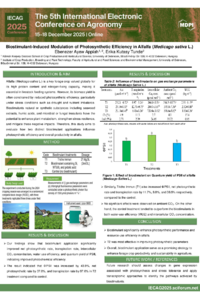
Ayew_poster_MDPI.pdf
VitiNet—An open-set framework for OOD-robust grape leaf disease classification
Evaluation of Cold Tolerance in Local Barley (Hordeum vulgare L.) Genotypes and the Role of Salicylic Acid in Their Resilience