Event submissions
Published
This submission belongs to the session S1. Biostimulation and Biocontrol Strategies of the event The 5th International Electronic Conference on Agronomy
Published date
11 Dec, 2025
Academic Editor
'%3e%3cpath%20d='M12.6657%2010.9104C12.4185%2010.325%2012.0599%209.79327%2011.6097%209.34482C11.1609%208.89508%2010.6293%208.5365%2010.0442%208.28888C10.0389%208.28626%2010.0337%208.28495%2010.0285%208.28233C10.8446%207.69279%2011.3752%206.73249%2011.3752%205.64904C11.3752%203.8542%209.92103%202.39999%208.1262%202.39999C6.33136%202.39999%204.87715%203.8542%204.87715%205.64904C4.87715%206.73249%205.40774%207.69279%206.22393%208.28364C6.21869%208.28626%206.21345%208.28757%206.20821%208.29019C5.62129%208.5378%205.09463%208.89284%204.64265%209.34613C4.1929%209.79493%203.83432%2010.3266%203.58671%2010.9117C3.34345%2011.4845%203.21226%2012.0987%203.20023%2012.7209C3.19988%2012.7349%203.20233%2012.7488%203.20744%2012.7619C3.21255%2012.7749%203.22022%2012.7867%203.22998%2012.7968C3.23975%2012.8068%203.25142%2012.8147%203.26431%2012.8202C3.2772%2012.8256%203.29105%2012.8284%203.30504%2012.8284H4.09109C4.14874%2012.8284%204.19459%2012.7825%204.1959%2012.7262C4.2221%2011.7148%204.62823%2010.7676%205.34617%2010.0497C6.08899%209.30683%207.0755%208.89808%208.1262%208.89808C9.17689%208.89808%2010.1634%209.30683%2010.9062%2010.0497C11.6242%2010.7676%2012.0303%2011.7148%2012.0565%2012.7262C12.0578%2012.7838%2012.1037%2012.8284%2012.1613%2012.8284H12.9474C12.9613%2012.8284%2012.9752%2012.8256%2012.9881%2012.8202C13.001%2012.8147%2013.0126%2012.8068%2013.0224%2012.7968C13.0322%2012.7867%2013.0398%2012.7749%2013.0449%2012.7619C13.0501%2012.7488%2013.0525%2012.7349%2013.0522%2012.7209C13.0391%2012.0947%2012.9094%2011.4855%2012.6657%2010.9104ZM8.1262%207.9024C7.52486%207.9024%206.9589%207.6679%206.53312%207.24211C6.10733%206.81633%205.87283%206.25037%205.87283%205.64904C5.87283%205.0477%206.10733%204.48174%206.53312%204.05596C6.9589%203.63018%207.52486%203.39567%208.1262%203.39567C8.72753%203.39567%209.29349%203.63018%209.71927%204.05596C10.1451%204.48174%2010.3796%205.0477%2010.3796%205.64904C10.3796%206.25037%2010.1451%206.81633%209.71927%207.24211C9.29349%207.6679%208.72753%207.9024%208.1262%207.9024Z'%20fill='%235D1EE1'/%3e%3c/g%3e%3c/svg%3e) Monica Boscaiu
Monica BoscaiuCitation
Milica Stojanović, Radomir Bodiroga, Slađana Savić, Zorica Jovanović, Đorđe Moravčević, Biofertiliser Effects on Lettuce Morphological Traits for Fresh Consumption and Processing in Two Distinct Soil Types, in Proceedings of The 5th International Electronic Conference on Agronomy, 15 December–18 December 2025, MDPI: Basel, Switzerland
Share
Email
Facebook
Twitter
LinkedIn
Biofertiliser Effects on Lettuce Morphological Traits for Fresh Consumption and Processing in Two Distinct Soil Types
'%3e%3cpath%20d='M12.6647%2010.9104C12.4176%2010.325%2012.0589%209.7933%2011.6088%209.34485C11.16%208.89511%2010.6283%208.53653%2010.0432%208.28891C10.038%208.28629%2010.0327%208.28498%2010.0275%208.28236C10.8437%207.69282%2011.3743%206.73252%2011.3743%205.64907C11.3743%203.85423%209.92005%202.40002%208.12522%202.40002C6.33038%202.40002%204.87618%203.85423%204.87618%205.64907C4.87618%206.73252%205.40677%207.69282%206.22296%208.28367C6.21772%208.28629%206.21248%208.2876%206.20724%208.29022C5.62031%208.53783%205.09365%208.89287%204.64167%209.34616C4.19192%209.79496%203.83334%2010.3266%203.58573%2010.9117C3.34247%2011.4846%203.21128%2012.0987%203.19925%2012.721C3.1989%2012.735%203.20135%2012.7489%203.20646%2012.7619C3.21157%2012.7749%203.21924%2012.7868%203.22901%2012.7968C3.23877%2012.8068%203.25045%2012.8148%203.26334%2012.8202C3.27623%2012.8256%203.29007%2012.8284%203.30406%2012.8284H4.09012C4.14776%2012.8284%204.19362%2012.7825%204.19493%2012.7262C4.22113%2011.7148%204.62726%2010.7676%205.34519%2010.0497C6.08802%209.30686%207.07452%208.89811%208.12522%208.89811C9.17592%208.89811%2010.1624%209.30686%2010.9052%2010.0497C11.6232%2010.7676%2012.0293%2011.7148%2012.0555%2012.7262C12.0568%2012.7839%2012.1027%2012.8284%2012.1603%2012.8284H12.9464C12.9604%2012.8284%2012.9742%2012.8256%2012.9871%2012.8202C13%2012.8148%2013.0117%2012.8068%2013.0214%2012.7968C13.0312%2012.7868%2013.0389%2012.7749%2013.044%2012.7619C13.0491%2012.7489%2013.0515%2012.735%2013.0512%2012.721C13.0381%2012.0947%2012.9084%2011.4856%2012.6647%2010.9104ZM8.12522%207.90243C7.52388%207.90243%206.95792%207.66793%206.53214%207.24215C6.10636%206.81636%205.87185%206.2504%205.87185%205.64907C5.87185%205.04773%206.10636%204.48177%206.53214%204.05599C6.95792%203.63021%207.52388%203.3957%208.12522%203.3957C8.72655%203.3957%209.29252%203.63021%209.7183%204.05599C10.1441%204.48177%2010.3786%205.04773%2010.3786%205.64907C10.3786%206.2504%2010.1441%206.81636%209.7183%207.24215C9.29252%207.66793%208.72655%207.90243%208.12522%207.90243Z'%20fill='%235D1EE1'/%3e%3c/g%3e%3c/svg%3e)
Milica Stojanović 1

Radomir Bodiroga 2
Slađana Savić 3
Zorica Jovanović 4
Đorđe Moravčević 4
1. Institute for Multidisciplinary Research, University of Belgrade, Kneza Višeslava 1, Belgrade 11030, Serbia
2. Faculty of Agriculture, University of East Sarajevo, Vuka Karadžića 30, East Sarajevo 71123, Bosnia and Herzegovina
3. Institute for Plant Protection and Environment, Teodora Drajzera 9, Belgrade 11040, Serbia
4. Faculty of Agriculture, University of Belgrade, Nemanjina 6, Belgrade 11080, Serbia
Abstract
Lettuce is a leafy vegetable consumed fresh or processed in ready-to-eat products, supporting lifestyle trends favouring quick, healthy, and convenient meals. Morphological traits impact yield, processing efficiency, shelf life, and product quality. Biofertilisers are gaining attention as eco-friendly, sustainable alternatives that enhance soil fertility, increase microflora diversity, stimulate plant growth, and reduce pollution in all agricultural systems. This study aimed to investigate the effect of biofertilisers on lettuce morphology traits for fresh consumption and processing. Six lettuce cultivars ('Kiribati', 'Murai', 'Aquino', 'Gaugin', 'Aleppo', and 'Carmesi') were cultivated over three consecutive seasons (autumn, winter, and spring) under greenhouse conditions. Experiments were conducted in two distinct soil types: Mollic Gleysol (Calcaric)-GL and Hortic Anthrosol (Terric, Transportic)-AT. Two biofertilisers, EM Aktiv and Vital Tricho, were applied alone and combined to the soil and foliar via a battery sprayer. Green cultivars, especially 'Kiribati' and 'Aleppo', had the highest levels in most morphological parameters, while red 'Gaugin' had the highest core ratio (stem to rosette height) in both soils. In GL soil, all biofertilisers increased rosette diameter, with Vital Tricho boosting dry leaf weight, and EM Aktiv and combined fertilisers raising core ratio. In contrast, in AT soil, all fertilisers significantly reduced fresh leaf weight and stem diameter, while Vital Tricho and combined treatment lowered rosette diameter and core ratio. Generally, morphological traits were higher in winter and spring trials than in autumn. Pearson correlation coefficients showed that fresh leaf weight was positively linked to all other traits in both soils. An increased core ratio negatively impacts processing quality; thus, maintaining it below 0.5 is essential. Although fertiliser did not influence all parameters, the interaction among all factors was significant, except for dry leaf weight in both soils, indicating the need to optimise biofertiliser application according to soil type.
Keywords
Lactuca sativa
microbiological fertilisers
seasonality
fresh and dry leaf weight
stem diameter
core ratio
soil types
Poster
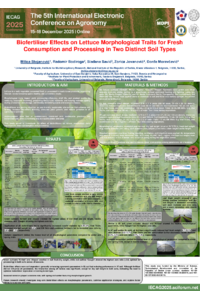
poster Agronomy conference.pdf
Economic viability of different coloured shade nets on water use efficiency and nutrients in Keitt Mango
AI-Powered Robotic System for Precision Irrigation and Pesticide Application in Sustainable Tomato