Event submissions
Published
This submission belongs to the session S4. Crop Water and Nutrient Management of the event The 5th International Electronic Conference on Agronomy
Published date
11 Dec, 2025
Academic Editor
'%3e%3cpath%20d='M12.6657%2010.9104C12.4185%2010.325%2012.0599%209.79327%2011.6097%209.34482C11.1609%208.89508%2010.6293%208.5365%2010.0442%208.28888C10.0389%208.28626%2010.0337%208.28495%2010.0285%208.28233C10.8446%207.69279%2011.3752%206.73249%2011.3752%205.64904C11.3752%203.8542%209.92103%202.39999%208.1262%202.39999C6.33136%202.39999%204.87715%203.8542%204.87715%205.64904C4.87715%206.73249%205.40774%207.69279%206.22393%208.28364C6.21869%208.28626%206.21345%208.28757%206.20821%208.29019C5.62129%208.5378%205.09463%208.89284%204.64265%209.34613C4.1929%209.79493%203.83432%2010.3266%203.58671%2010.9117C3.34345%2011.4845%203.21226%2012.0987%203.20023%2012.7209C3.19988%2012.7349%203.20233%2012.7488%203.20744%2012.7619C3.21255%2012.7749%203.22022%2012.7867%203.22998%2012.7968C3.23975%2012.8068%203.25142%2012.8147%203.26431%2012.8202C3.2772%2012.8256%203.29105%2012.8284%203.30504%2012.8284H4.09109C4.14874%2012.8284%204.19459%2012.7825%204.1959%2012.7262C4.2221%2011.7148%204.62823%2010.7676%205.34617%2010.0497C6.08899%209.30683%207.0755%208.89808%208.1262%208.89808C9.17689%208.89808%2010.1634%209.30683%2010.9062%2010.0497C11.6242%2010.7676%2012.0303%2011.7148%2012.0565%2012.7262C12.0578%2012.7838%2012.1037%2012.8284%2012.1613%2012.8284H12.9474C12.9613%2012.8284%2012.9752%2012.8256%2012.9881%2012.8202C13.001%2012.8147%2013.0126%2012.8068%2013.0224%2012.7968C13.0322%2012.7867%2013.0398%2012.7749%2013.0449%2012.7619C13.0501%2012.7488%2013.0525%2012.7349%2013.0522%2012.7209C13.0391%2012.0947%2012.9094%2011.4855%2012.6657%2010.9104ZM8.1262%207.9024C7.52486%207.9024%206.9589%207.6679%206.53312%207.24211C6.10733%206.81633%205.87283%206.25037%205.87283%205.64904C5.87283%205.0477%206.10733%204.48174%206.53312%204.05596C6.9589%203.63018%207.52486%203.39567%208.1262%203.39567C8.72753%203.39567%209.29349%203.63018%209.71927%204.05596C10.1451%204.48174%2010.3796%205.0477%2010.3796%205.64904C10.3796%206.25037%2010.1451%206.81633%209.71927%207.24211C9.29349%207.6679%208.72753%207.9024%208.1262%207.9024Z'%20fill='%235D1EE1'/%3e%3c/g%3e%3c/svg%3e) Cristina Calheiros
Cristina CalheirosCitation
M. SRI ABISANKAR, R. AUGUSTINE, J. CHRISTINA CATHRINE, T.S. PRADEEP, JAYA ANJANA SUNIL, Synergistic Effects of Nano-emulsion Biofertilizer and Organic Manures on Agronomic Traits of Chickpea, in Proceedings of The 5th International Electronic Conference on Agronomy, 15 December–18 December 2025, MDPI: Basel, Switzerland
Share
Email
Facebook
Twitter
LinkedIn
Synergistic Effects of Nano-emulsion Biofertilizer and Organic Manures on Agronomic Traits of Chickpea
'%3e%3cpath%20d='M12.6647%2010.9104C12.4176%2010.325%2012.0589%209.7933%2011.6088%209.34485C11.16%208.89511%2010.6283%208.53653%2010.0432%208.28891C10.038%208.28629%2010.0327%208.28498%2010.0275%208.28236C10.8437%207.69282%2011.3743%206.73252%2011.3743%205.64907C11.3743%203.85423%209.92005%202.40002%208.12522%202.40002C6.33038%202.40002%204.87618%203.85423%204.87618%205.64907C4.87618%206.73252%205.40677%207.69282%206.22296%208.28367C6.21772%208.28629%206.21248%208.2876%206.20724%208.29022C5.62031%208.53783%205.09365%208.89287%204.64167%209.34616C4.19192%209.79496%203.83334%2010.3266%203.58573%2010.9117C3.34247%2011.4846%203.21128%2012.0987%203.19925%2012.721C3.1989%2012.735%203.20135%2012.7489%203.20646%2012.7619C3.21157%2012.7749%203.21924%2012.7868%203.22901%2012.7968C3.23877%2012.8068%203.25045%2012.8148%203.26334%2012.8202C3.27623%2012.8256%203.29007%2012.8284%203.30406%2012.8284H4.09012C4.14776%2012.8284%204.19362%2012.7825%204.19493%2012.7262C4.22113%2011.7148%204.62726%2010.7676%205.34519%2010.0497C6.08802%209.30686%207.07452%208.89811%208.12522%208.89811C9.17592%208.89811%2010.1624%209.30686%2010.9052%2010.0497C11.6232%2010.7676%2012.0293%2011.7148%2012.0555%2012.7262C12.0568%2012.7839%2012.1027%2012.8284%2012.1603%2012.8284H12.9464C12.9604%2012.8284%2012.9742%2012.8256%2012.9871%2012.8202C13%2012.8148%2013.0117%2012.8068%2013.0214%2012.7968C13.0312%2012.7868%2013.0389%2012.7749%2013.044%2012.7619C13.0491%2012.7489%2013.0515%2012.735%2013.0512%2012.721C13.0381%2012.0947%2012.9084%2011.4856%2012.6647%2010.9104ZM8.12522%207.90243C7.52388%207.90243%206.95792%207.66793%206.53214%207.24215C6.10636%206.81636%205.87185%206.2504%205.87185%205.64907C5.87185%205.04773%206.10636%204.48177%206.53214%204.05599C6.95792%203.63021%207.52388%203.3957%208.12522%203.3957C8.72655%203.3957%209.29252%203.63021%209.7183%204.05599C10.1441%204.48177%2010.3786%205.04773%2010.3786%205.64907C10.3786%206.2504%2010.1441%206.81636%209.7183%207.24215C9.29252%207.66793%208.72655%207.90243%208.12522%207.90243Z'%20fill='%235D1EE1'/%3e%3c/g%3e%3c/svg%3e)
M. SRI ABISANKAR 1
R. AUGUSTINE 1
J. CHRISTINA CATHRINE 1
T.S. PRADEEP 1
JAYA ANJANA SUNIL 2
1. DIVISION OF AGRONOMY, SCHOOL OF AGRICULTURAL SCIENCES, KARUNYA INSTITUTE OF TECHNOLOGY AND SCIENCES, COIMBATORE- 641114, TAMIL NADU, INDIA.
2. DIVISION OF GENETICS AND PLANT BREEDING, SCHOOL OF AGRICULTURAL SCIENCES, KARUNYA INSTITUTE OF TECHNOLOGY AND SCIENCES, COIMBATORE- 641114, TAMIL NADU, INDIA.
Abstract
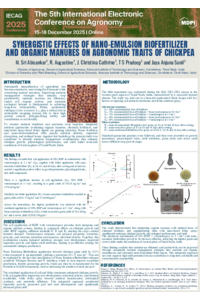
Identifying sustainable agricultural practices that simultaneously boost yield from existing farmland and optimize resource use efficiency is critical to meet the growing demands of an expanding population amid dwindling natural resources. Strengthening nutrient management approaches that enhance crop productivity, improve soil health, increase soil organic carbon, and maintain energy balance can promote sustainability in agricultural systems. In this context, chickpea (Cicer arietinum L.), distinguished by its comparatively high protein content among pulse crops, serves as an ideal model to evaluate diverse nutrient management strategies. Field investigations were conducted during the Rabi 2023-2024 season in the western part of Tamil Nadu state, India. The treatments were imposed in a factorial randomized block design with two factors: soil and foliar applications. The soil application consists of S1 – 100% recommended dose of fertilizer, S2 – 75% recommended dose of fertilizer + farm yard manure at 10 t ha⁻¹, S3 – 75% recommended dose of fertilizer + vermicompost at 5 t ha⁻¹, S4 – 50% recommended dose of fertilizer + farm yard manure at 10 t ha⁻¹, and S5 – 50% recommended dose of fertilizer + vermicompost at 5 t ha⁻¹, while the foliar application includes F1 – nano di-ammonium Phosphate (two sprays at 2% at 30 and 45 days after sowing), F2 – nano urea (two sprays at 2% at 30 and 45 days after sowing), and F3 – nano emulsion biofertilizer (two sprays at 10 ml L⁻¹ at 30 and 45 days after sowing). The application of nanoemulsion biofertilizer provided the highest values for growth, physiological, and yield parameters of chickpea at 30, 45, and 60 days after sowing, and at harvest. The grain yield and stover yield were recorded as 1111.60 kg ha⁻¹ and 2501.10 kg ha⁻¹, respectively. The combined application of the recommended 50% fertilizer dose + vermicompost at 5 t ha⁻¹ with nanoemulsion biofertilizer was found to be the most effective for chickpea productivity in the western part of Tamil Nadu, India.
Keywords
Chickpea
Nutrient management
Biofertilizer
Nano-emulsion
Soil and foliar
Poster
Synergistic Effects of Nano-emulsion Biofertilizer and Organic Manures on Agronomic Traits of Chickpea (1080 x 1536 px) (1).pdf
Using a combination of innovative electronic technologies (MAXGROW and a generator of Agro-Nanobubbles) for growing lettuce (Lactuca Sativa L.) in different soil types in potsunder high salinity irrigation water management
Analysis of the effect of different planting dates and varieties on the growth and yield of Potatoes (Solanum tuberosum L.) in Northern Central Namibia