Event submissions
Published
This submission belongs to the session S4. Crop Water and Nutrient Management of the event The 5th International Electronic Conference on Agronomy
Published date
11 Dec, 2025
Academic Editor
'%3e%3cpath%20d='M12.6657%2010.9104C12.4185%2010.325%2012.0599%209.79327%2011.6097%209.34482C11.1609%208.89508%2010.6293%208.5365%2010.0442%208.28888C10.0389%208.28626%2010.0337%208.28495%2010.0285%208.28233C10.8446%207.69279%2011.3752%206.73249%2011.3752%205.64904C11.3752%203.8542%209.92103%202.39999%208.1262%202.39999C6.33136%202.39999%204.87715%203.8542%204.87715%205.64904C4.87715%206.73249%205.40774%207.69279%206.22393%208.28364C6.21869%208.28626%206.21345%208.28757%206.20821%208.29019C5.62129%208.5378%205.09463%208.89284%204.64265%209.34613C4.1929%209.79493%203.83432%2010.3266%203.58671%2010.9117C3.34345%2011.4845%203.21226%2012.0987%203.20023%2012.7209C3.19988%2012.7349%203.20233%2012.7488%203.20744%2012.7619C3.21255%2012.7749%203.22022%2012.7867%203.22998%2012.7968C3.23975%2012.8068%203.25142%2012.8147%203.26431%2012.8202C3.2772%2012.8256%203.29105%2012.8284%203.30504%2012.8284H4.09109C4.14874%2012.8284%204.19459%2012.7825%204.1959%2012.7262C4.2221%2011.7148%204.62823%2010.7676%205.34617%2010.0497C6.08899%209.30683%207.0755%208.89808%208.1262%208.89808C9.17689%208.89808%2010.1634%209.30683%2010.9062%2010.0497C11.6242%2010.7676%2012.0303%2011.7148%2012.0565%2012.7262C12.0578%2012.7838%2012.1037%2012.8284%2012.1613%2012.8284H12.9474C12.9613%2012.8284%2012.9752%2012.8256%2012.9881%2012.8202C13.001%2012.8147%2013.0126%2012.8068%2013.0224%2012.7968C13.0322%2012.7867%2013.0398%2012.7749%2013.0449%2012.7619C13.0501%2012.7488%2013.0525%2012.7349%2013.0522%2012.7209C13.0391%2012.0947%2012.9094%2011.4855%2012.6657%2010.9104ZM8.1262%207.9024C7.52486%207.9024%206.9589%207.6679%206.53312%207.24211C6.10733%206.81633%205.87283%206.25037%205.87283%205.64904C5.87283%205.0477%206.10733%204.48174%206.53312%204.05596C6.9589%203.63018%207.52486%203.39567%208.1262%203.39567C8.72753%203.39567%209.29349%203.63018%209.71927%204.05596C10.1451%204.48174%2010.3796%205.0477%2010.3796%205.64904C10.3796%206.25037%2010.1451%206.81633%209.71927%207.24211C9.29349%207.6679%208.72753%207.9024%208.1262%207.9024Z'%20fill='%235D1EE1'/%3e%3c/g%3e%3c/svg%3e) Sofia Pereira
Sofia PereiraCitation
Francisco Gregório Do-Nascimento-Neto, Eva Sánchez-Hernández, Alone Lima Brito, Marilza Neves do Nascimento, Norlan Miguel Ruíz-Potosme, Jesús Martín-Gil, Pablo Martín-Ramos, Osmoprotective Mechanisms of Exogenous Proline in Salt-Stressed Physalis ixocarpa: Integrated Morphophysiological, Spectroscopic and Metabolomic Analysis, in Proceedings of The 5th International Electronic Conference on Agronomy, 15 December–18 December 2025, MDPI: Basel, Switzerland
Share
Email
Facebook
Twitter
LinkedIn
Osmoprotective Mechanisms of Exogenous Proline in Salt-Stressed Physalis ixocarpa: Integrated Morphophysiological, Spectroscopic and Metabolomic Analysis
'%3e%3cpath%20d='M12.6647%2010.9104C12.4176%2010.325%2012.0589%209.7933%2011.6088%209.34485C11.16%208.89511%2010.6283%208.53653%2010.0432%208.28891C10.038%208.28629%2010.0327%208.28498%2010.0275%208.28236C10.8437%207.69282%2011.3743%206.73252%2011.3743%205.64907C11.3743%203.85423%209.92005%202.40002%208.12522%202.40002C6.33038%202.40002%204.87618%203.85423%204.87618%205.64907C4.87618%206.73252%205.40677%207.69282%206.22296%208.28367C6.21772%208.28629%206.21248%208.2876%206.20724%208.29022C5.62031%208.53783%205.09365%208.89287%204.64167%209.34616C4.19192%209.79496%203.83334%2010.3266%203.58573%2010.9117C3.34247%2011.4846%203.21128%2012.0987%203.19925%2012.721C3.1989%2012.735%203.20135%2012.7489%203.20646%2012.7619C3.21157%2012.7749%203.21924%2012.7868%203.22901%2012.7968C3.23877%2012.8068%203.25045%2012.8148%203.26334%2012.8202C3.27623%2012.8256%203.29007%2012.8284%203.30406%2012.8284H4.09012C4.14776%2012.8284%204.19362%2012.7825%204.19493%2012.7262C4.22113%2011.7148%204.62726%2010.7676%205.34519%2010.0497C6.08802%209.30686%207.07452%208.89811%208.12522%208.89811C9.17592%208.89811%2010.1624%209.30686%2010.9052%2010.0497C11.6232%2010.7676%2012.0293%2011.7148%2012.0555%2012.7262C12.0568%2012.7839%2012.1027%2012.8284%2012.1603%2012.8284H12.9464C12.9604%2012.8284%2012.9742%2012.8256%2012.9871%2012.8202C13%2012.8148%2013.0117%2012.8068%2013.0214%2012.7968C13.0312%2012.7868%2013.0389%2012.7749%2013.044%2012.7619C13.0491%2012.7489%2013.0515%2012.735%2013.0512%2012.721C13.0381%2012.0947%2012.9084%2011.4856%2012.6647%2010.9104ZM8.12522%207.90243C7.52388%207.90243%206.95792%207.66793%206.53214%207.24215C6.10636%206.81636%205.87185%206.2504%205.87185%205.64907C5.87185%205.04773%206.10636%204.48177%206.53214%204.05599C6.95792%203.63021%207.52388%203.3957%208.12522%203.3957C8.72655%203.3957%209.29252%203.63021%209.7183%204.05599C10.1441%204.48177%2010.3786%205.04773%2010.3786%205.64907C10.3786%206.2504%2010.1441%206.81636%209.7183%207.24215C9.29252%207.66793%208.72655%207.90243%208.12522%207.90243Z'%20fill='%235D1EE1'/%3e%3c/g%3e%3c/svg%3e)
Francisco Gregório Do-Nascimento-Neto 1,2

Eva Sánchez-Hernández 2
Alone Lima Brito 1
Marilza Neves do Nascimento 1
Norlan Miguel Ruíz-Potosme 3

Jesús Martín-Gil 2

Pablo Martín-Ramos 2
1. Department of Biological Sciences, State University of Feira de Santana, Av. Transnordestina, s/n, Novo Horizonte, 44036-900 Feira de Santana, Brazil
2. Department of Agricultural and Forestry Engineering, ETSIIAA, University of Valladolid, Avenida de Madrid 44, 34004 Palencia, Spain
3. Department of Cartographic, Geodetic and Photogrammetric Engineering, EiFAB, University of Valladolid, C/ Universidad s/n, 42004 Soria, Spain
Abstract
Soil salinization threatens agricultural sustainability in semi-arid regions where Physalis ixocarpa (Mexican husk tomato) represents an economically important crop. While exogenous proline enhances salt tolerance in various species, the underlying molecular mechanisms and metabolic trade-offs in P. ixocarpa remain unexplored. This study employed integrated morphophysiological, spectroscopic, and metabolomic approaches to elucidate proline's multifaceted protective mechanisms beyond simple osmotic adjustment.
Germination screening established moderate salt stress conditions, where proline pretreatment via seed imbibition substantially restored germination rates and seedling vigor. Subsequent in vitro culture experiments applied proline directly to salt-stressed seedlings, revealing an unexpected strategic trade-off: proline-treated plants prioritized photosynthetic protection over structural growth, achieving chlorophyll levels exceeding even non-stressed controls while reducing root biomass. This resource reallocation represents an energy-efficient stress tolerance strategy.
Infrared spectroscopy demonstrated proline incorporation into plant tissues and restoration of structural polysaccharide conformations disrupted by salinity. Metabolomic profiling uncovered fundamental biochemical reorganization: salt stress triggered shifts in primary carbohydrate identity and synthesis of nitrogenous osmolytes, while proline treatment reversed these changes and generated active proline-derived metabolites.
A key finding challenges conventional understanding of stress protection: phenolic antioxidants disappeared under salt stress and were not restored by proline treatment, yet plants showed enhanced tolerance. This suggests proline operates through preemptive metabolic stabilization rather than reactive antioxidant synthesis—a more cost-effective protective mechanism. These results provide practical protocols for enhancing salt tolerance through both seed priming and seedling treatment, with potential application in marginal growing conditions where water quality and soil salinity limit production.
Keywords
Abiotic stress
ATR-FTIR
Chlorophyll content
GC-MS
Germination
Mexican husk tomato
NaCl
Resource reallocation
Solanaceae
Tomatillo
Poster
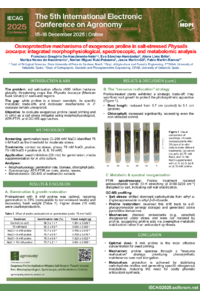
Poster sciforum-144643.pdf
Flood Stress and Growth Management For Plants in Arable Soils Using Cocopeat-Plant Growth Promoting Rhizobacteria Formulation
Establishment of Vitis vinifera varieties for table grape production as an alternative to climate change in Veracruz, Mexico.