Event submissions
Published
This submission belongs to the session S8. Sustainable Farming Systems and Soil Management of the event The 5th International Electronic Conference on Agronomy
Published date
11 Dec, 2025
Academic Editor
'%3e%3cpath%20d='M12.6657%2010.9104C12.4185%2010.325%2012.0599%209.79327%2011.6097%209.34482C11.1609%208.89508%2010.6293%208.5365%2010.0442%208.28888C10.0389%208.28626%2010.0337%208.28495%2010.0285%208.28233C10.8446%207.69279%2011.3752%206.73249%2011.3752%205.64904C11.3752%203.8542%209.92103%202.39999%208.1262%202.39999C6.33136%202.39999%204.87715%203.8542%204.87715%205.64904C4.87715%206.73249%205.40774%207.69279%206.22393%208.28364C6.21869%208.28626%206.21345%208.28757%206.20821%208.29019C5.62129%208.5378%205.09463%208.89284%204.64265%209.34613C4.1929%209.79493%203.83432%2010.3266%203.58671%2010.9117C3.34345%2011.4845%203.21226%2012.0987%203.20023%2012.7209C3.19988%2012.7349%203.20233%2012.7488%203.20744%2012.7619C3.21255%2012.7749%203.22022%2012.7867%203.22998%2012.7968C3.23975%2012.8068%203.25142%2012.8147%203.26431%2012.8202C3.2772%2012.8256%203.29105%2012.8284%203.30504%2012.8284H4.09109C4.14874%2012.8284%204.19459%2012.7825%204.1959%2012.7262C4.2221%2011.7148%204.62823%2010.7676%205.34617%2010.0497C6.08899%209.30683%207.0755%208.89808%208.1262%208.89808C9.17689%208.89808%2010.1634%209.30683%2010.9062%2010.0497C11.6242%2010.7676%2012.0303%2011.7148%2012.0565%2012.7262C12.0578%2012.7838%2012.1037%2012.8284%2012.1613%2012.8284H12.9474C12.9613%2012.8284%2012.9752%2012.8256%2012.9881%2012.8202C13.001%2012.8147%2013.0126%2012.8068%2013.0224%2012.7968C13.0322%2012.7867%2013.0398%2012.7749%2013.0449%2012.7619C13.0501%2012.7488%2013.0525%2012.7349%2013.0522%2012.7209C13.0391%2012.0947%2012.9094%2011.4855%2012.6657%2010.9104ZM8.1262%207.9024C7.52486%207.9024%206.9589%207.6679%206.53312%207.24211C6.10733%206.81633%205.87283%206.25037%205.87283%205.64904C5.87283%205.0477%206.10733%204.48174%206.53312%204.05596C6.9589%203.63018%207.52486%203.39567%208.1262%203.39567C8.72753%203.39567%209.29349%203.63018%209.71927%204.05596C10.1451%204.48174%2010.3796%205.0477%2010.3796%205.64904C10.3796%206.25037%2010.1451%206.81633%209.71927%207.24211C9.29349%207.6679%208.72753%207.9024%208.1262%207.9024Z'%20fill='%235D1EE1'/%3e%3c/g%3e%3c/svg%3e) Peter Gregory
Peter GregoryCitation
Lina Juodyte, Kęstutis Romaneckas, Austėja Švereikaitė, Jovita Balandaitė, Rokas Jonaitis, Dovydas Miliauskas, Impact of the Nutrient Relay Principle in Multi-Cropping Systems on Soil Structural Properties, in Proceedings of The 5th International Electronic Conference on Agronomy, 15 December–18 December 2025, MDPI: Basel, Switzerland
Share
Email
Facebook
Twitter
LinkedIn
Impact of the Nutrient Relay Principle in Multi-Cropping Systems on Soil Structural Properties
'%3e%3cpath%20d='M12.6647%2010.9104C12.4176%2010.325%2012.0589%209.7933%2011.6088%209.34485C11.16%208.89511%2010.6283%208.53653%2010.0432%208.28891C10.038%208.28629%2010.0327%208.28498%2010.0275%208.28236C10.8437%207.69282%2011.3743%206.73252%2011.3743%205.64907C11.3743%203.85423%209.92005%202.40002%208.12522%202.40002C6.33038%202.40002%204.87618%203.85423%204.87618%205.64907C4.87618%206.73252%205.40677%207.69282%206.22296%208.28367C6.21772%208.28629%206.21248%208.2876%206.20724%208.29022C5.62031%208.53783%205.09365%208.89287%204.64167%209.34616C4.19192%209.79496%203.83334%2010.3266%203.58573%2010.9117C3.34247%2011.4846%203.21128%2012.0987%203.19925%2012.721C3.1989%2012.735%203.20135%2012.7489%203.20646%2012.7619C3.21157%2012.7749%203.21924%2012.7868%203.22901%2012.7968C3.23877%2012.8068%203.25045%2012.8148%203.26334%2012.8202C3.27623%2012.8256%203.29007%2012.8284%203.30406%2012.8284H4.09012C4.14776%2012.8284%204.19362%2012.7825%204.19493%2012.7262C4.22113%2011.7148%204.62726%2010.7676%205.34519%2010.0497C6.08802%209.30686%207.07452%208.89811%208.12522%208.89811C9.17592%208.89811%2010.1624%209.30686%2010.9052%2010.0497C11.6232%2010.7676%2012.0293%2011.7148%2012.0555%2012.7262C12.0568%2012.7839%2012.1027%2012.8284%2012.1603%2012.8284H12.9464C12.9604%2012.8284%2012.9742%2012.8256%2012.9871%2012.8202C13%2012.8148%2013.0117%2012.8068%2013.0214%2012.7968C13.0312%2012.7868%2013.0389%2012.7749%2013.044%2012.7619C13.0491%2012.7489%2013.0515%2012.735%2013.0512%2012.721C13.0381%2012.0947%2012.9084%2011.4856%2012.6647%2010.9104ZM8.12522%207.90243C7.52388%207.90243%206.95792%207.66793%206.53214%207.24215C6.10636%206.81636%205.87185%206.2504%205.87185%205.64907C5.87185%205.04773%206.10636%204.48177%206.53214%204.05599C6.95792%203.63021%207.52388%203.3957%208.12522%203.3957C8.72655%203.3957%209.29252%203.63021%209.7183%204.05599C10.1441%204.48177%2010.3786%205.04773%2010.3786%205.64907C10.3786%206.2504%2010.1441%206.81636%209.7183%207.24215C9.29252%207.66793%208.72655%207.90243%208.12522%207.90243Z'%20fill='%235D1EE1'/%3e%3c/g%3e%3c/svg%3e)
Lina Juodyte 1

Kęstutis Romaneckas 1
Austėja Švereikaitė 1
Jovita Balandaitė 1
Rokas Jonaitis 1
Dovydas Miliauskas 1
1. Bioeconomy Research Institute, Agriculture Academy, Vytautas Magnus University, Akademija, LT-53361, Lithuania
Abstract
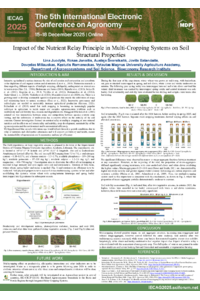
Intensive agricultural practices contribute to soil erosion, compaction, and the depletion of soil organic carbon and essential nutrients. There is a growing demand for sustainable practices that enable efficient crop production while minimizing environmental impact. Among these, multi-cropping has emerged as a promising strategy to address major agroecosystem challenges such as biodiversity loss, declining soil fertility, and increased greenhouse gas emissions. Prior studies have shown that crop interactions and interspecific competition in multi-cropping systems enhance root development and improve soil structural stability. Balandaitė et al. (2024) noted that multi-cropping is becoming a promising technique in agriculture.
A stationary field experiment was established in 2024 at the Experimental Station of Vytautas Magnus University Agriculture Academy (Lithuania; 54°53′N, 23°50′E), on Endocalcaric Amphistagnic Luvisol. The study aims to evaluate the effects of multi-cropping and nutrient relay on soil physical properties, crop development, and environmental indicators across two full crop rotation cycles.
Soil aggregate structure, stability, electrical conductivity, and greenhouse gas emissions were assessed before sowing and after harvest. Biomass samples were collected following the final cut. Preliminary results indicate that aggregate stability in multi-cropping systems is higher compared to monoculture spring barley, with a greater proportion of macroaggregates observed. These findings align with previous research showing that post-harvest residues from systems combining barley and red clover provide higher nutrient retention than monocultures. Additional results on biomass nutrient content are forthcoming.
In conclusion, multi-cropping positively influenced soil structure and stability in both the first and second crop rotations. The impact of nutrient relay will be further evaluated through subsequent assessments of the diagnostic crop. Ongoing observations across the full rotation cycles aim to provide insights supporting regenerative agriculture and alignment with the EU Green Deal objectives.
Keywords
nutrient relay
multi-cropping
soil structure
macroagregates
soil stability
Poster
Lina Juodyte_relay_cropping_last_2025.pdf
Enhancing photosynthetic efficiency and nutrient uptake in Maize (Zea mays L.) using extracellular polymeric substances recovered from waste sludge
Compost application as a mitigation strategy for water deficit stress in tomato plants