Event submissions
Published
This submission belongs to the session S8. Sustainable Farming Systems and Soil Management of the event The 5th International Electronic Conference on Agronomy
Published date
11 Dec, 2025
Academic Editor
'%3e%3cpath%20d='M12.6657%2010.9104C12.4185%2010.325%2012.0599%209.79327%2011.6097%209.34482C11.1609%208.89508%2010.6293%208.5365%2010.0442%208.28888C10.0389%208.28626%2010.0337%208.28495%2010.0285%208.28233C10.8446%207.69279%2011.3752%206.73249%2011.3752%205.64904C11.3752%203.8542%209.92103%202.39999%208.1262%202.39999C6.33136%202.39999%204.87715%203.8542%204.87715%205.64904C4.87715%206.73249%205.40774%207.69279%206.22393%208.28364C6.21869%208.28626%206.21345%208.28757%206.20821%208.29019C5.62129%208.5378%205.09463%208.89284%204.64265%209.34613C4.1929%209.79493%203.83432%2010.3266%203.58671%2010.9117C3.34345%2011.4845%203.21226%2012.0987%203.20023%2012.7209C3.19988%2012.7349%203.20233%2012.7488%203.20744%2012.7619C3.21255%2012.7749%203.22022%2012.7867%203.22998%2012.7968C3.23975%2012.8068%203.25142%2012.8147%203.26431%2012.8202C3.2772%2012.8256%203.29105%2012.8284%203.30504%2012.8284H4.09109C4.14874%2012.8284%204.19459%2012.7825%204.1959%2012.7262C4.2221%2011.7148%204.62823%2010.7676%205.34617%2010.0497C6.08899%209.30683%207.0755%208.89808%208.1262%208.89808C9.17689%208.89808%2010.1634%209.30683%2010.9062%2010.0497C11.6242%2010.7676%2012.0303%2011.7148%2012.0565%2012.7262C12.0578%2012.7838%2012.1037%2012.8284%2012.1613%2012.8284H12.9474C12.9613%2012.8284%2012.9752%2012.8256%2012.9881%2012.8202C13.001%2012.8147%2013.0126%2012.8068%2013.0224%2012.7968C13.0322%2012.7867%2013.0398%2012.7749%2013.0449%2012.7619C13.0501%2012.7488%2013.0525%2012.7349%2013.0522%2012.7209C13.0391%2012.0947%2012.9094%2011.4855%2012.6657%2010.9104ZM8.1262%207.9024C7.52486%207.9024%206.9589%207.6679%206.53312%207.24211C6.10733%206.81633%205.87283%206.25037%205.87283%205.64904C5.87283%205.0477%206.10733%204.48174%206.53312%204.05596C6.9589%203.63018%207.52486%203.39567%208.1262%203.39567C8.72753%203.39567%209.29349%203.63018%209.71927%204.05596C10.1451%204.48174%2010.3796%205.0477%2010.3796%205.64904C10.3796%206.25037%2010.1451%206.81633%209.71927%207.24211C9.29349%207.6679%208.72753%207.9024%208.1262%207.9024Z'%20fill='%235D1EE1'/%3e%3c/g%3e%3c/svg%3e) Peter Gregory
Peter GregoryCitation
Santiago C. Vásquez, Marlene Molina-Müller, Fernando Granja, Mirian Capa-Morocho, Wagner Oviedo-Castillo, Interactive Effects of Plant Density and Sowing Method on Growth and Productivity of Quinoa, in Proceedings of The 5th International Electronic Conference on Agronomy, 15 December–18 December 2025, MDPI: Basel, Switzerland
Share
Email
Facebook
Twitter
LinkedIn
Interactive Effects of Plant Density and Sowing Method on Growth and Productivity of Quinoa

Santiago C. Vásquez 1,2
'%3e%3cpath%20d='M12.6647%2010.9104C12.4176%2010.325%2012.0589%209.7933%2011.6088%209.34485C11.16%208.89511%2010.6283%208.53653%2010.0432%208.28891C10.038%208.28629%2010.0327%208.28498%2010.0275%208.28236C10.8437%207.69282%2011.3743%206.73252%2011.3743%205.64907C11.3743%203.85423%209.92005%202.40002%208.12522%202.40002C6.33038%202.40002%204.87618%203.85423%204.87618%205.64907C4.87618%206.73252%205.40677%207.69282%206.22296%208.28367C6.21772%208.28629%206.21248%208.2876%206.20724%208.29022C5.62031%208.53783%205.09365%208.89287%204.64167%209.34616C4.19192%209.79496%203.83334%2010.3266%203.58573%2010.9117C3.34247%2011.4846%203.21128%2012.0987%203.19925%2012.721C3.1989%2012.735%203.20135%2012.7489%203.20646%2012.7619C3.21157%2012.7749%203.21924%2012.7868%203.22901%2012.7968C3.23877%2012.8068%203.25045%2012.8148%203.26334%2012.8202C3.27623%2012.8256%203.29007%2012.8284%203.30406%2012.8284H4.09012C4.14776%2012.8284%204.19362%2012.7825%204.19493%2012.7262C4.22113%2011.7148%204.62726%2010.7676%205.34519%2010.0497C6.08802%209.30686%207.07452%208.89811%208.12522%208.89811C9.17592%208.89811%2010.1624%209.30686%2010.9052%2010.0497C11.6232%2010.7676%2012.0293%2011.7148%2012.0555%2012.7262C12.0568%2012.7839%2012.1027%2012.8284%2012.1603%2012.8284H12.9464C12.9604%2012.8284%2012.9742%2012.8256%2012.9871%2012.8202C13%2012.8148%2013.0117%2012.8068%2013.0214%2012.7968C13.0312%2012.7868%2013.0389%2012.7749%2013.044%2012.7619C13.0491%2012.7489%2013.0515%2012.735%2013.0512%2012.721C13.0381%2012.0947%2012.9084%2011.4856%2012.6647%2010.9104ZM8.12522%207.90243C7.52388%207.90243%206.95792%207.66793%206.53214%207.24215C6.10636%206.81636%205.87185%206.2504%205.87185%205.64907C5.87185%205.04773%206.10636%204.48177%206.53214%204.05599C6.95792%203.63021%207.52388%203.3957%208.12522%203.3957C8.72655%203.3957%209.29252%203.63021%209.7183%204.05599C10.1441%204.48177%2010.3786%205.04773%2010.3786%205.64907C10.3786%206.2504%2010.1441%206.81636%209.7183%207.24215C9.29252%207.66793%208.72655%207.90243%208.12522%207.90243Z'%20fill='%235D1EE1'/%3e%3c/g%3e%3c/svg%3e)
Marlene Molina-Müller 1,2
Fernando Granja 1,2
Mirian Capa-Morocho 1,2
Wagner Oviedo-Castillo 1
1. Agronomy Department, Faculty of Agricultural Sciences and Renewable Natural Resources, National University of Loja, Guillermo Falconí University Campus, Loja 110103, Ecuador
2. Research Group in Ecophysiology and Agricultural Production (AgroPHYS), National University of Loja, Guillermo Falconí University Campus, Loja 110103, Ecuador
Abstract
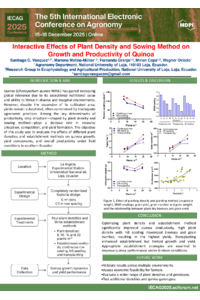
Quinoa (Chenopodium quinoa Willd.) has gained increasing global relevance due to its exceptional nutritional value and ability to thrive in diverse and marginal environments. However, despite the expansion of its cultivated area, yields remain suboptimal, often constrained by inadequate agronomic practices. Among the key determinants of productivity, crop structure—shaped by plant density and sowing method—plays a decisive role in resource allocation, competition, and yield formation. This study assessed the effects of four plant densities (8, 10, 15, and 20 plants m⁻²) and three establishment methods (continuous row sowing, hill seeding, and transplanting) on quinoa growth dynamics and yield performance under field conditions at the La Argelia Experimental Station, Universidad Nacional de Loja, Ecuador. A completely randomized factorial design was implemented, with 6 m² plots and 0.5 m row spacing. Both plant density and establishment method significantly influenced most growth and yield traits. Transplanting improved establishment efficiency but delayed physiological maturity, reduced plant height, and decreased aboveground biomass, likely due to post-transplant stress. In contrast, hill seeding at high plant density promoted greater plant height (2.28 m), aboveground biomass (2414 g m⁻²), and grain number (235,415 grains m⁻²). The highest yield (600 g m⁻²) was achieved at 20 plants m⁻², exceeding the lowest density by more than 30%, mainly through increased grain number per unit area and enhanced biomass production. These results underscore the importance of optimizing plant density and establishment method to maximize quinoa productivity and provide practical guidelines for improving resource-use efficiency under Andean growing conditions.
Keywords
quinoa
plant density
sowing method
transplanting
grain yield
Poster
IECAG 2025. SC. vasquez quinoa.pdf
Compost application as a mitigation strategy for water deficit stress in tomato plants
Deficit Irrigation Strategies (DI and PRD) Effects on Potato (Solanum Tuberosum L.) Yield, Nitrogen Nutrition, NUE and IWUE under Tunisian Semi-arid Conditions.