Event submissions
Published
This submission belongs to the session S5. Crop Biotic Interactions of the event The 5th International Electronic Conference on Agronomy
Published date
11 Dec, 2025
Academic Editor
'%3e%3cpath%20d='M12.6657%2010.9104C12.4185%2010.325%2012.0599%209.79327%2011.6097%209.34482C11.1609%208.89508%2010.6293%208.5365%2010.0442%208.28888C10.0389%208.28626%2010.0337%208.28495%2010.0285%208.28233C10.8446%207.69279%2011.3752%206.73249%2011.3752%205.64904C11.3752%203.8542%209.92103%202.39999%208.1262%202.39999C6.33136%202.39999%204.87715%203.8542%204.87715%205.64904C4.87715%206.73249%205.40774%207.69279%206.22393%208.28364C6.21869%208.28626%206.21345%208.28757%206.20821%208.29019C5.62129%208.5378%205.09463%208.89284%204.64265%209.34613C4.1929%209.79493%203.83432%2010.3266%203.58671%2010.9117C3.34345%2011.4845%203.21226%2012.0987%203.20023%2012.7209C3.19988%2012.7349%203.20233%2012.7488%203.20744%2012.7619C3.21255%2012.7749%203.22022%2012.7867%203.22998%2012.7968C3.23975%2012.8068%203.25142%2012.8147%203.26431%2012.8202C3.2772%2012.8256%203.29105%2012.8284%203.30504%2012.8284H4.09109C4.14874%2012.8284%204.19459%2012.7825%204.1959%2012.7262C4.2221%2011.7148%204.62823%2010.7676%205.34617%2010.0497C6.08899%209.30683%207.0755%208.89808%208.1262%208.89808C9.17689%208.89808%2010.1634%209.30683%2010.9062%2010.0497C11.6242%2010.7676%2012.0303%2011.7148%2012.0565%2012.7262C12.0578%2012.7838%2012.1037%2012.8284%2012.1613%2012.8284H12.9474C12.9613%2012.8284%2012.9752%2012.8256%2012.9881%2012.8202C13.001%2012.8147%2013.0126%2012.8068%2013.0224%2012.7968C13.0322%2012.7867%2013.0398%2012.7749%2013.0449%2012.7619C13.0501%2012.7488%2013.0525%2012.7349%2013.0522%2012.7209C13.0391%2012.0947%2012.9094%2011.4855%2012.6657%2010.9104ZM8.1262%207.9024C7.52486%207.9024%206.9589%207.6679%206.53312%207.24211C6.10733%206.81633%205.87283%206.25037%205.87283%205.64904C5.87283%205.0477%206.10733%204.48174%206.53312%204.05596C6.9589%203.63018%207.52486%203.39567%208.1262%203.39567C8.72753%203.39567%209.29349%203.63018%209.71927%204.05596C10.1451%204.48174%2010.3796%205.0477%2010.3796%205.64904C10.3796%206.25037%2010.1451%206.81633%209.71927%207.24211C9.29349%207.6679%208.72753%207.9024%208.1262%207.9024Z'%20fill='%235D1EE1'/%3e%3c/g%3e%3c/svg%3e) J.D. Flores-Félix
J.D. Flores-FélixCitation
Verónica Carbajal-Rocha, Arnulfo Dominguez-Hernandez, Elisa Dominguez-Hernandez, Martha Elena Domínguez-Hernandez, Evaluation of Phytotoxicity of Manure-derived Fertilisers Using Seed Germination and Root Elongation Bioassays, in Proceedings of The 5th International Electronic Conference on Agronomy, 15 December–18 December 2025, MDPI: Basel, Switzerland
Share
Email
Facebook
Twitter
LinkedIn
Evaluation of Phytotoxicity of Manure-derived Fertilisers Using Seed Germination and Root Elongation Bioassays
'%3e%3cpath%20d='M12.6647%2010.9104C12.4176%2010.325%2012.0589%209.7933%2011.6088%209.34485C11.16%208.89511%2010.6283%208.53653%2010.0432%208.28891C10.038%208.28629%2010.0327%208.28498%2010.0275%208.28236C10.8437%207.69282%2011.3743%206.73252%2011.3743%205.64907C11.3743%203.85423%209.92005%202.40002%208.12522%202.40002C6.33038%202.40002%204.87618%203.85423%204.87618%205.64907C4.87618%206.73252%205.40677%207.69282%206.22296%208.28367C6.21772%208.28629%206.21248%208.2876%206.20724%208.29022C5.62031%208.53783%205.09365%208.89287%204.64167%209.34616C4.19192%209.79496%203.83334%2010.3266%203.58573%2010.9117C3.34247%2011.4846%203.21128%2012.0987%203.19925%2012.721C3.1989%2012.735%203.20135%2012.7489%203.20646%2012.7619C3.21157%2012.7749%203.21924%2012.7868%203.22901%2012.7968C3.23877%2012.8068%203.25045%2012.8148%203.26334%2012.8202C3.27623%2012.8256%203.29007%2012.8284%203.30406%2012.8284H4.09012C4.14776%2012.8284%204.19362%2012.7825%204.19493%2012.7262C4.22113%2011.7148%204.62726%2010.7676%205.34519%2010.0497C6.08802%209.30686%207.07452%208.89811%208.12522%208.89811C9.17592%208.89811%2010.1624%209.30686%2010.9052%2010.0497C11.6232%2010.7676%2012.0293%2011.7148%2012.0555%2012.7262C12.0568%2012.7839%2012.1027%2012.8284%2012.1603%2012.8284H12.9464C12.9604%2012.8284%2012.9742%2012.8256%2012.9871%2012.8202C13%2012.8148%2013.0117%2012.8068%2013.0214%2012.7968C13.0312%2012.7868%2013.0389%2012.7749%2013.044%2012.7619C13.0491%2012.7489%2013.0515%2012.735%2013.0512%2012.721C13.0381%2012.0947%2012.9084%2011.4856%2012.6647%2010.9104ZM8.12522%207.90243C7.52388%207.90243%206.95792%207.66793%206.53214%207.24215C6.10636%206.81636%205.87185%206.2504%205.87185%205.64907C5.87185%205.04773%206.10636%204.48177%206.53214%204.05599C6.95792%203.63021%207.52388%203.3957%208.12522%203.3957C8.72655%203.3957%209.29252%203.63021%209.7183%204.05599C10.1441%204.48177%2010.3786%205.04773%2010.3786%205.64907C10.3786%206.2504%2010.1441%206.81636%209.7183%207.24215C9.29252%207.66793%208.72655%207.90243%208.12522%207.90243Z'%20fill='%235D1EE1'/%3e%3c/g%3e%3c/svg%3e)
Verónica Carbajal-Rocha 1
Arnulfo Dominguez-Hernandez 2
Elisa Dominguez-Hernandez 2,3

Martha Elena Domínguez-Hernandez 1
1. Department of Agricultural Sciences, Faculty of Higher Studies Cuautitlán, National Autonomous University of Mexico, Cuautitlán Izcalli 54714, Mexico
2. Graduate Programme in Systems Engineering, Research and Graduate Studies Section, Higher School of Mechanical and Electrical Engineering, National Polytechnic Institute, Gustavo A. Madero 07738, Mexico
3. Department of Mathematics, Faculty of Higher Studies Cuautitlán, National Autonomous University of Mexico, Cuautitlán Izcalli 54714, Mexico
Abstract
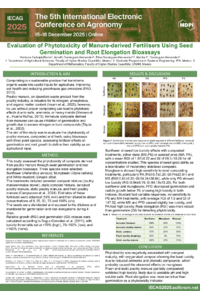
This study evaluated the phytotoxicity of poultry manure-derived fertilizers. Four composting treatments were obtained from fresh poultry droppings at different initial C/N ratios (12 and 30, P and M, respectively) and oxygenation levels: static pile (S) and forced aeration (A). Acute toxicity tests were performed on seeds of three plant species (Helianthus annuus, Vigna radiata, and Sinapis alba) using elutriates of fresh poultry droppings (FPDs) and composts (1:10 w/v) at different concentrations (25, 50, 75 and 100% v/v). Seeds were disinfected, exposed to elutriates, and monitored for germination and root elongation over 4 days. Relative growth and germination indexes were calculated (RGI and GI, respectively). Toxicity/inhibition thresholds for GI and ICR were <80% (high), 80–100% (low), and >100% (none). Sunflower showed low toxicity effects with composted treatments, either static (MS,PS) or aerated ones (MA, PA), with a mean RGI of 1.07±0.22 and GI of 99.5±18.26 for all concentrations studied. Mungbeans showed high sensitivity to most composting treatments, particularly PA (RGI:0.7±0.25; GI:74±23.54) and MS (RGI:0.62±0.36; GI:64.24±38.84), while only PS showed low toxicity (RGI:0.94±0.15; GI:94.18±13.23). For both sunflower and mungbeans, FPD decreased germination and radicle growth below 70, showing high toxicity in both indexes. Mustard had variable responses, no sensitivity to PS and MA treatments, with average RGI of 1.5 and GI of 147.32, while MS and FPD caused slightly low toxicity, and PA had high toxicity. Root elongation (RGI) was more robust than germination (GI) for detecting phytotoxicity. In general, it was observed that composting poultry droppings, regardless of the aeration or initial C/N, reduced in sensitive species, making it suitable for its use as fertilizer.
Keywords
phytotoxicity
compost
seed germination
inhibition
sunflower
mungbean
mustard
Poster
poster COMPOST.pdf
Quantifying tiller contribution to yield as a compensatory and water stress adaptation mechanism in sorghum
SYMBIOTIC PERFORMANCE, C ASSIMILATION AND PLANT WATER-USE EFFICIENCY IN FOUR GROUNDNUT VARIETIES GROWN IN NORTH WEST PROVINCE FIELD, SOUTH AFRICA, MEASURED USING 15N AND 13C NATURAL ABUNDANCE TECHNIQUES