Event submissions
Published
This submission belongs to the session S4. Crop Water and Nutrient Management of the event The 5th International Electronic Conference on Agronomy
Published date
11 Dec, 2025
Academic Editor
'%3e%3cpath%20d='M12.6657%2010.9104C12.4185%2010.325%2012.0599%209.79327%2011.6097%209.34482C11.1609%208.89508%2010.6293%208.5365%2010.0442%208.28888C10.0389%208.28626%2010.0337%208.28495%2010.0285%208.28233C10.8446%207.69279%2011.3752%206.73249%2011.3752%205.64904C11.3752%203.8542%209.92103%202.39999%208.1262%202.39999C6.33136%202.39999%204.87715%203.8542%204.87715%205.64904C4.87715%206.73249%205.40774%207.69279%206.22393%208.28364C6.21869%208.28626%206.21345%208.28757%206.20821%208.29019C5.62129%208.5378%205.09463%208.89284%204.64265%209.34613C4.1929%209.79493%203.83432%2010.3266%203.58671%2010.9117C3.34345%2011.4845%203.21226%2012.0987%203.20023%2012.7209C3.19988%2012.7349%203.20233%2012.7488%203.20744%2012.7619C3.21255%2012.7749%203.22022%2012.7867%203.22998%2012.7968C3.23975%2012.8068%203.25142%2012.8147%203.26431%2012.8202C3.2772%2012.8256%203.29105%2012.8284%203.30504%2012.8284H4.09109C4.14874%2012.8284%204.19459%2012.7825%204.1959%2012.7262C4.2221%2011.7148%204.62823%2010.7676%205.34617%2010.0497C6.08899%209.30683%207.0755%208.89808%208.1262%208.89808C9.17689%208.89808%2010.1634%209.30683%2010.9062%2010.0497C11.6242%2010.7676%2012.0303%2011.7148%2012.0565%2012.7262C12.0578%2012.7838%2012.1037%2012.8284%2012.1613%2012.8284H12.9474C12.9613%2012.8284%2012.9752%2012.8256%2012.9881%2012.8202C13.001%2012.8147%2013.0126%2012.8068%2013.0224%2012.7968C13.0322%2012.7867%2013.0398%2012.7749%2013.0449%2012.7619C13.0501%2012.7488%2013.0525%2012.7349%2013.0522%2012.7209C13.0391%2012.0947%2012.9094%2011.4855%2012.6657%2010.9104ZM8.1262%207.9024C7.52486%207.9024%206.9589%207.6679%206.53312%207.24211C6.10733%206.81633%205.87283%206.25037%205.87283%205.64904C5.87283%205.0477%206.10733%204.48174%206.53312%204.05596C6.9589%203.63018%207.52486%203.39567%208.1262%203.39567C8.72753%203.39567%209.29349%203.63018%209.71927%204.05596C10.1451%204.48174%2010.3796%205.0477%2010.3796%205.64904C10.3796%206.25037%2010.1451%206.81633%209.71927%207.24211C9.29349%207.6679%208.72753%207.9024%208.1262%207.9024Z'%20fill='%235D1EE1'/%3e%3c/g%3e%3c/svg%3e) Sofia Pereira
Sofia PereiraCitation
Gabrijel Ondrasek, Marina Bubalo Kovačić, Marko Reljić, Sanja Stipičević, René Matthies, Predrag Samardžija, Jelena Horvatinec, Agronomic Potential of Anaerobically Digested Sewage Sludge from Croatian Capital Wastewater Treatment Plant, in Proceedings of The 5th International Electronic Conference on Agronomy, 15 December–18 December 2025, MDPI: Basel, Switzerland
Share
Email
Facebook
Twitter
LinkedIn
Agronomic Potential of Anaerobically Digested Sewage Sludge from Croatian Capital Wastewater Treatment Plant

Gabrijel Ondrasek 1
'%3e%3cpath%20d='M12.6647%2010.9104C12.4176%2010.325%2012.0589%209.7933%2011.6088%209.34485C11.16%208.89511%2010.6283%208.53653%2010.0432%208.28891C10.038%208.28629%2010.0327%208.28498%2010.0275%208.28236C10.8437%207.69282%2011.3743%206.73252%2011.3743%205.64907C11.3743%203.85423%209.92005%202.40002%208.12522%202.40002C6.33038%202.40002%204.87618%203.85423%204.87618%205.64907C4.87618%206.73252%205.40677%207.69282%206.22296%208.28367C6.21772%208.28629%206.21248%208.2876%206.20724%208.29022C5.62031%208.53783%205.09365%208.89287%204.64167%209.34616C4.19192%209.79496%203.83334%2010.3266%203.58573%2010.9117C3.34247%2011.4846%203.21128%2012.0987%203.19925%2012.721C3.1989%2012.735%203.20135%2012.7489%203.20646%2012.7619C3.21157%2012.7749%203.21924%2012.7868%203.22901%2012.7968C3.23877%2012.8068%203.25045%2012.8148%203.26334%2012.8202C3.27623%2012.8256%203.29007%2012.8284%203.30406%2012.8284H4.09012C4.14776%2012.8284%204.19362%2012.7825%204.19493%2012.7262C4.22113%2011.7148%204.62726%2010.7676%205.34519%2010.0497C6.08802%209.30686%207.07452%208.89811%208.12522%208.89811C9.17592%208.89811%2010.1624%209.30686%2010.9052%2010.0497C11.6232%2010.7676%2012.0293%2011.7148%2012.0555%2012.7262C12.0568%2012.7839%2012.1027%2012.8284%2012.1603%2012.8284H12.9464C12.9604%2012.8284%2012.9742%2012.8256%2012.9871%2012.8202C13%2012.8148%2013.0117%2012.8068%2013.0214%2012.7968C13.0312%2012.7868%2013.0389%2012.7749%2013.044%2012.7619C13.0491%2012.7489%2013.0515%2012.735%2013.0512%2012.721C13.0381%2012.0947%2012.9084%2011.4856%2012.6647%2010.9104ZM8.12522%207.90243C7.52388%207.90243%206.95792%207.66793%206.53214%207.24215C6.10636%206.81636%205.87185%206.2504%205.87185%205.64907C5.87185%205.04773%206.10636%204.48177%206.53214%204.05599C6.95792%203.63021%207.52388%203.3957%208.12522%203.3957C8.72655%203.3957%209.29252%203.63021%209.7183%204.05599C10.1441%204.48177%2010.3786%205.04773%2010.3786%205.64907C10.3786%206.2504%2010.1441%206.81636%209.7183%207.24215C9.29252%207.66793%208.72655%207.90243%208.12522%207.90243Z'%20fill='%235D1EE1'/%3e%3c/g%3e%3c/svg%3e)
Marina Bubalo Kovačić 1
Marko Reljić 1
Sanja Stipičević 2
René Matthies 3
Predrag Samardžija 3
Jelena Horvatinec 1
1. Faculty of Agriculture, University of Zagreb, Zagreb, 10000, Croatia
2. Institute for Medical Research and Occupational Health, Zagreb, 10000, Croatia
3. Zagrebačke otpadne vode l.t.d., Zagreb, 10000, Croatia
Abstract
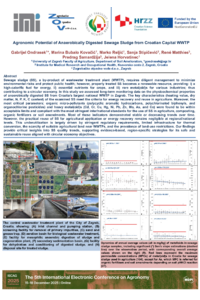
Sewage sludge (SS), a by-product of wastewater treatment plants (WWTPs), poses significant environmental and public health challenges if not properly managed. However, when adequately treated, SS can become a valuable source of essential nutrients for crops, thereby contributing to sustainable agriculture and circular economy initiatives. This study presents a comprehensive long-term analysis of the physicochemical properties of anaerobically digested SS from the central WWTP in Zagreb, Croatia. Key parameters, including nitrogen (N), phosphorus (P), potassium (K), and carbon (C), demonstrate that the sludge meets established criteria for agricultural reuse. In addition, concentrations of potentially toxic metal(loid)s (e.g., Cd, Cr, Cu, Hg, Ni, Pb, Zn, Mo, As, and Co) remained within permissible limits and complied with strict national and international regulations governing their use in agriculture and soil amendments. Most indicators showed stable or declining trends over the monitoring period, indicating consistent treatment quality and low environmental risk. Nevertheless, actual reuse of SS in agriculture remains limited, largely due to regulatory, infrastructural, and logistical barriers, including limited access to suitable land near WWTPs. This study underscores the agronomic value and safety of SS and highlights the need for targeted strategies to support its sustainable application. Policy adjustments, infrastructure investment, and greater public awareness are essential to unlock the full potential of SS and advance circular, resource-efficient wastewater management systems.
Keywords
Circular economy
Waste management
Nutrients
Heavy metal(loid)s
Poster
sciforum-140947.pdf
Effect of Herbicide-treated soil inoculum on Nodulation in Cowpea (Vigna unguiculata L. Walp.) and Soybean (Glycine max L. Merr.) planted under Glasshouse Conditions
An in vitro approach to study oxidative stress in tomato roots during root-knot nematode infection