Event submissions
Published
This submission belongs to the session S5. Crop Biotic Interactions of the event The 5th International Electronic Conference on Agronomy
Published date
11 Dec, 2025
Academic Editor
'%3e%3cpath%20d='M12.6657%2010.9104C12.4185%2010.325%2012.0599%209.79327%2011.6097%209.34482C11.1609%208.89508%2010.6293%208.5365%2010.0442%208.28888C10.0389%208.28626%2010.0337%208.28495%2010.0285%208.28233C10.8446%207.69279%2011.3752%206.73249%2011.3752%205.64904C11.3752%203.8542%209.92103%202.39999%208.1262%202.39999C6.33136%202.39999%204.87715%203.8542%204.87715%205.64904C4.87715%206.73249%205.40774%207.69279%206.22393%208.28364C6.21869%208.28626%206.21345%208.28757%206.20821%208.29019C5.62129%208.5378%205.09463%208.89284%204.64265%209.34613C4.1929%209.79493%203.83432%2010.3266%203.58671%2010.9117C3.34345%2011.4845%203.21226%2012.0987%203.20023%2012.7209C3.19988%2012.7349%203.20233%2012.7488%203.20744%2012.7619C3.21255%2012.7749%203.22022%2012.7867%203.22998%2012.7968C3.23975%2012.8068%203.25142%2012.8147%203.26431%2012.8202C3.2772%2012.8256%203.29105%2012.8284%203.30504%2012.8284H4.09109C4.14874%2012.8284%204.19459%2012.7825%204.1959%2012.7262C4.2221%2011.7148%204.62823%2010.7676%205.34617%2010.0497C6.08899%209.30683%207.0755%208.89808%208.1262%208.89808C9.17689%208.89808%2010.1634%209.30683%2010.9062%2010.0497C11.6242%2010.7676%2012.0303%2011.7148%2012.0565%2012.7262C12.0578%2012.7838%2012.1037%2012.8284%2012.1613%2012.8284H12.9474C12.9613%2012.8284%2012.9752%2012.8256%2012.9881%2012.8202C13.001%2012.8147%2013.0126%2012.8068%2013.0224%2012.7968C13.0322%2012.7867%2013.0398%2012.7749%2013.0449%2012.7619C13.0501%2012.7488%2013.0525%2012.7349%2013.0522%2012.7209C13.0391%2012.0947%2012.9094%2011.4855%2012.6657%2010.9104ZM8.1262%207.9024C7.52486%207.9024%206.9589%207.6679%206.53312%207.24211C6.10733%206.81633%205.87283%206.25037%205.87283%205.64904C5.87283%205.0477%206.10733%204.48174%206.53312%204.05596C6.9589%203.63018%207.52486%203.39567%208.1262%203.39567C8.72753%203.39567%209.29349%203.63018%209.71927%204.05596C10.1451%204.48174%2010.3796%205.0477%2010.3796%205.64904C10.3796%206.25037%2010.1451%206.81633%209.71927%207.24211C9.29349%207.6679%208.72753%207.9024%208.1262%207.9024Z'%20fill='%235D1EE1'/%3e%3c/g%3e%3c/svg%3e) J.D. Flores-Félix
J.D. Flores-FélixCitation
Norma Dolores Zamora, Aurea Bernardino-Nicanor, Leopoldo González-Cruz, José Mayolo Simitrio Juárez-Goiz, Ana María Ramos, Agave salmiana and chinicuil (Comadia redtenbacheri): A Relationship That Promotes the Generation of Bioactive Compounds, in Proceedings of The 5th International Electronic Conference on Agronomy, 15 December–18 December 2025, MDPI: Basel, Switzerland
Share
Email
Facebook
Twitter
LinkedIn
Agave salmiana and chinicuil (Comadia redtenbacheri): A Relationship That Promotes the Generation of Bioactive Compounds
'%3e%3cpath%20d='M12.6647%2010.9104C12.4176%2010.325%2012.0589%209.7933%2011.6088%209.34485C11.16%208.89511%2010.6283%208.53653%2010.0432%208.28891C10.038%208.28629%2010.0327%208.28498%2010.0275%208.28236C10.8437%207.69282%2011.3743%206.73252%2011.3743%205.64907C11.3743%203.85423%209.92005%202.40002%208.12522%202.40002C6.33038%202.40002%204.87618%203.85423%204.87618%205.64907C4.87618%206.73252%205.40677%207.69282%206.22296%208.28367C6.21772%208.28629%206.21248%208.2876%206.20724%208.29022C5.62031%208.53783%205.09365%208.89287%204.64167%209.34616C4.19192%209.79496%203.83334%2010.3266%203.58573%2010.9117C3.34247%2011.4846%203.21128%2012.0987%203.19925%2012.721C3.1989%2012.735%203.20135%2012.7489%203.20646%2012.7619C3.21157%2012.7749%203.21924%2012.7868%203.22901%2012.7968C3.23877%2012.8068%203.25045%2012.8148%203.26334%2012.8202C3.27623%2012.8256%203.29007%2012.8284%203.30406%2012.8284H4.09012C4.14776%2012.8284%204.19362%2012.7825%204.19493%2012.7262C4.22113%2011.7148%204.62726%2010.7676%205.34519%2010.0497C6.08802%209.30686%207.07452%208.89811%208.12522%208.89811C9.17592%208.89811%2010.1624%209.30686%2010.9052%2010.0497C11.6232%2010.7676%2012.0293%2011.7148%2012.0555%2012.7262C12.0568%2012.7839%2012.1027%2012.8284%2012.1603%2012.8284H12.9464C12.9604%2012.8284%2012.9742%2012.8256%2012.9871%2012.8202C13%2012.8148%2013.0117%2012.8068%2013.0214%2012.7968C13.0312%2012.7868%2013.0389%2012.7749%2013.044%2012.7619C13.0491%2012.7489%2013.0515%2012.735%2013.0512%2012.721C13.0381%2012.0947%2012.9084%2011.4856%2012.6647%2010.9104ZM8.12522%207.90243C7.52388%207.90243%206.95792%207.66793%206.53214%207.24215C6.10636%206.81636%205.87185%206.2504%205.87185%205.64907C5.87185%205.04773%206.10636%204.48177%206.53214%204.05599C6.95792%203.63021%207.52388%203.3957%208.12522%203.3957C8.72655%203.3957%209.29252%203.63021%209.7183%204.05599C10.1441%204.48177%2010.3786%205.04773%2010.3786%205.64907C10.3786%206.2504%2010.1441%206.81636%209.7183%207.24215C9.29252%207.66793%208.72655%207.90243%208.12522%207.90243Z'%20fill='%235D1EE1'/%3e%3c/g%3e%3c/svg%3e)
Norma Dolores Zamora 1

Aurea Bernardino-Nicanor 1

Leopoldo González-Cruz 1
José Mayolo Simitrio Juárez-Goiz 1
Ana María Ramos 1
1. Department of Biochemical Engineering, National Technological Institute of Mexico – IT of Celaya, Celaya, Guanajuato 38010, Mexico
Abstract
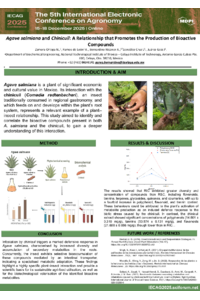
Agave salmiana is a plant of great economic and cultural value in Mexico, whose interaction with the insect chinicuil (Comadia redtenbacheri), a phytophagous species that develops in its root system, represents a key example of the plant–insect relationship. The objective of this study was to identify and relate the bioactive compounds present in both A. salmiana and the chinicuil to better understand this interaction. Samples were collected from A. salmiana free of chinicuil (RSC) and infected by chinicuil (RIC), as well as chinicuils from the infected agave. Both materials were dried, pulverized, and subjected to hydroethanolic extraction (70:30) at a 1:10 w/v ratio. Subsequently, phytochemical screening was performed on the roots and entomochemical screening on the chinicuil. Total polyphenols were quantified using the Folin–Ciocalteu method (GAE mg/g), flavonoids with the AlCl3 method (QE mg/g), and tannins with the Vanillin–HCl method (CE mg/g), followed by statistical analysis with ANOVA and Tukey’s test (p < 0.05).
The results showed that RIC presented a greater diversity and concentration of compounds compared to RSC, including flavonoids, tannins, terpenes, glycosides, quinones, and coumarins, with up to a fourfold increase in polyphenol, flavonoid, and tannin content. This behavior could be attributed to the plant’s activation of metabolite production as an induced defense response to the biotic stress caused by the chinicuil. In contrast, the chinicuil extract showed significant concentrations of polyphenols (14.801 ± 0.310 mg/g), tannins (53.574 ± 0.131 mg/g), and flavonoids (21.600 ± 0.086 mg/g), though lower than in RIC. The screening revealed that the insect performs a selective uptake of metabolites, with low compound accumulation, indicating a detoxification mechanism that allows it to exploit the plant’s metabolites without suffering adverse effects. These findings confirm a close biotic relationship, providing valuable insights for the development of functional foods and sustainable agricultural strategies based on ecological interactions.
Keywords
Agave salmiana
Comadia redtenbacheri
Bioactive compounds
Plant-insect interaction
Poster
Zamora-ortega_poster.pdf
Biotic interactions modulating stress tolerance in Lablab purpureus
Enhancing Seasonal Resilience and Resource Efficiency in Button Mushroom Production through the Mushroom Kothi System