Event submissions
Published
This submission belongs to the session S8. Sustainable Farming Systems and Soil Management of the event The 5th International Electronic Conference on Agronomy
Published date
11 Dec, 2025
Academic Editor
'%3e%3cpath%20d='M12.6657%2010.9104C12.4185%2010.325%2012.0599%209.79327%2011.6097%209.34482C11.1609%208.89508%2010.6293%208.5365%2010.0442%208.28888C10.0389%208.28626%2010.0337%208.28495%2010.0285%208.28233C10.8446%207.69279%2011.3752%206.73249%2011.3752%205.64904C11.3752%203.8542%209.92103%202.39999%208.1262%202.39999C6.33136%202.39999%204.87715%203.8542%204.87715%205.64904C4.87715%206.73249%205.40774%207.69279%206.22393%208.28364C6.21869%208.28626%206.21345%208.28757%206.20821%208.29019C5.62129%208.5378%205.09463%208.89284%204.64265%209.34613C4.1929%209.79493%203.83432%2010.3266%203.58671%2010.9117C3.34345%2011.4845%203.21226%2012.0987%203.20023%2012.7209C3.19988%2012.7349%203.20233%2012.7488%203.20744%2012.7619C3.21255%2012.7749%203.22022%2012.7867%203.22998%2012.7968C3.23975%2012.8068%203.25142%2012.8147%203.26431%2012.8202C3.2772%2012.8256%203.29105%2012.8284%203.30504%2012.8284H4.09109C4.14874%2012.8284%204.19459%2012.7825%204.1959%2012.7262C4.2221%2011.7148%204.62823%2010.7676%205.34617%2010.0497C6.08899%209.30683%207.0755%208.89808%208.1262%208.89808C9.17689%208.89808%2010.1634%209.30683%2010.9062%2010.0497C11.6242%2010.7676%2012.0303%2011.7148%2012.0565%2012.7262C12.0578%2012.7838%2012.1037%2012.8284%2012.1613%2012.8284H12.9474C12.9613%2012.8284%2012.9752%2012.8256%2012.9881%2012.8202C13.001%2012.8147%2013.0126%2012.8068%2013.0224%2012.7968C13.0322%2012.7867%2013.0398%2012.7749%2013.0449%2012.7619C13.0501%2012.7488%2013.0525%2012.7349%2013.0522%2012.7209C13.0391%2012.0947%2012.9094%2011.4855%2012.6657%2010.9104ZM8.1262%207.9024C7.52486%207.9024%206.9589%207.6679%206.53312%207.24211C6.10733%206.81633%205.87283%206.25037%205.87283%205.64904C5.87283%205.0477%206.10733%204.48174%206.53312%204.05596C6.9589%203.63018%207.52486%203.39567%208.1262%203.39567C8.72753%203.39567%209.29349%203.63018%209.71927%204.05596C10.1451%204.48174%2010.3796%205.0477%2010.3796%205.64904C10.3796%206.25037%2010.1451%206.81633%209.71927%207.24211C9.29349%207.6679%208.72753%207.9024%208.1262%207.9024Z'%20fill='%235D1EE1'/%3e%3c/g%3e%3c/svg%3e) Peter Gregory
Peter GregoryCitation
Sebbah Tarik, Edite Cunha, Liliana Espírito Santo, Alberto N. Araújo, Ana F. Vinha, M. Conceição Montenegro, M. Beatriz P. P. Oliveira, Revalorization of vineyard pruning by-products from different Vitis vinifera varieties: Evaluation of the phenolic profile across two defoliation seasons, in Proceedings of The 5th International Electronic Conference on Agronomy, 15 December–18 December 2025, MDPI: Basel, Switzerland
Share
Email
Facebook
Twitter
LinkedIn
Revalorization of vineyard pruning by-products from different Vitis vinifera varieties: Evaluation of the phenolic profile across two defoliation seasons
'%3e%3cpath%20d='M12.6647%2010.9104C12.4176%2010.325%2012.0589%209.7933%2011.6088%209.34485C11.16%208.89511%2010.6283%208.53653%2010.0432%208.28891C10.038%208.28629%2010.0327%208.28498%2010.0275%208.28236C10.8437%207.69282%2011.3743%206.73252%2011.3743%205.64907C11.3743%203.85423%209.92005%202.40002%208.12522%202.40002C6.33038%202.40002%204.87618%203.85423%204.87618%205.64907C4.87618%206.73252%205.40677%207.69282%206.22296%208.28367C6.21772%208.28629%206.21248%208.2876%206.20724%208.29022C5.62031%208.53783%205.09365%208.89287%204.64167%209.34616C4.19192%209.79496%203.83334%2010.3266%203.58573%2010.9117C3.34247%2011.4846%203.21128%2012.0987%203.19925%2012.721C3.1989%2012.735%203.20135%2012.7489%203.20646%2012.7619C3.21157%2012.7749%203.21924%2012.7868%203.22901%2012.7968C3.23877%2012.8068%203.25045%2012.8148%203.26334%2012.8202C3.27623%2012.8256%203.29007%2012.8284%203.30406%2012.8284H4.09012C4.14776%2012.8284%204.19362%2012.7825%204.19493%2012.7262C4.22113%2011.7148%204.62726%2010.7676%205.34519%2010.0497C6.08802%209.30686%207.07452%208.89811%208.12522%208.89811C9.17592%208.89811%2010.1624%209.30686%2010.9052%2010.0497C11.6232%2010.7676%2012.0293%2011.7148%2012.0555%2012.7262C12.0568%2012.7839%2012.1027%2012.8284%2012.1603%2012.8284H12.9464C12.9604%2012.8284%2012.9742%2012.8256%2012.9871%2012.8202C13%2012.8148%2013.0117%2012.8068%2013.0214%2012.7968C13.0312%2012.7868%2013.0389%2012.7749%2013.044%2012.7619C13.0491%2012.7489%2013.0515%2012.735%2013.0512%2012.721C13.0381%2012.0947%2012.9084%2011.4856%2012.6647%2010.9104ZM8.12522%207.90243C7.52388%207.90243%206.95792%207.66793%206.53214%207.24215C6.10636%206.81636%205.87185%206.2504%205.87185%205.64907C5.87185%205.04773%206.10636%204.48177%206.53214%204.05599C6.95792%203.63021%207.52388%203.3957%208.12522%203.3957C8.72655%203.3957%209.29252%203.63021%209.7183%204.05599C10.1441%204.48177%2010.3786%205.04773%2010.3786%205.64907C10.3786%206.2504%2010.1441%206.81636%209.7183%207.24215C9.29252%207.66793%208.72655%207.90243%208.12522%207.90243Z'%20fill='%235D1EE1'/%3e%3c/g%3e%3c/svg%3e)
Sebbah Tarik 1
Edite Cunha 1
Liliana Espírito Santo 1,2

Alberto N. Araújo 1
Ana F. Vinha 1,3
M. Conceição Montenegro 1

M. Beatriz P. P. Oliveira 1
1. LAQV/REQUIMTE, Department of Chemical Sciences, Faculty of Pharmacy, University of Porto, R. Jorge de Viterbo Ferreira 228, 4050-313 Porto, Portugal
2. Nutrition and Bromatology Group, Department of Analytical Chemistry and Food Science, Faculty of Science, University of Vigo, E-32004 Ourense, Spain.
3. FP-I3ID, Research Institute, Innovation and Development Fernando Pessoa, Faculty of Health Sciences, Fernando Pessoa University, Praça 9 Abril 349, 4249-004 Porto, Portugal.
Abstract
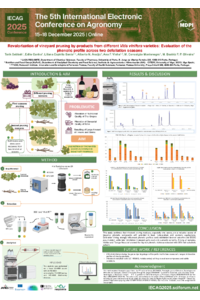
In the context of sustainable viticulture and circular bioeconomy, this study investigated the valorization potential of vineyard pruning by-products (leaves), gathered during two seasonal defoliation events across eight Vitis vinifera varieties (Vinhão, Touriga Nacional, Padeiro de Basto, Alvarinho, Sauvignon Blanc, Loureiro, Moscatel Galigo Branco, and Arinto). This study aimed to evaluate the influence of different defoliation timings (May and June, respectively) on the polyphenolic composition in hydroalcoholic extracts from dried leaves. Identification and quantification of catechin, epigallocatechin gallate (EGCG), gallic acid, quercetin, rutin, ellagic, and 3-O-methylellagic acid (3-MEA) were performed using high-performance liquid chromatography (HPLC) with an ultraviolet multi-diode detector (DAD). Based on the results obtained, it was determined that 50% ethanol solution resulted in a higher content of phenolic compounds for vine leaves in second defoliation. Early defoliation influenced the phenolic composition of leaves by promoting the accumulation of gallic acid and catechin, while the content of quercetin and 3-MEA was higher in second defoliation. Catechin was the most abundant polyphenol identified in the stems, ranging from 32.0 to 345 mg/100 g in the first defoliation and from 24.6 to 309 mg/100 g in the second defoliation. Higher contents of quercetin were obtained in leaf extracts collected from second harvest, particularly in the Vinhão variety (53 mg/100g). Thus, the contents of 3-MEA, an ellagic acid derivative and a prospective medication for cancer treatment, were found exclusively in leaves collected during the second defoliation, revealing significant differences between cultivars. As a result, these findings allow the optimization of bioactive extraction from vineyard waste for use in functional ingredients, so contributing to a more environmentally friendly and waste-reducing food system. Valorization of this pruning waste presents a possible alternative to disposal, in line with sustainable and health-promoting food innovation goals and enhancing a circular economy.
Keywords
Vitis vinifera
pruning by-products
polyphenols
HPLC
circular economy.
Poster
FINAL VERSION IECAG 2025.pdf
Enhancing Seasonal Resilience and Resource Efficiency in Button Mushroom Production through the Mushroom Kothi System
Insect Dynamics in Sunflower Agroecosystems: Between Pest Pressure and Beneficial Insects