Event submissions
Published
This submission belongs to the session S5. Crop Biotic Interactions of the event The 5th International Electronic Conference on Agronomy
Published date
11 Dec, 2025
Academic Editor
'%3e%3cpath%20d='M12.6657%2010.9104C12.4185%2010.325%2012.0599%209.79327%2011.6097%209.34482C11.1609%208.89508%2010.6293%208.5365%2010.0442%208.28888C10.0389%208.28626%2010.0337%208.28495%2010.0285%208.28233C10.8446%207.69279%2011.3752%206.73249%2011.3752%205.64904C11.3752%203.8542%209.92103%202.39999%208.1262%202.39999C6.33136%202.39999%204.87715%203.8542%204.87715%205.64904C4.87715%206.73249%205.40774%207.69279%206.22393%208.28364C6.21869%208.28626%206.21345%208.28757%206.20821%208.29019C5.62129%208.5378%205.09463%208.89284%204.64265%209.34613C4.1929%209.79493%203.83432%2010.3266%203.58671%2010.9117C3.34345%2011.4845%203.21226%2012.0987%203.20023%2012.7209C3.19988%2012.7349%203.20233%2012.7488%203.20744%2012.7619C3.21255%2012.7749%203.22022%2012.7867%203.22998%2012.7968C3.23975%2012.8068%203.25142%2012.8147%203.26431%2012.8202C3.2772%2012.8256%203.29105%2012.8284%203.30504%2012.8284H4.09109C4.14874%2012.8284%204.19459%2012.7825%204.1959%2012.7262C4.2221%2011.7148%204.62823%2010.7676%205.34617%2010.0497C6.08899%209.30683%207.0755%208.89808%208.1262%208.89808C9.17689%208.89808%2010.1634%209.30683%2010.9062%2010.0497C11.6242%2010.7676%2012.0303%2011.7148%2012.0565%2012.7262C12.0578%2012.7838%2012.1037%2012.8284%2012.1613%2012.8284H12.9474C12.9613%2012.8284%2012.9752%2012.8256%2012.9881%2012.8202C13.001%2012.8147%2013.0126%2012.8068%2013.0224%2012.7968C13.0322%2012.7867%2013.0398%2012.7749%2013.0449%2012.7619C13.0501%2012.7488%2013.0525%2012.7349%2013.0522%2012.7209C13.0391%2012.0947%2012.9094%2011.4855%2012.6657%2010.9104ZM8.1262%207.9024C7.52486%207.9024%206.9589%207.6679%206.53312%207.24211C6.10733%206.81633%205.87283%206.25037%205.87283%205.64904C5.87283%205.0477%206.10733%204.48174%206.53312%204.05596C6.9589%203.63018%207.52486%203.39567%208.1262%203.39567C8.72753%203.39567%209.29349%203.63018%209.71927%204.05596C10.1451%204.48174%2010.3796%205.0477%2010.3796%205.64904C10.3796%206.25037%2010.1451%206.81633%209.71927%207.24211C9.29349%207.6679%208.72753%207.9024%208.1262%207.9024Z'%20fill='%235D1EE1'/%3e%3c/g%3e%3c/svg%3e) J.D. Flores-Félix
J.D. Flores-FélixCitation
Ana Karen Granados-Mayorga, Martha Elena Domínguez-Hernández, Alan Cortés-Caballero, Nora Maricela Martínez-Zandate, Miguel Ángel Méndez-Juárez, Jesús Fernando Nuñez-Morales, María Fernanda Torres-Tapia, Insect Dynamics in Sunflower Agroecosystems: Between Pest Pressure and Beneficial Insects, in Proceedings of The 5th International Electronic Conference on Agronomy, 15 December–18 December 2025, MDPI: Basel, Switzerland
Share
Email
Facebook
Twitter
LinkedIn
Insect Dynamics in Sunflower Agroecosystems: Between Pest Pressure and Beneficial Insects
'%3e%3cpath%20d='M12.6647%2010.9104C12.4176%2010.325%2012.0589%209.7933%2011.6088%209.34485C11.16%208.89511%2010.6283%208.53653%2010.0432%208.28891C10.038%208.28629%2010.0327%208.28498%2010.0275%208.28236C10.8437%207.69282%2011.3743%206.73252%2011.3743%205.64907C11.3743%203.85423%209.92005%202.40002%208.12522%202.40002C6.33038%202.40002%204.87618%203.85423%204.87618%205.64907C4.87618%206.73252%205.40677%207.69282%206.22296%208.28367C6.21772%208.28629%206.21248%208.2876%206.20724%208.29022C5.62031%208.53783%205.09365%208.89287%204.64167%209.34616C4.19192%209.79496%203.83334%2010.3266%203.58573%2010.9117C3.34247%2011.4846%203.21128%2012.0987%203.19925%2012.721C3.1989%2012.735%203.20135%2012.7489%203.20646%2012.7619C3.21157%2012.7749%203.21924%2012.7868%203.22901%2012.7968C3.23877%2012.8068%203.25045%2012.8148%203.26334%2012.8202C3.27623%2012.8256%203.29007%2012.8284%203.30406%2012.8284H4.09012C4.14776%2012.8284%204.19362%2012.7825%204.19493%2012.7262C4.22113%2011.7148%204.62726%2010.7676%205.34519%2010.0497C6.08802%209.30686%207.07452%208.89811%208.12522%208.89811C9.17592%208.89811%2010.1624%209.30686%2010.9052%2010.0497C11.6232%2010.7676%2012.0293%2011.7148%2012.0555%2012.7262C12.0568%2012.7839%2012.1027%2012.8284%2012.1603%2012.8284H12.9464C12.9604%2012.8284%2012.9742%2012.8256%2012.9871%2012.8202C13%2012.8148%2013.0117%2012.8068%2013.0214%2012.7968C13.0312%2012.7868%2013.0389%2012.7749%2013.044%2012.7619C13.0491%2012.7489%2013.0515%2012.735%2013.0512%2012.721C13.0381%2012.0947%2012.9084%2011.4856%2012.6647%2010.9104ZM8.12522%207.90243C7.52388%207.90243%206.95792%207.66793%206.53214%207.24215C6.10636%206.81636%205.87185%206.2504%205.87185%205.64907C5.87185%205.04773%206.10636%204.48177%206.53214%204.05599C6.95792%203.63021%207.52388%203.3957%208.12522%203.3957C8.72655%203.3957%209.29252%203.63021%209.7183%204.05599C10.1441%204.48177%2010.3786%205.04773%2010.3786%205.64907C10.3786%206.2504%2010.1441%206.81636%209.7183%207.24215C9.29252%207.66793%208.72655%207.90243%208.12522%207.90243Z'%20fill='%235D1EE1'/%3e%3c/g%3e%3c/svg%3e)
Ana Karen Granados-Mayorga 1

Martha Elena Domínguez-Hernández 1
Alan Cortés-Caballero 1
Nora Maricela Martínez-Zandate 1
Miguel Ángel Méndez-Juárez 1
Jesús Fernando Nuñez-Morales 1
María Fernanda Torres-Tapia 1
1. Department of Agricultural Sciences, Faculty of Higher Education Cuautitlán. National Autonomous University of Mexico. Cuautitlán Izcalli, State of Mexico 54714, Mexico
Abstract
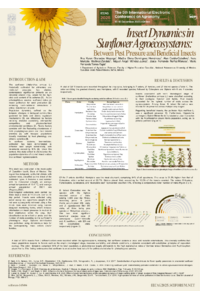
Sunflower (Helianthus annuus L.), as an allogamous and entomophilous species, plays a dual role in agroecosystems: it serves as a host that supports diverse insect populations, including pests, while simultaneously providing essential resources that sustain pollinators and natural enemies. Understanding this balance is key factor for sustainable crop management. This study was conducted in Cuautitlán Izcalli, State of Mexico, to analyze the population dynamics of diurnal insect visitors to sunflower. Over a 79-day monitoring period, 2986 individuals from 20 species were recorded. Hemiptera was the most abundant order, dominated by Aphididae (>1600 individuals), alongside other significant pests such as Sphenarium purpurascens Charpentier (Orthoptera: Pyrgomorphidae) and Bemisia tabaci Gennadius (Hemiptera: Aleyrodidae). Importantly, sunflower also attracted a wide range of beneficial insects. The most frequent natural enemies were Hippodamia convergens Guérin-Méneville (Coleoptera: Coccinellidae), a key predator of aphids, while Apis mellifera L. (Hymenoptera: Apidae) represented the dominant pollinator species. Population peaks occurred mainly in September, coinciding with favorable environmental conditions and the onset of flowering, which enhanced both pest and beneficial insect activity. These results highlight sunflower’s ecological importance not only as a host of major pest species but also as a critical reservoir for pollinators and natural enemies. Recognizing this dual function is fundamental for integrated pest management strategies that seek to reduce pesticide use and strengthen ecosystem services in sunflower-based systems.
Keywords
Crop monitoring
Pollinators
Biological control
Natural enemies
Crop-Insect interactions
Poster
Insect Dynamics in Sunflower Agroecosystems.pdf
Revalorization of vineyard pruning by-products from different Vitis vinifera varieties: Evaluation of the phenolic profile across two defoliation seasons
Interaction Effect of Foliar Fertilisation and Precision Drip Irrigation on Cob-related Yield Components in Maize Hybrids