Event submissions
Published
This submission belongs to the session S8. Sustainable Farming Systems and Soil Management of the event The 5th International Electronic Conference on Agronomy
Published date
11 Dec, 2025
Academic Editor
'%3e%3cpath%20d='M12.6657%2010.9104C12.4185%2010.325%2012.0599%209.79327%2011.6097%209.34482C11.1609%208.89508%2010.6293%208.5365%2010.0442%208.28888C10.0389%208.28626%2010.0337%208.28495%2010.0285%208.28233C10.8446%207.69279%2011.3752%206.73249%2011.3752%205.64904C11.3752%203.8542%209.92103%202.39999%208.1262%202.39999C6.33136%202.39999%204.87715%203.8542%204.87715%205.64904C4.87715%206.73249%205.40774%207.69279%206.22393%208.28364C6.21869%208.28626%206.21345%208.28757%206.20821%208.29019C5.62129%208.5378%205.09463%208.89284%204.64265%209.34613C4.1929%209.79493%203.83432%2010.3266%203.58671%2010.9117C3.34345%2011.4845%203.21226%2012.0987%203.20023%2012.7209C3.19988%2012.7349%203.20233%2012.7488%203.20744%2012.7619C3.21255%2012.7749%203.22022%2012.7867%203.22998%2012.7968C3.23975%2012.8068%203.25142%2012.8147%203.26431%2012.8202C3.2772%2012.8256%203.29105%2012.8284%203.30504%2012.8284H4.09109C4.14874%2012.8284%204.19459%2012.7825%204.1959%2012.7262C4.2221%2011.7148%204.62823%2010.7676%205.34617%2010.0497C6.08899%209.30683%207.0755%208.89808%208.1262%208.89808C9.17689%208.89808%2010.1634%209.30683%2010.9062%2010.0497C11.6242%2010.7676%2012.0303%2011.7148%2012.0565%2012.7262C12.0578%2012.7838%2012.1037%2012.8284%2012.1613%2012.8284H12.9474C12.9613%2012.8284%2012.9752%2012.8256%2012.9881%2012.8202C13.001%2012.8147%2013.0126%2012.8068%2013.0224%2012.7968C13.0322%2012.7867%2013.0398%2012.7749%2013.0449%2012.7619C13.0501%2012.7488%2013.0525%2012.7349%2013.0522%2012.7209C13.0391%2012.0947%2012.9094%2011.4855%2012.6657%2010.9104ZM8.1262%207.9024C7.52486%207.9024%206.9589%207.6679%206.53312%207.24211C6.10733%206.81633%205.87283%206.25037%205.87283%205.64904C5.87283%205.0477%206.10733%204.48174%206.53312%204.05596C6.9589%203.63018%207.52486%203.39567%208.1262%203.39567C8.72753%203.39567%209.29349%203.63018%209.71927%204.05596C10.1451%204.48174%2010.3796%205.0477%2010.3796%205.64904C10.3796%206.25037%2010.1451%206.81633%209.71927%207.24211C9.29349%207.6679%208.72753%207.9024%208.1262%207.9024Z'%20fill='%235D1EE1'/%3e%3c/g%3e%3c/svg%3e) Peter Gregory
Peter GregoryCitation
SEEMA BHARDWAJ, S.K. Behera, Rahul Mishra, Delineation of Management Zones in Citrus Orchards Using Geostatistics and Clustering Techniques in Central India, in Proceedings of The 5th International Electronic Conference on Agronomy, 15 December–18 December 2025, MDPI: Basel, Switzerland
Share
Email
Facebook
Twitter
LinkedIn
Delineation of Management Zones in Citrus Orchards Using Geostatistics and Clustering Techniques in Central India
'%3e%3cpath%20d='M12.6647%2010.9104C12.4176%2010.325%2012.0589%209.7933%2011.6088%209.34485C11.16%208.89511%2010.6283%208.53653%2010.0432%208.28891C10.038%208.28629%2010.0327%208.28498%2010.0275%208.28236C10.8437%207.69282%2011.3743%206.73252%2011.3743%205.64907C11.3743%203.85423%209.92005%202.40002%208.12522%202.40002C6.33038%202.40002%204.87618%203.85423%204.87618%205.64907C4.87618%206.73252%205.40677%207.69282%206.22296%208.28367C6.21772%208.28629%206.21248%208.2876%206.20724%208.29022C5.62031%208.53783%205.09365%208.89287%204.64167%209.34616C4.19192%209.79496%203.83334%2010.3266%203.58573%2010.9117C3.34247%2011.4846%203.21128%2012.0987%203.19925%2012.721C3.1989%2012.735%203.20135%2012.7489%203.20646%2012.7619C3.21157%2012.7749%203.21924%2012.7868%203.22901%2012.7968C3.23877%2012.8068%203.25045%2012.8148%203.26334%2012.8202C3.27623%2012.8256%203.29007%2012.8284%203.30406%2012.8284H4.09012C4.14776%2012.8284%204.19362%2012.7825%204.19493%2012.7262C4.22113%2011.7148%204.62726%2010.7676%205.34519%2010.0497C6.08802%209.30686%207.07452%208.89811%208.12522%208.89811C9.17592%208.89811%2010.1624%209.30686%2010.9052%2010.0497C11.6232%2010.7676%2012.0293%2011.7148%2012.0555%2012.7262C12.0568%2012.7839%2012.1027%2012.8284%2012.1603%2012.8284H12.9464C12.9604%2012.8284%2012.9742%2012.8256%2012.9871%2012.8202C13%2012.8148%2013.0117%2012.8068%2013.0214%2012.7968C13.0312%2012.7868%2013.0389%2012.7749%2013.044%2012.7619C13.0491%2012.7489%2013.0515%2012.735%2013.0512%2012.721C13.0381%2012.0947%2012.9084%2011.4856%2012.6647%2010.9104ZM8.12522%207.90243C7.52388%207.90243%206.95792%207.66793%206.53214%207.24215C6.10636%206.81636%205.87185%206.2504%205.87185%205.64907C5.87185%205.04773%206.10636%204.48177%206.53214%204.05599C6.95792%203.63021%207.52388%203.3957%208.12522%203.3957C8.72655%203.3957%209.29252%203.63021%209.7183%204.05599C10.1441%204.48177%2010.3786%205.04773%2010.3786%205.64907C10.3786%206.2504%2010.1441%206.81636%209.7183%207.24215C9.29252%207.66793%208.72655%207.90243%208.12522%207.90243Z'%20fill='%235D1EE1'/%3e%3c/g%3e%3c/svg%3e)
SEEMA BHARDWAJ 1

S.K. Behera 1
Rahul Mishra 2
1. Division of soil chemistry and fertility, ICAR-Indian institute of soil science, Bhopal 462038, India
2. AICRP-MSP, ICAR-Indian institute of soil science ,Bhopal 462038, India
Abstract
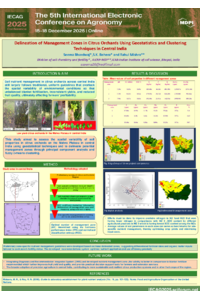
Soil nutrient management in citrus orchards across central India still largely follows traditional, uniform guidelines that overlook the spatial variability of environmental conditions. This often results in unbalanced blanket fertilization, inconsistent yields, and reduced fruit quality, ultimately affecting farmers’ profitability. This study aimed to assess the spatial variability of soil properties in citrus orchards on the Malwa Plateau in central India using geostatistical techniques and to delineate potential management zones through principal component analysis and fuzzy c-means clustering. A total of 104 orchards were selected in the citrus-growing areas of the Rajgarh region, Madhya Pradesh. Surface soil samples (0–20 cm depth) were collected in 2022 to analyze pH, electrical conductivity (EC), organic matter, and levels of primary, secondary, and micronutrients. The data were subjected to descriptive and geostatistical analyses. Management zones were delineated using clustering methods, with the optimal number of zones determined by the Fuzziness Performance Index and Fuzzy Partition Entropy.
Results revealed significant spatial variability in soil properties, with three distinct management zones identified as optimal for citrus orchards. Most soil attributes varied significantly across these zones. Based on these delineated zones, preliminary zone-specific nutrient management guidelines were developed, suggesting differentiated fertilizer rates and organic matter inputs tailored to each zone’s fertility status. The developed recommendations system optimizes nutrient application, uses efficiency, further integrates the Diagnosis and Recommendation Integrated System (DRIS), and develops a nutrient management zone. The validity is better than blanket fertilizer recommendations, which further improve fruit yield and quality and provide practical decision-support tools for farmers and extension services.
This study provides a foundation for implementing site-specific nutrient management. It supports broader adoption of precision agriculture in central India, contributing to more sustainable, resilient citrus production systems.
Keywords
spatial variability
citrus
delineation
management zones
Poster
FINAL POSTER.pdf
Assessment of Soil Electrical Conductivity and Yield Responses of Maize Hybrids under different Plant Densities
Influence of Municipal Refuse Waste used as Fertilizer Material on Soil Physical and Chemical Properties