Event submissions
Published
This submission belongs to the session S8. Sustainable Farming Systems and Soil Management of the event The 5th International Electronic Conference on Agronomy
Published date
11 Dec, 2025
Academic Editor
'%3e%3cpath%20d='M12.6657%2010.9104C12.4185%2010.325%2012.0599%209.79327%2011.6097%209.34482C11.1609%208.89508%2010.6293%208.5365%2010.0442%208.28888C10.0389%208.28626%2010.0337%208.28495%2010.0285%208.28233C10.8446%207.69279%2011.3752%206.73249%2011.3752%205.64904C11.3752%203.8542%209.92103%202.39999%208.1262%202.39999C6.33136%202.39999%204.87715%203.8542%204.87715%205.64904C4.87715%206.73249%205.40774%207.69279%206.22393%208.28364C6.21869%208.28626%206.21345%208.28757%206.20821%208.29019C5.62129%208.5378%205.09463%208.89284%204.64265%209.34613C4.1929%209.79493%203.83432%2010.3266%203.58671%2010.9117C3.34345%2011.4845%203.21226%2012.0987%203.20023%2012.7209C3.19988%2012.7349%203.20233%2012.7488%203.20744%2012.7619C3.21255%2012.7749%203.22022%2012.7867%203.22998%2012.7968C3.23975%2012.8068%203.25142%2012.8147%203.26431%2012.8202C3.2772%2012.8256%203.29105%2012.8284%203.30504%2012.8284H4.09109C4.14874%2012.8284%204.19459%2012.7825%204.1959%2012.7262C4.2221%2011.7148%204.62823%2010.7676%205.34617%2010.0497C6.08899%209.30683%207.0755%208.89808%208.1262%208.89808C9.17689%208.89808%2010.1634%209.30683%2010.9062%2010.0497C11.6242%2010.7676%2012.0303%2011.7148%2012.0565%2012.7262C12.0578%2012.7838%2012.1037%2012.8284%2012.1613%2012.8284H12.9474C12.9613%2012.8284%2012.9752%2012.8256%2012.9881%2012.8202C13.001%2012.8147%2013.0126%2012.8068%2013.0224%2012.7968C13.0322%2012.7867%2013.0398%2012.7749%2013.0449%2012.7619C13.0501%2012.7488%2013.0525%2012.7349%2013.0522%2012.7209C13.0391%2012.0947%2012.9094%2011.4855%2012.6657%2010.9104ZM8.1262%207.9024C7.52486%207.9024%206.9589%207.6679%206.53312%207.24211C6.10733%206.81633%205.87283%206.25037%205.87283%205.64904C5.87283%205.0477%206.10733%204.48174%206.53312%204.05596C6.9589%203.63018%207.52486%203.39567%208.1262%203.39567C8.72753%203.39567%209.29349%203.63018%209.71927%204.05596C10.1451%204.48174%2010.3796%205.0477%2010.3796%205.64904C10.3796%206.25037%2010.1451%206.81633%209.71927%207.24211C9.29349%207.6679%208.72753%207.9024%208.1262%207.9024Z'%20fill='%235D1EE1'/%3e%3c/g%3e%3c/svg%3e) Peter Gregory
Peter GregoryCitation
Magdoline mustafa ahmed Mustafa, Ronald Kuunya, Andras Tamas, Ratonyi Tamas, Sustainable Maize Crop Management: A Multifactorial Long-Term Field Experiment in Hungary, in Proceedings of The 5th International Electronic Conference on Agronomy, 15 December–18 December 2025, MDPI: Basel, Switzerland
Share
Email
Facebook
Twitter
LinkedIn
Sustainable Maize Crop Management: A Multifactorial Long-Term Field Experiment in Hungary
'%3e%3cpath%20d='M12.6647%2010.9104C12.4176%2010.325%2012.0589%209.7933%2011.6088%209.34485C11.16%208.89511%2010.6283%208.53653%2010.0432%208.28891C10.038%208.28629%2010.0327%208.28498%2010.0275%208.28236C10.8437%207.69282%2011.3743%206.73252%2011.3743%205.64907C11.3743%203.85423%209.92005%202.40002%208.12522%202.40002C6.33038%202.40002%204.87618%203.85423%204.87618%205.64907C4.87618%206.73252%205.40677%207.69282%206.22296%208.28367C6.21772%208.28629%206.21248%208.2876%206.20724%208.29022C5.62031%208.53783%205.09365%208.89287%204.64167%209.34616C4.19192%209.79496%203.83334%2010.3266%203.58573%2010.9117C3.34247%2011.4846%203.21128%2012.0987%203.19925%2012.721C3.1989%2012.735%203.20135%2012.7489%203.20646%2012.7619C3.21157%2012.7749%203.21924%2012.7868%203.22901%2012.7968C3.23877%2012.8068%203.25045%2012.8148%203.26334%2012.8202C3.27623%2012.8256%203.29007%2012.8284%203.30406%2012.8284H4.09012C4.14776%2012.8284%204.19362%2012.7825%204.19493%2012.7262C4.22113%2011.7148%204.62726%2010.7676%205.34519%2010.0497C6.08802%209.30686%207.07452%208.89811%208.12522%208.89811C9.17592%208.89811%2010.1624%209.30686%2010.9052%2010.0497C11.6232%2010.7676%2012.0293%2011.7148%2012.0555%2012.7262C12.0568%2012.7839%2012.1027%2012.8284%2012.1603%2012.8284H12.9464C12.9604%2012.8284%2012.9742%2012.8256%2012.9871%2012.8202C13%2012.8148%2013.0117%2012.8068%2013.0214%2012.7968C13.0312%2012.7868%2013.0389%2012.7749%2013.044%2012.7619C13.0491%2012.7489%2013.0515%2012.735%2013.0512%2012.721C13.0381%2012.0947%2012.9084%2011.4856%2012.6647%2010.9104ZM8.12522%207.90243C7.52388%207.90243%206.95792%207.66793%206.53214%207.24215C6.10636%206.81636%205.87185%206.2504%205.87185%205.64907C5.87185%205.04773%206.10636%204.48177%206.53214%204.05599C6.95792%203.63021%207.52388%203.3957%208.12522%203.3957C8.72655%203.3957%209.29252%203.63021%209.7183%204.05599C10.1441%204.48177%2010.3786%205.04773%2010.3786%205.64907C10.3786%206.2504%2010.1441%206.81636%209.7183%207.24215C9.29252%207.66793%208.72655%207.90243%208.12522%207.90243Z'%20fill='%235D1EE1'/%3e%3c/g%3e%3c/svg%3e)
Magdoline mustafa ahmed Mustafa 1,2
Ronald Kuunya 1
Andras Tamas 3
Ratonyi Tamas 4
1. Kerpely Kálmán Doctoral School, Faculty of Agricultural and Food Sciences and Environmental Management, Böszörményi Campus, Institute of Land Use, Engineering and Precision Farming Technology, University of Debrecen, Debrecen, 4032, Hungary
2. Environment, Natural Resources and Desertification Research Institute, National Center for Research, Khartoum, 1111, Sudan
3. Debrecen University, kerpely kálmán, Crop Production and Horticultural Sciences, Debrecen, Hungary
4. Faculty of Agricultural and Food Sciences and Environmental Management, Böszörményi Campus, Institute of Land Use, Engineering and Precision Farming Technology, University of Debrecen, Debrecen, 4032, Hungary
Abstract
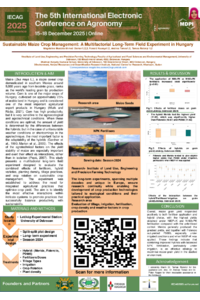
This study presents a multifactorial long-term field experiment designed to evaluate the combined effects of fertilizers, hybrid varieties, planting density, tillage practices, and crop rotation on sustainable crop management. The treatments included three tillage systems (Ripping tillage, Strip tillage, Winter plowing), three levels of NPK fertilizer (0, 80, 160 t/ha), three maize hybrids (Merida, Fiednico, and P9985), two plant densities (60,000 and 80,000 plants per hectare), three types of tillage, crop rotation (winter wheat, maize) and irrigation (irrigated –non irrigated). The study was conducted in 2024 at the Látókép Experimental Station (Debrecen, Hungary). The experiment was established to address the need for integrated agricultural practices that optimize crop yield, soil health, and resource use efficiency over extended periods. The long-term experiment has a split-plot design. The main plot treatments are tillage and irrigation, with no replication. Data were collected following standardized protocols and statistically analysed using Genstat 12th edition. Results demonstrate significant interactions among the factors. The three hybrid treatments evaluated: Merida hybrid had the highest average yield (11.02 t/ha), followed by Fiedncio and P998510.67-10.51 t/ha, respectively. Interaction between hybrids, fertilizer, and tillage did not show a significant difference in yield, as determined by the Duncan multiple-range test at the 5% significance level. It could suggest using a low amount of fertilizer with any type of hybrid and tillage. Irrigated plots consistently outperformed non-irrigated counterparts. All hybrids with ripping tillage had the highest yields, and Merida yielded significantly more with ripping tillage (p<0.05). This suggests that Merida is a promising variety for cultivation, making it a preferred choice for farmers looking to maximize output. This research provides valuable insights into balancing productivity with sustainability, offering a framework for developing resilient cropping systems that can adapt to evolving agricultural challenges. The findings support the adoption of diverse management practices to enhance both economic and ecological outcomes in long-term crop production.
Keywords
Maize
Fertilizers
Hybrid
Plant Density
Tillage
Crop Rotation
Sustainable agriculture
Poster
sciforum-152540.pdf
Supplementary Red LED Lighting for Concurrent Disease Suppression and Yield Gains in New Zealand Glasshouse production
Evaluation of Peroxidase Activity and Proline Content as Indicators of a Particular Light Duration Tolerance Mechanism in Ginger Plant (Zingiber officinale R.)